Learning difficulties and communication
| Website: | Moodle ZČU |
| Kurs: | KPG/CPDI - Communication with people with disabilities |
| Buch: | Learning difficulties and communication |
| Gedruckt von: | Gast |
| Datum: | Montag, 9. November 2026, 05:14 |
1. What are the Developmental Learning Difficulties?
Developmental learning difficulties (or disorders or disabilities) include a variety of problems affecting the education and adopting of reading, writing and maths skills (but also arts, music, or motor skills) by pupils with at least average intellectual abilities (IQ could be even above average, but never below!).
The causes are often hereditary, but developmental learning disabilities are also connected with ADHD syndrome (they are often accompanied by attention disorders and hyperactivity).
Typical developmental learning disabilities are well-known among the public today as dyslexia, dysgraphia, dyskalkulia, etc.
Some children with developmental learning disabilities become discouraged as soon as they start school because their teachers or parents fail to treat them appropriately. Learning becomes a burden and lack of success discourages them from further education. They keep struggling later in life with understanding texts, and with slow reading and writing, often making too many mistakes. They can also make many mistakes in calculations, etc. They tend to be considered less intelligent or capable, especially when people are unaware of their disability.
For a person with ADHD (Attention Deficit Hyperactivity Disorder), it is extremely difficult to keep focus for a prolonged period of time. For ADHD patients, it is too taxing to pay attention to a single activity, especially if he or she is required to sit quietly. To watch a movie for 90 minutes or listen to a sermon for an hour is an exertion. Children with ADHD are often preoccupied, impulsive, in a constant state of flu; they react without thinking, even though during adulthood these characteristics are subdued by self-control. In spite of that, adults with ADHD are often clearly restless; they cannot stay focused for too long; they are disorderly and exhibit other typical characteristics. In some extreme cases, their impulsive behaviour could provoke uncontrolled reactions resulting in conflicts with others or even with the law. ADHD is also often accompanied by speech disorders, specifically compulsive talking. People with ADHD more often encounter neurotic problems in adulthood, and they have suicidal tendencies more often than those who do not suffer with this problem.
2. Dyslexia
Dyslexia means slow reading with many mistakes and mixing mirror letters when reading printed text (b-d, p-q, etc.). People with dyslexia may struggle with longer complex texts, which makes their secondary school/university studies extremely laborious and toilsome. It means that communication through written or printed texts can be difficult for people with severe forms of dyslexia.
In fact, we can meet a number of cases where there is dyslexia associated with dysortography, which is a difficulty in mastering and applying grammar rules even in one's mother language.
Watch a short video about dyslexia:
Do not hesitate to read other information on related website as well!
3. Dysgraphia
Dysgraphia describes problems with writing. The script is difficult to read (not orderly, too big/small, uneven and gritty). Children with dysorthography make a lot of grammar mistakes because they lack language sensitivity.
Before you watch a short video about dysgraphia, try to estimate what specific problems may the people with this disorder have in their communication activities:
You can find a smart overview of dysgraphia and the possibilities of support for children and adults with dysgraphia on the following websites: |
4. Dyscalculia
Dyscalculia is about difficulties in reading and writing numbers and formulas, etc. However, people rarely talk about how difficult life with developmental learning disabilities is and and how they can make life complicated even in adulthood.
Can you find and write possible problems of people with dyscalculia in communication with others?
Watch a short video focused on symptoms of dyscalculia in children
5. ADHD
For a person with ADHD (Attention Deficit Hyperactivity Disorder), it is extremely difficult to keep focus and pay attention to a single activity for a prolonged period of time, especially if he or she is required to sit quietly. To watch a movie for 90 minutes or listen to a sermon for an hour is an exertion. Children with ADHD are often preoccupied, impulsive, in a constant state of flu; they react without thinking, even though during adulthood these characteristics are subdued by self-control. In spite of that, adults with ADHD are often clearly restless; they cannot stay focused for too long; they are disorderly and exhibit other typical characteristics. In some extreme cases, their impulsive behaviour could provoke uncontrolled reactions resulting in conflicts with others or even with the law. ADHD is also often accompanied by speech disorders, specifically compulsive talking. People with ADHD more often encounter neurotic problems in adulthood, and they have suicidal tendencies more often than those who do not suffer with this problem.
What issues conected to interpersonal comunication would you expect in people with ADHD? Try to estimate a few of them:
The following video brings the information on ADHD in outline:
Diagnostic criteria for ADHD
Symptoms of inattention:
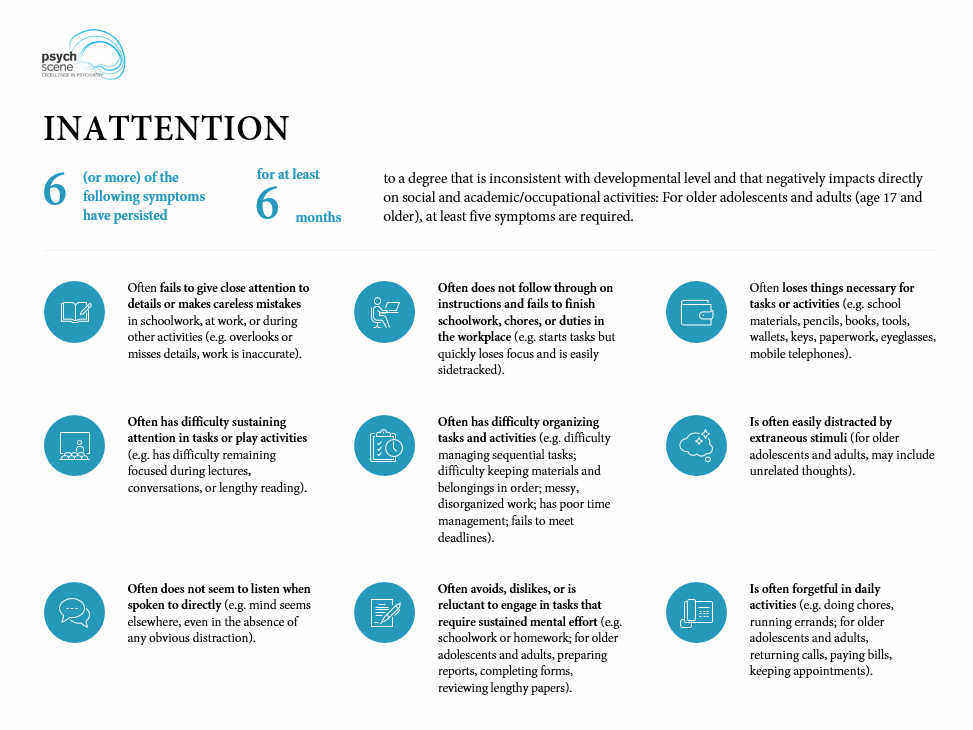
(https://psychscenehub.com/psychinsights/diagnosis-and-management-of-adult-adhd/)
Symptoms of hyperactivity and impulsivity:
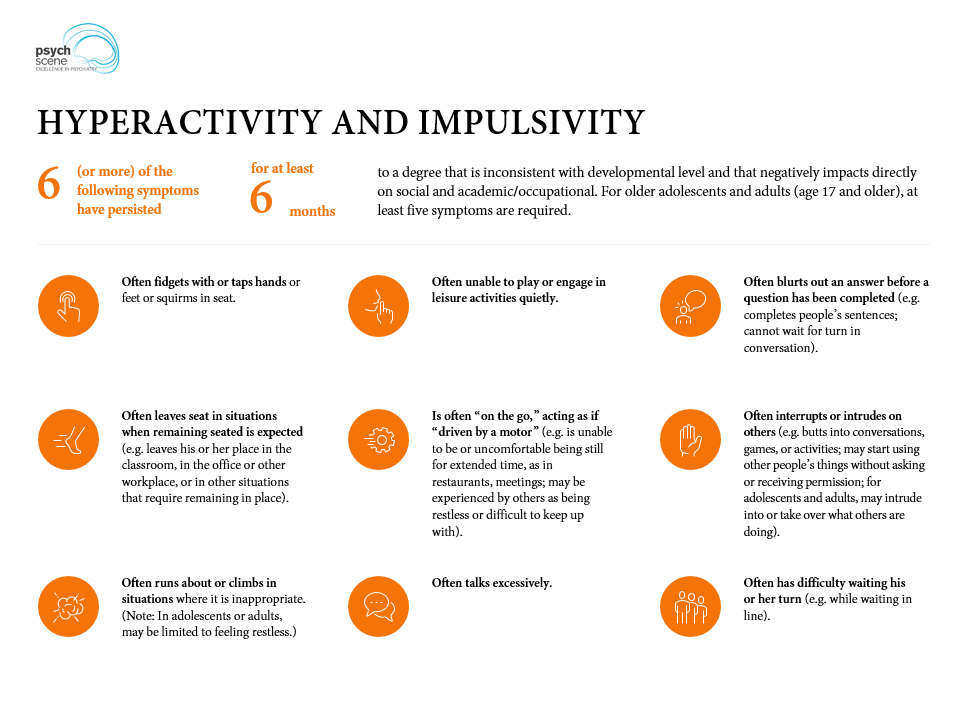
(https://psychscenehub.com/psychinsights/diagnosis-and-management-of-adult-adhd/)
Warnings and symptoms in children:
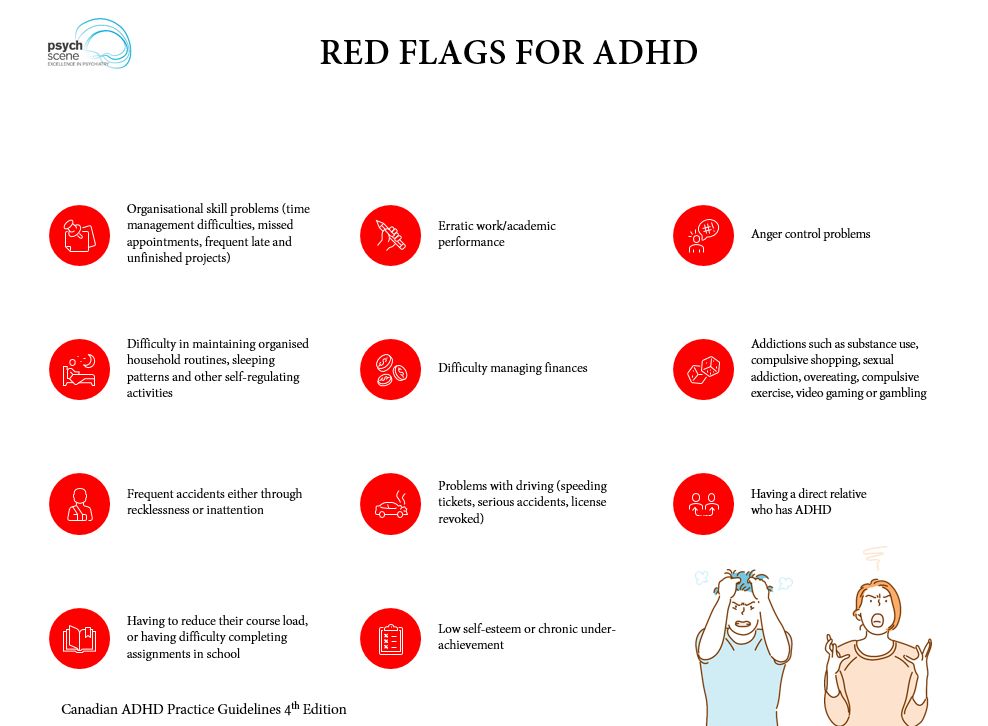
(https://psychscenehub.com/psychinsights/diagnosis-and-management-of-adult-adhd/)
Symptoms in adults:
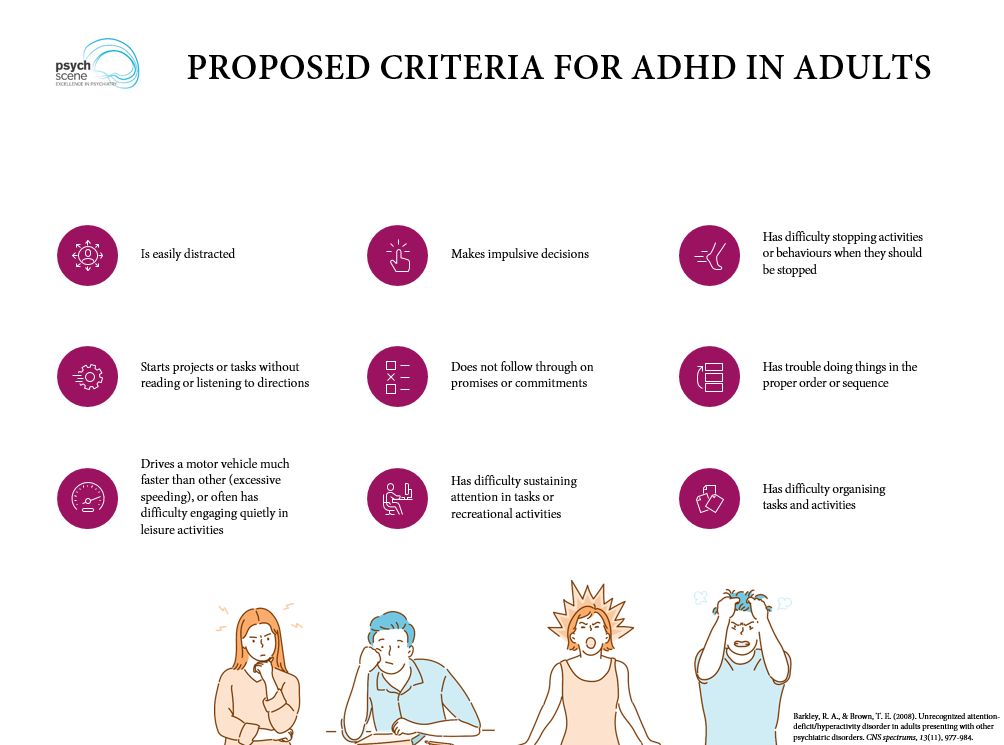
(https://psychscenehub.com/psychinsights/diagnosis-and-management-of-adult-adhd/)