Introduction
| Site: | Moodle ZČU |
| Course: | KEV/EMB Elektromobilita - podklady k výuce |
| Book: | Introduction |
| Printed by: | Guest user |
| Date: | Sunday, 8 November 2026, 10:07 PM |
1. Motivation
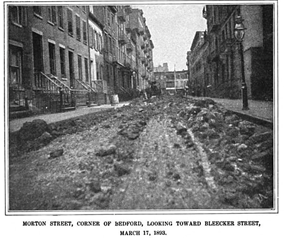
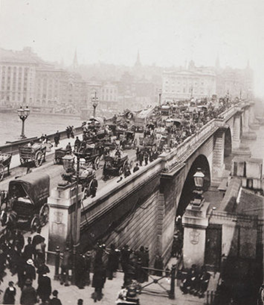
Historie – the great horse manure crisis 1894
- In the 19th century, horses were the main driving force behind transport.
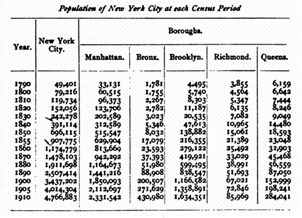
- At the same time, the population of the big city is growing very fast.
- Cities have problems with large numbers of animals.



http://30494445.weebly.com/
https://ourworldindata.org/co2-and-other-greenhouse-gas-emissions
https://www.businesshorsepower.com/
2. History
Electric cars
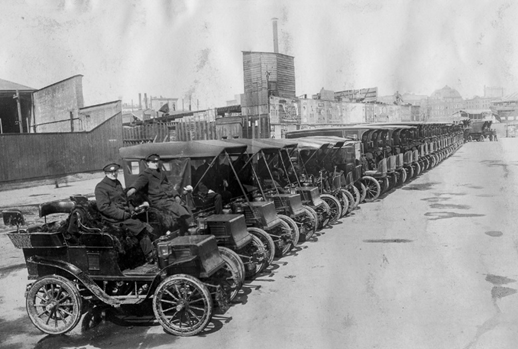
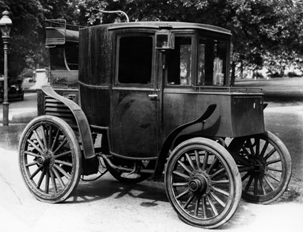
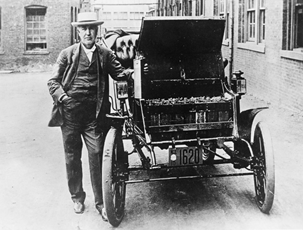
- The first cars offer a way out of the transport crisis.
- Electric cars were initially the dominant means, especially in American cities.
- Subsequently, electric cars for many decades replaced cars with internal combustion engines.
3. Motivation in the 21st century
- Over the last decade, the field of electromobility has received unprecedented attention.
- The beginning of the modern era of electromobility around 2010
- The period of global economic crisis
- New business for many companies
- The road to recovery of the automotive industry
- Emission pressures - tightening limits
- Technology - Lithium-based batteries
- Conservative car market
- Skepticism, especially criticism of the range
- Missing charging infrastructure
- New technologies for manufacturers (e.g. car manufacturers used to voltage of 12 V only)
- Missing car service network
3.1. Financial crisis of 2008 and decline in car sales
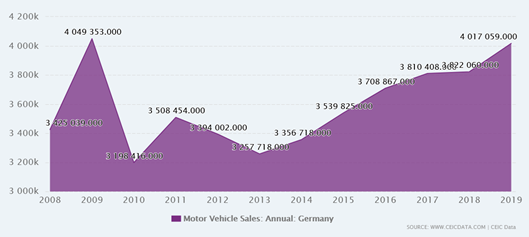
Decline in car sales in Germany in 2010
Decline in car sales in U.S. in 2010
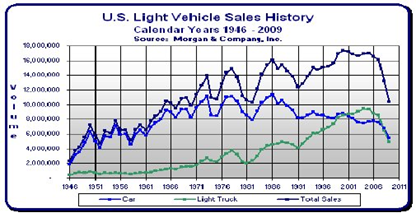
www.morgancom.com/
3.2. Pollutant emissions
- Internal combustion engine cars emit a number of pollutants directly on the streets.
- Cities in particular are plagued by smog, which is largely driven by traffic.
- In some parts of the world, smog is the main motivation for switching to electric cars (especially China).

3.3. Carbon dioxide emissions
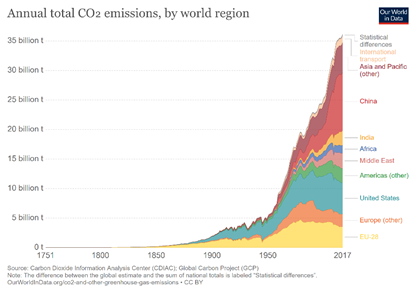
In addition to pollutant emissions, carbon dioxide (CO2) emissions causing the so-called greenhouse effect and possible climate change are also problematic. At the same time, total CO2 emissions have increased significantly in recent decades, and humanity currently produces approximately 40 billion tons of CO2 per year.
Annual CO2 emissions by region (2017)
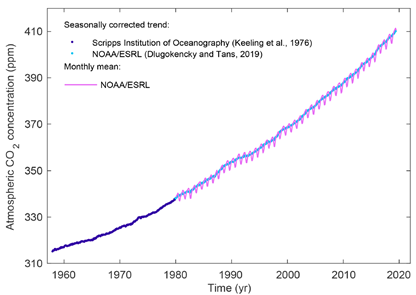
According to measurements made by the Mauna Loa observatories in the Hawaiian Islands, the concentration of CO2 in the atmosphere is currently around 410 parts per million (ppm), while in the pre-industrial era (before 1750) the CO2 concentration did not exceed 300 ppm.
Vývoj
koncentrace atmosférického CO2 (ppm – částic na 1 milion)
- Combustion of 1 kg of carbon produces 3.67 kg of CO2.
- Due to the C content, for example in petrol (C4H10 to C12H30) in an amount of about 83% and a density of 0.73 kg / l, 1 liter of petrol contains about 0.61 kg of carbon.
- Its combustion produces 2.24 kg of CO2.
- At a consumption of 4.1 l / 100 km, it is 9.2 kg of CO2, or 92 g / km.
- Combustion of a 50 l tank produces 112 kg of CO2.
- Elementary stoichiometric merging equation
1 kg C + 2.67 kg O2 → 3.67 kg CO2
https://ourworldindata.org/co2-and-other-greenhouse-gas-emissions
3.4. Growing markets
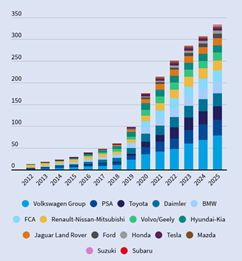
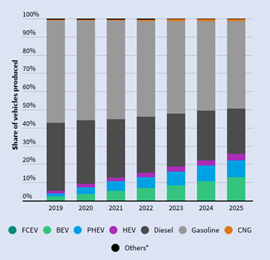
- The market for electric or hybrid cars is growing, and growth is predicted in the future as well.
- The absence of an electrically powered model in the product portfolio currently means a noticeable loss for the carmaker.
3.5. Other factors
- Existing technology - a radical change in the last 10 years
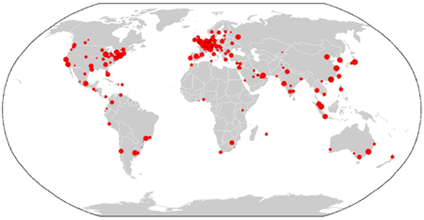
- Population concentration in large cities
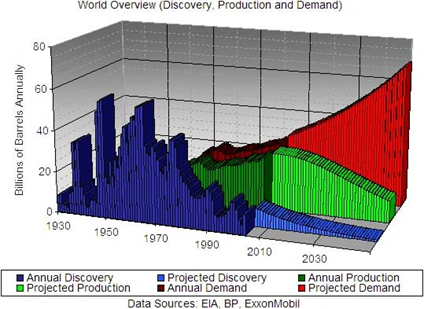
- Declining numbers of new oil fields
4. Situation in the EU
- In the EU, the issue of CO2 is emphasized.
-
Vehicle electrification is seen as a way to lower CO2, especially in the EU.
- In terms of the overall CO2 balance of the car, however, it is a complex chain involving
- extraction of raw materials,
- fuel production and electricity production,
- transport and transfer,
- production of car and traction batteries,
- recharging, combustion and energy conversion in a specific type of engine.
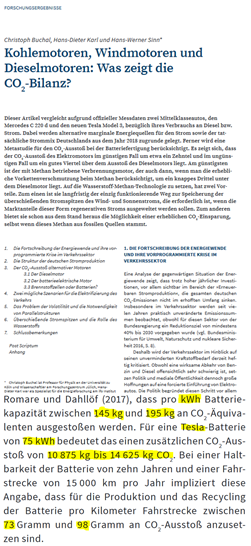
- From the point of view of the drive itself, CO2 emissions are always about the conversion efficiency of a particular technology.
- With high combustion efficiency and low losses of further conversions, own greenhouse gas emissions will be significantly reduced.
- In the case of pollutant emissions (excluding CO2), the technology of purely electric cars has a clear benefit, especially in urban agglomerations and other places with a high concentration of traffic.


4.1. European legislation
In the countries of the European Union, the effort to reduce emissions has been reflected directly in legislation for more than ten years. In 1998, the European Automobile Manufacturers Association (ACEA) undertook to reduce average emissions from new passenger cars sold to 140 g CO2 per kilometer per car by 2008. The following year, the Japan Automobile Manufacturers Association (JAMA) and the Korea Automobile Manufacturers Association (KAMA) also undertook to reduce emissions to 140 g CO2 / km by 2009, with average new passenger car emissions of 160 g CO2 / km in 2007.The results of the review of the Community's emission reduction strategy are evaluated in 2007, showing that progress has been made towards achieving the emission target of 140 g CO2 / km for new passenger cars by 2008/09. However, the following target of 120 g CO2 / km by 2012 is at risk and the Commission proposes a legislative framework to reach the Community target and sets a limit of 130 g CO2 / km for category M1 (passenger cars) for 2012. However, the limit is not fixed. from the weight of the cars.
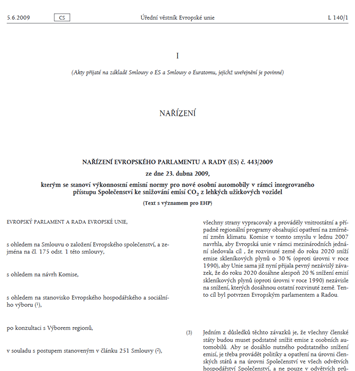
Regulation No 443/2009 of the European Parliament and of the Council setting emission performance standards for new passenger cars is adopted in 2009 as part of the Community's integrated approach to reduce CO2 emissions from light-duty vehicles. The regulation calculates a 30% reduction in greenhouse gas emissions by 2020 compared to 1990 and sets a limit for the average new fleet emissions of 95 g CO2 / km for 2020. At the same time, the regulation declares that a sufficient amount should be allocated from the budget. and that the regulation aims to create incentives for the car industry to invest in new technologies. The regulation sets a basic limit of 130 g CO2 / km for the years 2012 - 2015, which is recalculated according to the weight of the vehicle. The regulation already provides for fines for exceeding emission limits.
In addition, car manufacturers can obtain so-called supercredits for each vehicle with emissions of less than 50 g CO2 / km. For automakers, this practically means a significant reduction in the emissions balance and the risk of exceeding the limits for each electrified car that appears in the fleet.
In the following years, the first test prototypes and prototype fleets of electric cars began to appear at most car manufacturers, testing took place, experience was gathered, including analyzes of competition solutions, and new development departments were built. Although there are many test projects and prototype cars from previous decades, the beginnings of modern electromobility with massive development and a real impact on the product portfolio can be dated to the years 2009-2010.
The Paris Agreement, which is the output of the Paris Climate Conference (2015), aims to keep the increase in global average temperature well below 2°C above pre-industrial levels. In this context, the European Union aims to reduce domestic greenhouse gas emissions by at least 40% by 2030 compared to 1990. This target has been endorsed as the intended contribution of the Union and its Member States to the Paris Agreement.
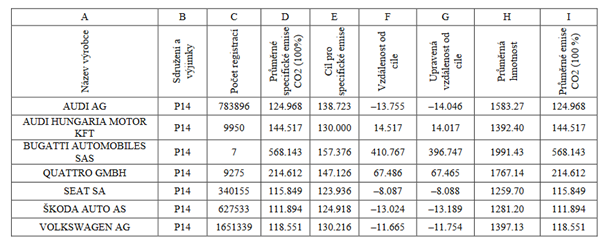
REGULATION (EU) 2019/631 of the European Parliament and of the Council of 17 April 2019 laying down CO2 emission performance standards for new passenger cars and new light commercial vehicles is issued in 2019. With effect from 1 January 2020, this Regulation sets an average emissions target for EU fleets of new EU-registered passenger cars of 95 g CO2 / km and an average emissions target for new light commercial vehicles registered in the EU of 147 g CO2 / km. . In addition, the regulation states that, for example, for passenger cars, these targets will be further reduced by 15% for 2025, and by 37% for 2030 (compared to 2021). The regulation also sets charges for exceeding the emission targets: each additional gram of CO2 / km x EUR 95 x the number of newly registered vehicles.
4.2. EU limits for CO2 emissions
- 2020: 95 g CO2 /km (~ 4 l/100 km petrol, ~ 3,6 l/100 km oil)
- 2030: 59 g CO2 /km (~ 2,5 l/100 km petrol, ~ 2,2 l/100 km oil)
- Each additional g CO2 x EUR 95 x number of newly registered vehicles
- REGULATION (EU) 2019/631 OF THE EUROPEAN PARLIAMENT AND OF THE COUNCIL of 17 April 2019
5. Limiting factors for customers
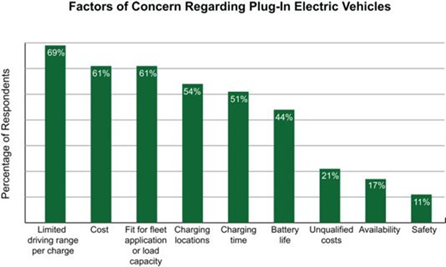
People most often see the following disadvantages with electric vehicles:
- limited driving range,
- price,
- charging time,
- missing charging infrastructure.
6. Technology and marketing
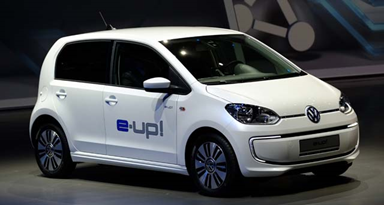
Small city cars
From a technical point of view, the battery vehicle is suitable for small city cars:
- low weight,
- low average speed,
- short driving range is sufficient (e.g. commuting to work, shopping, etc.).
- Great performances
- High speeds
- Long range requirement
- => extreme demands on battery size
However, in terms of marketing, the car is salable. The properties of the electric drive give the car a significantly sportier character. The battery will not make the car more expensive by hundreds, but only by tens of percent.
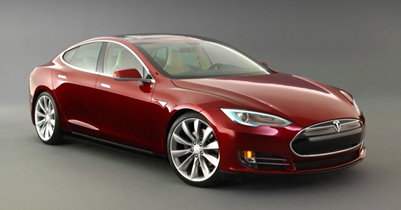
https://www.tesla.com
7. Examples for performance comparison
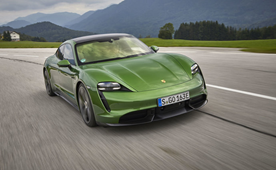 |
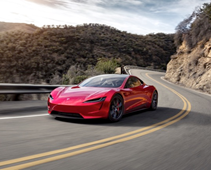 |
 |
|---|---|---|
|
Porsche Taycan (460 – 560 kW) |
Tesla Roadster (1 MW) |
Toroidion (1 MW) |
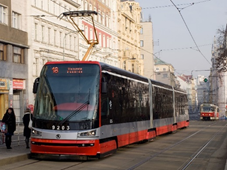 |
 |
 |
|
Tram Škoda 15T (720 kW) |
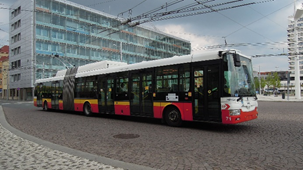
Trolley bus Škoda 31Tr (250 kW) |
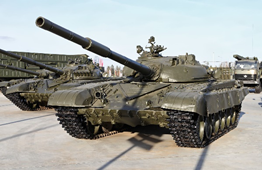
Tank T-72 (630 kW) |
https://www.porsche.com
https://www.toroidion.com
https://www.skoda.cz
https://cs.wikipedia.org
https://www.tesla.com