Paralingual means
| Stránky: | Moodle ZČU |
| Kurz: | KCJ/PS -Public speech |
| Kniha: | Paralingual means |
| Vytiskl(a): | Nepřihlášený host |
| Datum: | pondělí, 9. listopadu 2026, 11.09 |
1. Your voice
The tone of voice (prosody, pitch, volume, intonation) also send strong messages. Your voice can reveal as much about your personal history as your appearance. The sound of a voice and the content of speech can provide clues to an individual's emotional state.
If self-esteem is low, it may be reflected by hesitancy in the voice. A shy person may speak quietly, but someone who is confident in themselves will be more likely to have command of their voice and clarity of speech.
It is worth taking time to improve your command over your voice, especially if you find it hard to speak in public. It can even help to boost your confidence!
It is important to get used to the sound of your own voice. Most people are more relaxed in a private situation, particularly at home, where there are no pressures to conform to any other social rules and expectations. This is not the case in public situations when there are all sorts of influences exerted upon the way people speak.
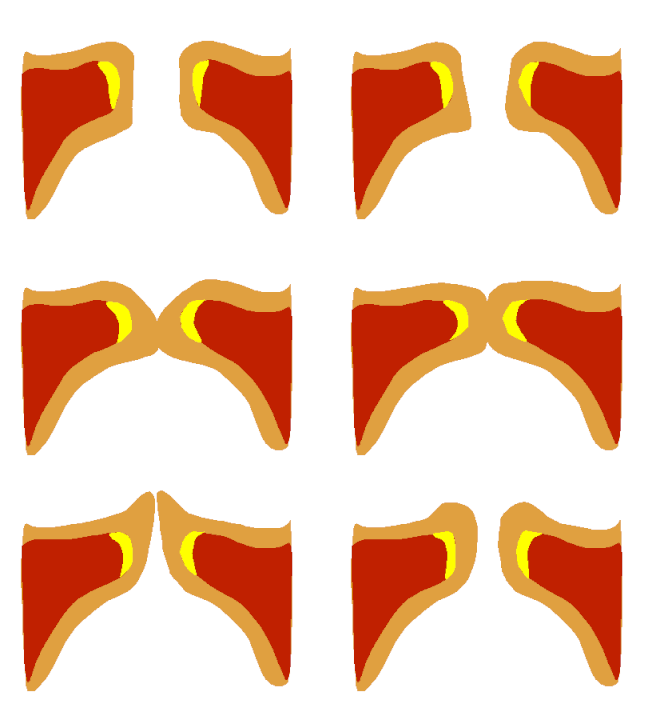
The vocal cords (folds) in motion:
2. Vocal production
The following three core elements of vocal production need to be understood for anyone wishing to become an effective speaker:
- Volume - to be heard.
- Clarity - to be understood.
- Variety - to add interest.
2.1. Volume
Some people have naturally soft voices and physically cannot bellow. Additionally, if the voice is raised too much, tonal quality is lost. Instead of raising the voice, it should be 'projected out'. Support the voice with lots of breath - the further you want to project the voice out, the more breath you need. It also needs to come from the diaphragm, not the throat.
When talking to a group or meeting, it is important not to aim your talk to the front row or just to the people nearest you. Instead, you need to consciously project what you have to say to those furthest away. By developing a strong voice, as opposed to a loud voice, you will be seen positively.
2.2. Clarity
Some people tend to speak through clenched teeth and with little movement of their lips. It is this inability to open mouths and failure to make speech sounds with precision that is the root cause of inaudibility. The sound is locked into the mouth and not let out.
To have good articulation it is important to unclench the jaw, open the mouth and give full benefit to each sound you make, paying attention to the ends of words. This will also help your audience to understand.
2.3. Variety
To make speech effective and interesting, certain techniques can be applied. Words convey meaning, but the way that they are said reflects feelings and emotions. Vocal variety can be achieved by variations in:
- Pace: This is the speed at which you talk. If speech is too fast, then listeners will not have time to assimilate what is being said. It is also a good idea to vary the pace - quickening up at times and then slowing down – because this will help to maintain interest.
- Volume: By raising or lowering volume occasionally, you can create emphasis. If you drop your voice to almost a whisper (as long as it is projected) for a sentence or two, it will make your audience suddenly alert. Be careful not to overuse this technique, though, or it will lose its impact.
- Pitch - Inflection - Emphasis: When speaking in public, try to convey the information with as much vocal energy and enthusiasm as possible. This does not mean your voice has to swoop and dive all over the place in an uncontrolled manner. Try to make the talk interesting. Remember that when you are nervous or excited, your vocal chords tense and shorten, causing the voice to get higher. Emphasise certain words and phrases within the talk to convey their importance and help to add variety.
- Pause: Pauses are powerful. They can be used for effect to highlight the preceding statement or to gain attention before an important message. Pauses mean silence for a few seconds. Listeners interpret meaning during pauses so have the courage to stay silent for up to five seconds – dramatic pauses like this convey authority and confidence.
3. The effect of breath on voice and speech
The voice is responsive to emotions and sometimes gets 'blocked', which can prevent or hinder the expression of a range of feelings.
When under stress an individual's breathing pattern will change. When your muscles are tense you cannot use your lungs to their full capacity. When someone is frightened or nervous, a common symptom is tension in the neck and shoulders. This occurs because, when under pressure, we tend to breath faster. This means we inhale plenty of air, but there is not enough time to exhale fully and relax, so we do not get the full benefit.
By using full lung capacity the breath will support the voice and the voice will become richer, fuller and stronger. This will benefit individuals who have a small voice and who worry that they cannot be heard when speaking to a group of people. Volume is controlled in the abdomen not in the throat, so breathing to full strength will allow for greater control of the voice.
Breathing deeply and rhythmically has a calming and therapeutic effect as it releases tension and promotes relaxation. People who are relaxed are more balanced, receptive and confident. It is no coincidence that many religions use rhythmic breathing techniques such as meditation, yoga and silent contemplation, and vocal release in the form of chants, mantras or hymn singing as aids to their devotions. By easing physical tension, mental stress decreases and the mind is effectively freed to follow creative pursuits.