Inclusive conditions
| Site: | Moodle ZČU |
| Course: | KPG/INED - Inclusive education |
| Book: | Inclusive conditions |
| Printed by: | Nepřihlášený host |
| Date: | Sunday, 8 November 2026, 7:46 PM |
1. What is necessary for inclusion?
As the conditions for inclusive education, we can mention the elements related to organizational, material and staffing issues of the school. For successful inclusive educational process, a school environment must be adapted to the heterogeneous composition of pupils' group in many ways, otherwise there would remain some barriers, especially for students with SEN.
Selected basic indicators of a well-prepared school are as follows:
- All school classes are heterogeneous.
- The school provides continuous education of all its pedagogical staff in the areas of effective work with a heterogeneous classes.
- The school has aids, staff and support tools for effective work with children with special needs.
- All school educational and other activities (and events) are accessible to all pupils, regardless of their family background or disability.
In the following subchapters you will find the most important conditions for quality inclusive education...
1.1. Spatial conditions
Spatial conditions are related to ensuring safe and barrier-free access to school for all students, as well as their movement at school (removal of various barriers complicating movement in space). A suitable request can be also the creation of a clear orientation plan, which is visibly located. For pupils with physical disabilities, it is necessary to provide an elevator, a stair climber or other type of devices for handling a pupil on wheelchair. In the classroom, it is a matter of bench location or proper lighting.
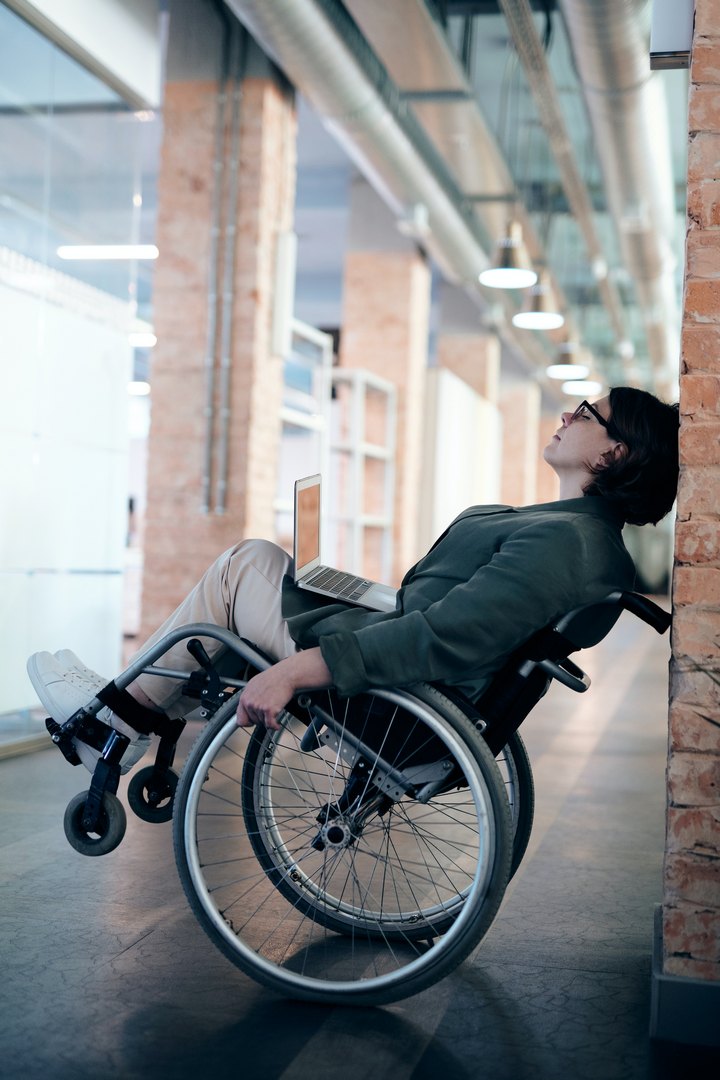
(Photo by Marcus Aurelius from Pexels)
1.2. Organizational conditions
Organizational conditions are represent by effective organization of the entire teaching system for all students within the class, but also within the whole school.
Special attention can be paied to:
- the length of teaching units and breaks (especially with regard to the needs of pupils with SEN)
- the priority of a heterogeneous arrangement of the class
- the arrangement of classroom environment according to the needs of individual students
What might be the appropriate arrangement of a classroom in which there is a hard-hearing student who is reading from the lips? |

(Photo by RF._.studio from Pexels)
1.3. Material conditions
These conditions are linked closely to implementation of support tools recommended for individual pupils with SEN by the school counseling center. The purchase of necessary material and technical equipment is associated with considerable financial expenses. Although the inclusion is not just a matter of finance (and the inclusive education is considered to be cheaper than segregative education of pupils with SEN), material background is also very important as well.

(Photo by bongkarn thanyakij from Pexels)
1.4. Staff conditions
Staff (personnel) conditions consist mainly in the professional readiness of pedagogical staff, as well as in their professional skills, their motivation and ability to motivate others. Each teacher should be able to create a pleasant and natural climate in the classroom, be communicative and empathetic to pupils and their parents.
Of course, the necessary part of teaching profession is teacher's further education (lifelong learning), which contributes to develop his/her own inclusive strategies. One of the most important prerequisites for successful inclusive education in schools are teachers (and other staff) who incline to inclusion - so that an inclusive approach is not only formally declared, but really implemented in the school.
Watch the video and write down your own answer to the question "What does inclusive teaching mean to you?" |
1.5. Content of education
These conditions are given by the Framework Educational Program for the relevant level of education, and at the School Educational Program. In the inclusive school, it is necessary to take into account the needs of each pupils with SEN so that the content of education is in line with its needs - it means that also Individual Eductional Plans are created in case of need (according to the recommendation from the School Counceling Center. Subjects of special educational care designed specifically for pupuls with SEN can be included in the SEP. These may include e.g. speech therapy, sign language, spatial orientation, visual stimulation, reading and writing Braille, communication and social skills, etc.
Watch the video and write down what are the most important benefits of IEP: |