Eger Graben
| Stránky: | Moodle ZČU |
| Kurz: | CBG/KEEX - Krajinně-ekologická exkurze |
| Kniha: | Eger Graben |
| Vytiskl(a): | Nepřihlášený host |
| Datum: | neděle, 8. listopadu 2026, 18.42 |
1. Eger Graben
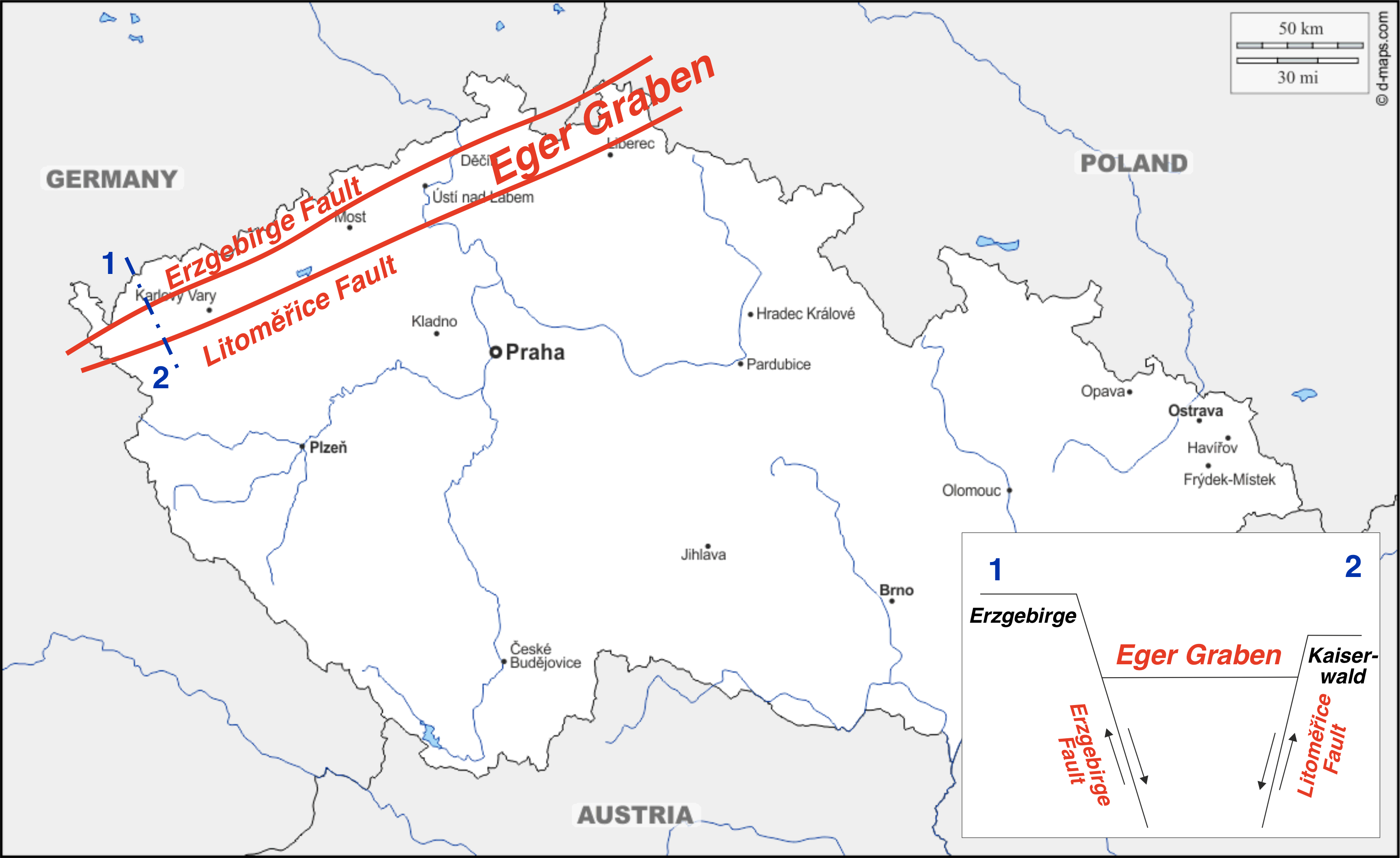
In the North-westernmost part of the Czech Republic rise the Ore Mountains (Krušné hory; Erzgebirge). This mountain chain is a tilted Hercynian block with a steep slope facing SE towards Bohemia and much less steep slope facing NW to the Saxony. The Ore Mountains were formed during a long complicated process - During the Variscan Orogeny, vast high mountains (covering most of present Czech Republic) emerged. These mountains were at the end of Palaeozoic era eroded into the low hillyland. During the Alpine Orogeny this hillyland formed by brittle rocks (slates and gneisses) broke apart and the separate block of Ore Mountains was uplifted and tilted towards NW.
Parallel to the Ore Mountains lies the deep and relatively narrow trench, the Eger Graben. During the Alpine Orogeny, not only the Ore Mountains were uplifted, but the neighboring block dropped forming the trench (Graben). On the SE, the Graben is surrounded by the Kaiserwald (Slavkovský les), that was uplifted similarly to the Ore Mountains. In many places along the faults the volcanic rocks (eg. Doupov Mountains stratovolcano) emerged to the surface and partly infilled the Graben. These volcanic processes ceased during Late Tertiary, only minor earthquakes and other phenomena of the past volcanic activity (eg. mofettas) can still occur in the broader area.
In the times after the Graben was formed, it subsequently started to infill with sediments transported by the rivers flowing from neighboring mountains. In the endorheic basins at the bottom of the Graben the water seeps into the cracks and joints in the rocks. Deep underground, the water is heated by the nearby hot rocks and in the form of water vapour it gets to the surface where it boils and bubbles in the numerous mudpools.