Kinetic analysis
| Website: | Moodle ZČU |
| Kurs: | Experimental diagnosis - šablona |
| Buch: | Kinetic analysis |
| Gedruckt von: | Nepřihlášený host |
| Datum: | Sonntag, 8. November 2026, 20:31 |
1. Basic historical data
Compared to kinematic motion analysis, the history of dynamic motion analysis using force platforms is shorter and less diverse. The year 1843 can be used as the initial year, when the English physicist Wheatstone applied a bridge circuit to measure electrical resistances. This procedure (Wheatstone bridge) became the basis for measuring changes in resistance that occur in strain gauges. In the 1970s, M. Carlet developed a device (air-filled pad) for measuring the force acting on the heel and forefoot.
The first "classical" force platform to measure the vertical component of the reaction sphere is the platform constructed by EJ Marey and G. Demeny at the turn of the 19th and 20th centuries. Trottoire Dynamique "for measuring the three components of the reaction force. Both platforms worked on a similar principle as the equipment created by M. Carlet. In 1930, W O. Fenn assembled the first mechanical force platform to measure the vertical component of force. The movement of the reaction force with the implication to the movement of the projection of the centre of gravity of the body into the substrate was described in 1938 by E A. Helle-brandt. In the same year, H. Elftman published a work in which he described the use of multiple platforms simultaneously.
The measurement of the magnitude of the forces on the contact of the foot with the pad when walking using a strain gauge, without distinguishing the individual phases in the foot load, was performed by D. M. Cunnigham (1950).Together with G. W. Brown, he developed a tensometric platform for measuring the basic parameters of the reaction force vector. The first piezoelectric platform from Kistler, which became the basis for later platforms, was installed in 1969. This date can be considered the beginning of a modern era of platform used for various areas of human activity. In 1971, a similar power platform with a piezoelectric amplifier was installed in San Francisco
From 1974 is meant the use of a platform using strain gauges, in which one of the outputs was the display of reaction force vectors during the support phase of walking in Butterfly pattern (se more in paper bellow)
2. Kinetic analysis of human movement: principles
Kinetic (so-called dynamic) analysis evaluates motion in terms of the forces that cause it.
It deals with forces:
- internal - arising in the musculoskeletal system, changes the state of motion of individual parts of the system, do not affect the movement of the body as a whole (dynamometry)
- external - acting in direct contact with an external object (eg contact of the surface with the pad) (dynamic posturography, treadmills)
3. Reaction force
Reaction force
Reaction force is a force acting on a person when the soles of the feet come into contact with the pad. Reaction force´s magnitude reflects the force of gravity (based on the weight of the evaluated segments) and the force caused by its own movement (involuntary or voluntary change of body position).
A force platform with built-in force sensors is used to measure the
reaction force.
Force platforms
The force platform measures the magnitude and direction of the reaction force vectors during standing and walking.
There are two types of power platforms - static and mobile. Platform types differ in the number and properties of force sensors.
The effect of force > surface deformation > it is recorded
by force sensors si an electrical signal is sent > it is processed and
evaluated.
The signals from all force sensors are summed > the resulting reaction force is created.
The resulting reaction force is the result of all partial forces acting on
the substrate. Place of action of the resulting reaction force = Center of pressure (COP). see chapter 3. Force platforms COP The position of the force vector is determined on the basis of the position
coordinates x, y, z, with respect to the defined reference point of the
platform. The output evaluated parameters for the platforms are the position of the
COP and the size of the individual components of the reaction forces (vertical,
mediolateral, anteroposterior). The position of the COP indicates the projection of the center of gravity
of the body onto the base (so-called center of gravity - COG). Based on the COP trajectory, the size of titrations during standing or the
course of stepping cycles during walking is evaluated (the symmetry of the
lower limbs can also be assessed here). The magnitude of the reaction force of the surface (vertical part) is
usually assessed in connection with the analysis of walking (treadmile with a
built-in force platform) and its modifications (dynamic computer
posturography).
4. Force platforms
The basic instrument used to measure the reaction force of the pad is the force platform. Force platforms are most often used for the assessment of postural stability (balance) in static and dynamic situations, for the evaluation of the magnitude of the applied force in the support phase of walking and for the evaluation of the explosive force of the lower limbs during a vertical jump. In these cases, the platform is built into the floor so that its surface is at the same level as the floor surface.The platform is usually covered with a material of the same color as the color of the surrounding floor. This procedure is used to minimize environmental disturbances.
When approaching biomechanical analysis, whether it’s in a clinic or
research institution, it would be impossible to rely on a singular tool
to perform a truly comprehensive evaluation. To determine which system
best fits your needs, it’s important to understand the capabilities of
force plates and pressure mapping solutions.
Force plates (or force platforms) are systems designed to record motion
of the body mass and muscular output changes on top of the plate’s
surface over time. Researchers and clinicians can use this information
to interpret how forces are generated and transferred during a variety
of different movements.
A force plate measures the ground reaction forces over time during
static or dynamic motions such as gait. They provide information on the
three dimensional components of force (X, Y and Z), which can then be
used to look at more in depth joint loadings. While force plates are
considered the gold standard, they do have some limitations. For
example, force plates are rarely large enough to capture
multiple/consecutive foot strikes and typically cannot describe the
location of peak force/pressure under the foot. In order to overcome
this limitation, and to develop a broader, more objective view of a
patient’s lower extremity function, pressure measurement solutions are
often used in tandem with force platform systems.
Pressure
measurement systems are used by the medical community to investigate
and rehabilitate foot and gait problems. However, pressure is only one
of the many parameters calculated with these solutions. Contact area,
ground reaction force, and derivatives of force, such as center of
force, trajectories and impulse (force-time relationship), can also be
measured to better understand muscular imbalances, deficits, and
instabilities.
Utilizing a pressure mapping system in the lab or clinic allows you to
measure multiple points of contact simultaneously in a dynamic, detailed
pressure map, which provides contact and peak pressure data across an
area. This information is unattainable from force platforms.
Pressure measurement solutions offer the ability to segment views by
foot and even isolate ground reaction force and center of pressure by
foot region, thereby furthering analysis into foot function, balance,
sway. For deeper dive into the force plate, see ebook bellow.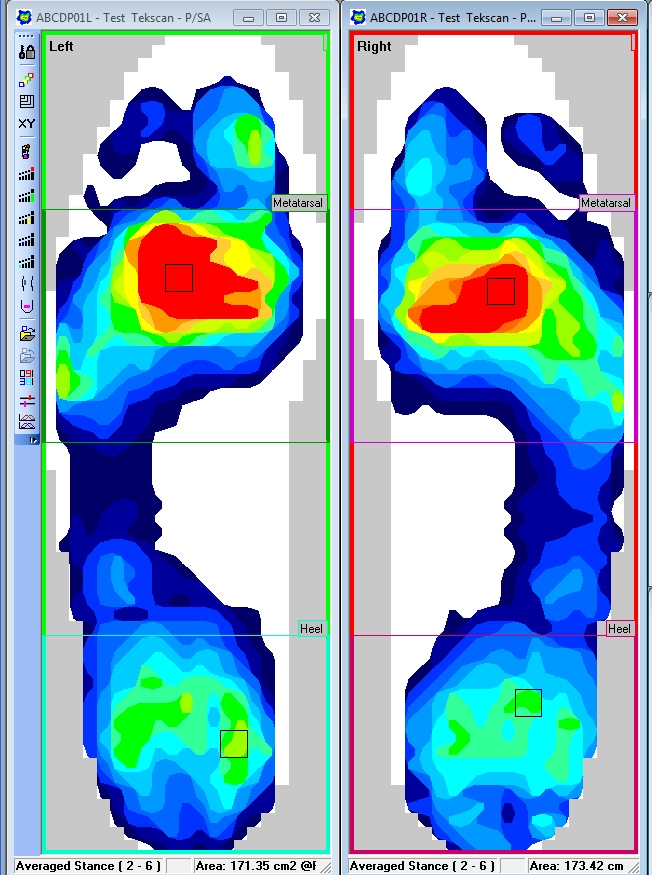 The ability to segment the foot for detailed analysis is one difference from a force plate.
It’s essential for researchers and clinicians with a focus on biomechanical analysis
to rely on a number of tools to gather objective information for
assessments. Due to its versatility and capacity to isolate force
measurements, pressure mapping should be considered an important element
in biomechanical analysis alongside conventional force plates.
5. Application of kinetic analysis
1. Dynamic computer posturography
- isolated sensory, motor, biomechanical components involved in balance
- analyzed how the patient is able to use these components to maintain balance
The posturograph consists of two modules, differing in size and use of force platforms:
- Smart Equitest System - a dual movable force strain gauge platform is built in here
- Balance Master System - a dual static strain gauge platform (larger) is built in here
1.1 Smart Equitest System (part of dynamic posturography)
1.2. Balance Master System module
5.1. Use in therapy
Possible to use in disorders of standing stability, perception of symmetry, control of the center of gravity, training of controlled loading of the feet in a closed chain, active stabilization of the body sitting / standing.
Treadmill with built-in force platform (C-mill, Zebris)
Disorders of standing stability, perception of symmetry, control of the center of gravity, training of controlled loading of the feet in a closed chain, active stabilization of the body sitting / standing.
The device consists of a plate with built-in strain gauges (piezoelectric) sensors, which generate a voltage created by a force acting on the surface of the plate.
They allow an analyze the distribution of pressures acting during the contact of the foot with the pad - color map / 3D. The treadmill on the force platform allows walking / running at a set constant speed, which can be recorded on video cameras. The size of the vertical component of the reaction force of the substrate is important. The course of the force curve can distinguish abnormalities during the execution of the step cycle and shows changes depending on the change of speed.
The vertical component of the reaction force of the surface normally has a two-peak course (see the figure dynamic analysis of Stance phase"
At the time of initial contact, the applied force Fz increases, which reaches a peak in the phase when the standing lower limb takes over the weight of the whole body - decreases during the middle standing phase (load is compensated by slight flexion of the knee joint) - by activating plantar flexors the second peak occurs lower limb) - decrease of force in the phase of double support - zero force when detaching the foot from the surface.
The treadmills can also evaluate the change in the position of the COP - on stationary force platforms it has a wavy trajectory, on the force platforms below the treadmill - a butterfly.
Therapy:
Influencing the spatiotemporal characteristics of walking - projection of tracks on a treadmill or screen - clarification of the patient's ability to modify walking
Adaptability training (Virtual training) - training in a virtual environment teaching the patient to avoid obstacles, modify the length and width of the step