Vegetation and animals
| Sitio: | Moodle ZČU |
| Curso: | CBG/FGCRZ - Fyzická geografie ČR |
| Libro: | Vegetation and animals |
| Imprimido por: | Nepřihlášený host |
| Día: | lunes, 9 de noviembre de 2026, 03:16 |
1. Vegetation
Today's Czech landscape is a heterogeneous mosaic of forests, arable land and settlements. The composition of flora and fauna is result of long-term Quaternary development under the changing climate conditions. The location of the Czech Republic in the central part of Europe led to the diverse mix of Atlantic, Alpine, Boreal, Mediterranean, Pannonian and steppic species (Fig. 1).
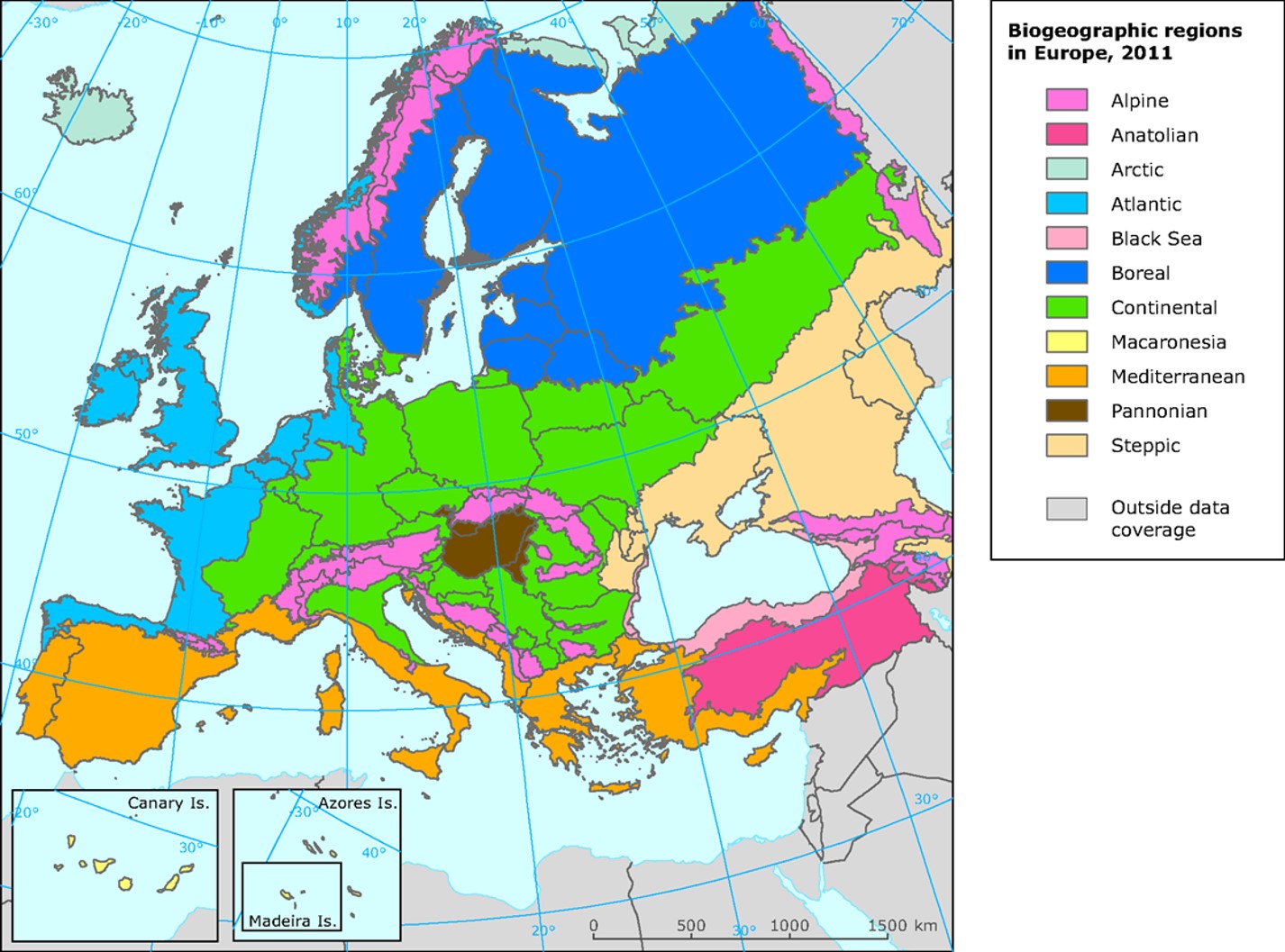
Fig. 1. European biogeographic regions. Most of the territory of the Czech Republic is included in the Continental zone. Southern Moravia is dominated by the Pannonian vegetation.
Native vegetation and landscape were transformed by anthropogenic activities. Particularly steppe areas were under the pressure. These areas are covered by Chernozems, the most quality soil, and native grassland vegetation had to step aside to arable land. Also forest areas were reduced by the Neolithic and later human activities.
Not only land cover was changed but also species composition was transformed. Originally dominated broad-leaved deciduous forests were replaced by the agricultural coniferous forests (mostly spruce) which are planted in middle and lower elevation where is not their natural occurrence. Nevertheless, the forest areas take 33% of state area.
1.1. Biomes
Similar to western and central Europe, the most widespread biome in the Czech Republic is the broad-leaved deciduous forest. Other biomes - forest-steppe, spruce and pine taiga and mountain tundra are only small extension (Fig. 1). Nowadays, the biomes are only theoretical concepts because the central European landscape is strongly affected by the human impact (Fig. 2), in this case we can speak about the potential vegetation.
Fig. 1. Approximate distribution of Czech biomes (Source: Chytrý, 2012).

Fig. 2. Forest cover in 2000 (Source: Chytrý, 2012)
Broad-leaved deciduous forest biome occurs up to 1000–1200 m
a.s.l., but is absent from dry and warm lowlands (Fig. 1). Dominant zonal types of natural vegetation in this biome are forests of beech (Fagus sylvatica) with an admixture of fir (Abies alba) at middle and higher
altitudes and of hornbeam (Carpinus betulus) at low altitudes. Other broad-leaved trees (maples, alder, ash, oak, lime, elm) occur especially at sites where the composition of tree species has changed as a result of past forest
management or natural disturbances, or at azonal sites such as floodplains, scree slopes,
ravines, rock outcrops and dry slopes with shallow soil. Large areas of this biome are
now covered by coniferous plantations, arable land and different types of permanent grasslands.
1.2. Altitudinal vegetation belts
Altitudinal vegetation belts are developed in every area with sufficient elevation differences. Both precipitation and temperature are changing with increasing elevation (see Topic "Climate and weather") and influence the vegetation. Maximum eight belts could be distinguished in the territory of the Czech Republic: lowland, colline, supracolline, submontane, montane, supramontane, subalpine and alpine belt (Fig. 1). The extension of individual vegetation belts can vary among regions.

Fig. 1. Altitudinal belts and timberline in the summit areas of the highest Czech mountain ranges. Altitudes of the highest peak of each range are given. The scheme represents entire mountain ranges including the parts ouside the borders of the Czech Republic (Source: Holý, 2012).
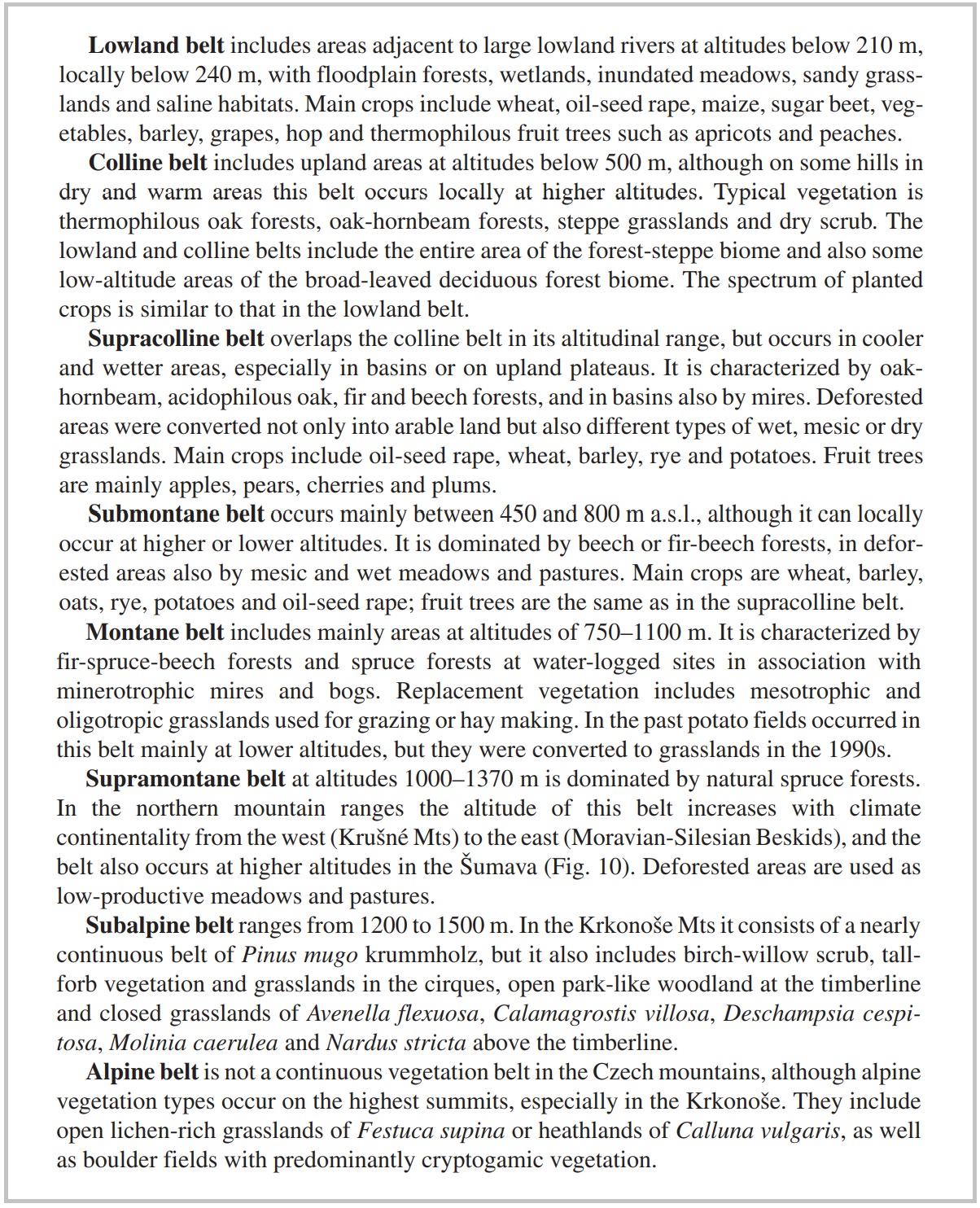
There is a brief description of individual altitudinal vegetation belts (from Holý, 2012):
There are different
classifications of vegetation belts in the literature. One of the most common one use the forest vegetation belts (Fig. 2). Do not forget that the Czech landscape is transformed by the anthropogenic activities and the tree composition of below mentioned belts and spatial distribution of forest does not correspond to the real situation (compare to the Fig. 2 in the previous Chapter 1.1).


Fig. 2. Forest altitudinal vegetation zones.
1.3. Landscapes with a high diversity of vegetation types
Biodiversity hot spots of the Czech landscape could be found in some restricted areas such as areas with high topographic heterogeneity, geological diversity or occurrence of specific bedrock types. These specific conditions (e.g. high elevation differences in the small area and thus high diversity of microclimate, or occurrence of specific bedrock which influence soil conditions and attract the unique vegetation) lead to the high diversity of the vegetation.
These are:
- Deep river valleys of the Bohemian Massif
- Karst areas
- Sandstone pseudokarst
- Solitary volcanic rocks
- Glacial cirques
- Lowland riverine landscapes
- Serpentine areas


2. Animals
Similar to the vegetation, also Czech fauna descend from different parts of Europe and Asia. The forest species (bison, deer, fallow deer) are mainly Boreal or Mediterranean origin, rarely Caspian or Manchurian origin. The thermophilous species come from the Mediterranean or from steppic areas of eastern or southeastern Europe, these are e.g. European hamster (Cricetus cricetus), steppe polecat (Mustela eversmanii), European ground squirrel (Spermophilus citellus), common vole (Microtus arvalis), great bustard (Otis tarda). Oreotundral species are typical for the mountain cold areas, e.g. buteo (Buteo buteo), marmots (Marmota marmota).