Part 2 – Writing a conclusion
| Website: | Moodle ZČU |
| Kurs: | UJP/AEP5 Akademická angličtina 5 - šablona |
| Buch: | Part 2 – Writing a conclusion |
| Gedruckt von: | Nepřihlášený host |
| Datum: | Dienstag, 10. November 2026, 08:28 |
1. Conclusion examples
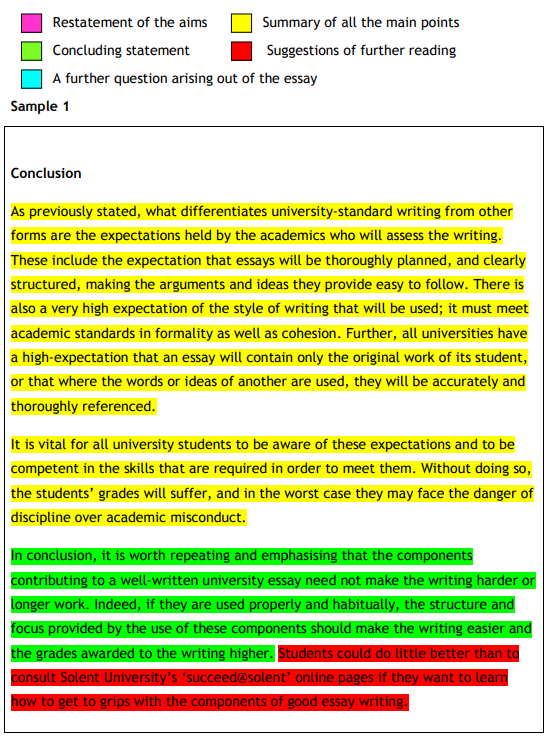
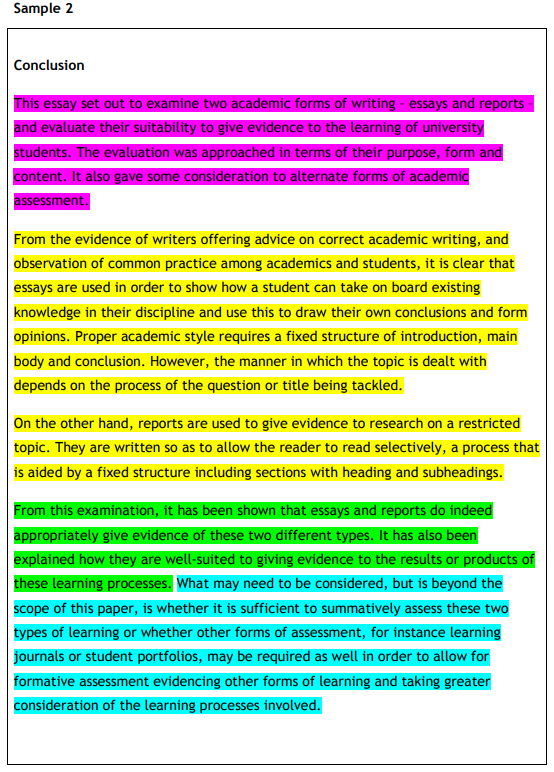
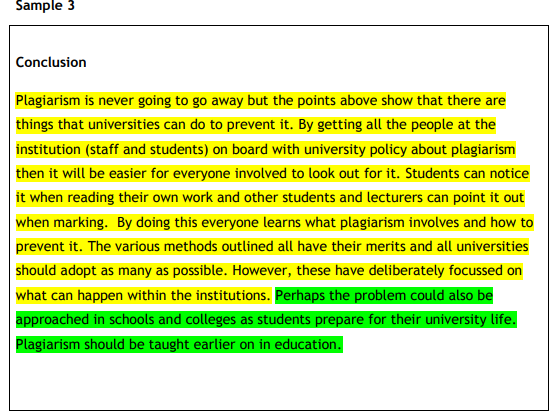
Conclusions typically summarise material, include anticipated results, limitations and further steps that need to be taken in the research.
Please take a look at the following conclusion examples, taken from the Solent Online Learning website:
1.1. Exercise 6.2
Think about your target audience, who they are, their profession, their age, their professional interests and their anticipated expectations. Write this information down along with the perspectives (e.g. economic, political, environmental, socio-phychological, geographical, etc.) you will be using in your writing.
2. What a conclusion is NOT
A quick recap on how to write a conclusion can be found at the Oxbridge Essays Website:
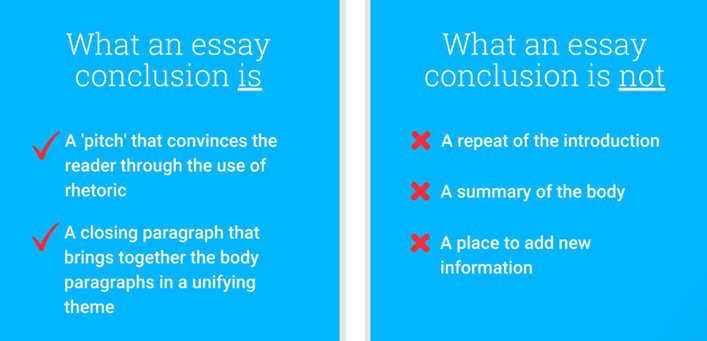
Source: Oxbridge Essays Website, accessed Nov 1, 2021 at https://www.oxbridgeessays.com/blog/how-to-conclude-your-essay-well/
More ideas about what might be best to avoid in your writing are listed below:
- Focusing on a minor point in the essay.
- Apologizing for your view by saying such things as "I may not be an expert" or "At least this is my opinion."
- Attempting to make up for an incomplete structure. (If you initially promised to discuss/analyse 30 articles and only attempt a complete analysis or review of ten articles, do not try to cover the remaining texts in a concluding paragraph. In such a situation, it is best to limit your paper to topics you can realistically cover).
Instead, it may appear useful to use one or more of the following concluding techniques:
• Ask a provocative question.
• Evoke a vivid image of a problem discussed.
• Call for some sort of action.
• Universalize (compare to other situations).
• Suggest results or consequences.
Source: Richmond University writing lab, accessed Nov 1, 2021 at http://writing2.richmond.edu/writing/wweb/conclude.html
In many cases your content, structure and vocabulary will significantly vary depending on your target audience and the perspectives you use to look at the problem.
2.1. Exercise 6.3
Watch the following video on what happens if we switch our view of academic writing from sending our message randomly to the world in a written form to having a live conversation with a speific audience. Check the information you have noted down in exercise 3 and see if it matches the rationale and the purpose of your assignment (scientific article/essay). This way we can approach our writing „as an opportunity to participate in an ongoing dialogue with the scholars“ (University of Purdue Writing Lab website, 2021).
Video – Writing is a conversation, University of Purdue Writing Lab accessed on Nov 1, 2021 at