Part 2 – Four types of academic texts
| Stránky: | Moodle ZČU |
| Kurz: | UJP/AEP5 Akademická angličtina 5 - šablona |
| Kniha: | Part 2 – Four types of academic texts |
| Vytiskl(a): | Nepřihlášený host |
| Datum: | pondělí, 9. listopadu 2026, 10.16 |
1. Descriptive VS Critical writing
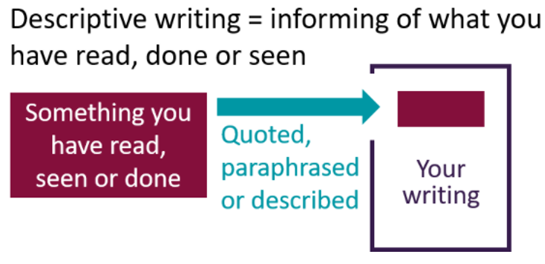
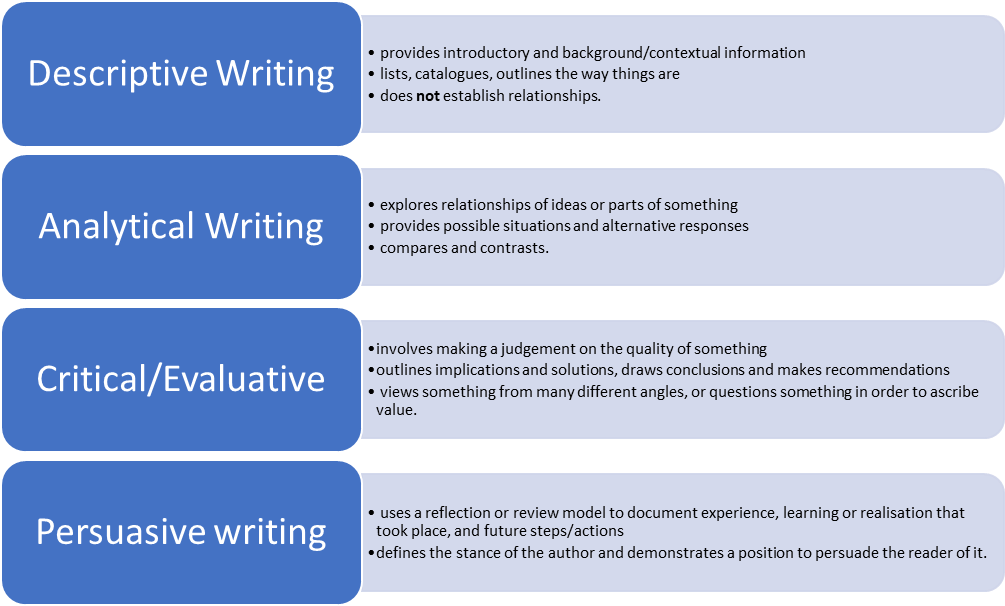
Academic writing styles are often grouped into descriptive and critical writing, with the latter breaking down into analytical and persuasive writing types.
Figure 1 – Descriptive writing usually answers the questions: Who, What, When, Where?
Source: University of Hull, accessed on Nov 4, 2021 at https://libguides.hull.ac.uk/criticalwriting/descriptive-critical
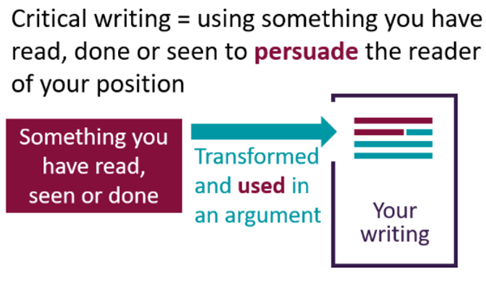
Critical writing usually answers the questions: why it is relevant and significant, how this theory can be used in practice, why is it persuading or misleading, how it leads to a conclusion.
Source: University of Hull, accessed on Nov 4, 2021 at https://libguides.hull.ac.uk/criticalwriting/descriptive-critical
The Eastern Institute of Technology in New Zealand presents the four writing types as follows:
Source: EIT, New Zealand http://www2.eit.ac.nz/library/ls_guides_descriptivewriting.html accessed on Nov 4, 2021
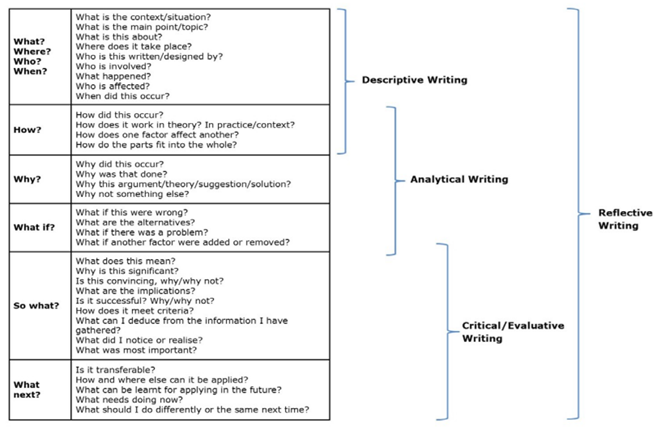
You are welcome to use the following questions to help you think and then write in the appropriate style, or move your writing from one style to another.
Figure 4 – How to generate critical thinking and move through writing styles
Source: Adapted from Critical Thinking, by Learning Development with Plymouth University, 2010 (https://www.plymouth.ac.uk/studentlife/services/student-services/learning-development). Copyright 2006 by Learning Development, University of Plymouth accessed Nov 4, 2021.
1.1. 3 Differences between the two styles
The following examples showcase the difference between descriptive writing and critical/analytical writing. They are taken from: Cottrell, S. 2003. The Study Skills Handbook. 2nd ed. London: Palgrave.
1. State what happened VERSUS identify its significance
To write critically you will need to not only describe what happened, but also identify the significance of what happened.
Descriptive example
"The data shows that the incidence (new cases) of asthma rates in children under 15 years old increased rapidly from 1977, peaking in 1993 and then declining, though rates still remain significantly higher than pre-1976 levels."
Critical example
"The trend, from 1977 until 1993, of a rapid rise in rates of asthma diagnosis in children under 15 years, suggests that one of the causal factors was particularly prevalent during this time, but has since declined in importance or effect."
2. Explain the theory VERSUS show its relevance
Descriptive writing will explain what the theory says. To write critically you need to go further and show why that theory is relevant.
Descriptive example
"Carl Rogers' theory of a person-centred approach focuses on the freedom of the individual to determine what values should be used to measure successful personal outcomes or benefit, and is particularly relevant for social workers when wanting to take into account the diverse needs of the client group."
Critical example
"Carl Rogers' theory of a person-centred approach is particularly suitable for social workers wanting to work with a client group with diverse needs because it allows the client to determine what values should be used to measure successful outcomes, rather than those externally determined by, for example, the service, state or dominant culture in society."
3. Note the method used vs indicate its appropriateness
Rather than simply noting the method used, which is the descriptive approach, a critical writer will show how appropriate that method was.
Descriptive example
"In addition to competency-based questions, the candidates were asked to complete an in-tray exercise, which required them to allocate different priority levels to tasks, as an appropriate method to measure their likely performance in the actual job."
Critical example
"In addition to competency-based questions, candidates were asked to complete an in-tray task prioritisation exercise. This was because it was considered a more effective way to measure likely performance in the actual role as the majority of the job would involve similar tasks, with little interaction with customers and therefore less requirement for highly developed communication skills."