Part 3 – The art of academic reading
| Stránky: | Moodle ZČU |
| Kurz: | UJP/AEP5 Akademická angličtina 5 - šablona |
| Kniha: | Part 3 – The art of academic reading |
| Vytiskl(a): | Nepřihlášený host |
| Datum: | pondělí, 9. listopadu 2026, 06.28 |
1. What is academic reading about
The Learning center at the University of Hawaii Maui College has posted a video on YouTube on College reading strategies (link https://www.youtube.com/watch?v=faZF9x4A2Vs) It covers additional active reading strategies readers can use before, during, and after the reading process
In the presentation it has been stated that it is essential to understand the difference between reading and critical reading.
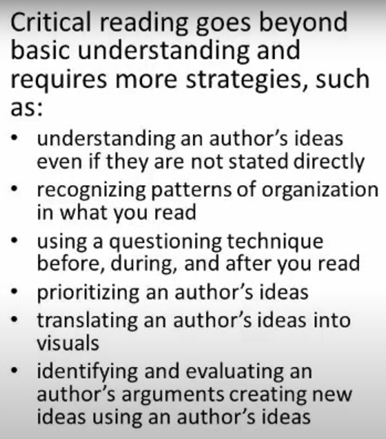
Source: University of Hawaii Maui College on YouTube https://www.youtube.com/watch?v=faZF9x4A2Vs
So what is academic reading? (The following information is adapted from Hurst, 2011)
Purpose of Academic Reading
Casual reading across genres, from books and magazines to newspapers and blogs, is something students should be encouraged to do in their free time because it can be both educational and fun. In college, however, instructors generally expect students to read resources that have particular value in the context of a course. Why is academic reading beneficial?
Information comes from reputable sources: Web sites and blogs can be a source of insight and information, but not all are useful as academic resources. They may be written by people or companies whose main purpose is to share an opinion or sell you something. Academic sources such as textbooks and scholarly journal articles, on the other hand, are usually written by experts in the field and have to pass stringent peer review requirements in order to get published.
Learn how to form arguments: In most college classes except for creating writing, when instructors ask you to write a paper, they expect it to be argumentative in style. This means that the goal of the paper is to research a topic and develop an argument about it using evidence and facts to support your position. Since many college reading assignments (especially journal articles) are written in a similar style, you’ll gain experience studying their strategies and learning to emulate them.
Exposure to different viewpoints: One purpose of assigned academic readings is to give students exposure to different viewpoints and ideas. For example, in an ethics class, you might be asked to read a series of articles written by medical professionals and religious leaders who are pro-life or pro-choice and consider the validity of their arguments. Such experience can help you wrestle with ideas and beliefs in new ways and develop a better understanding of how others’ views differ from your own.
1.1. Reading Strategies for Academic Texts
In order to learn and retain what you read, it’s a good idea to do things like circling key words, writing notes, and reflecting. Actively reading academic texts can be challenging for students who are used to reading for entertainment alone, but practicing the following steps will get you up to speed:
Preview: You can gain insight from an academic text before you even begin the reading assignment. For example, if you are assigned a nonfiction book, read the title, the back of the book, and table of contents. Scanning this information can give you an initial idea of what you’ll be reading and some useful context for thinking about it. You can also start to make connections between the new reading and knowledge you already have, which is another strategy for retaining information.
Read: While you read an academic text, you should have a pen or pencil in hand. Circle or highlight key concepts. Write questions or comments in the margins or in a notebook. This will help you remember what you are reading and also build a personal connection with the subject matter.
Summarize: After you an read academic text, it’s worth taking the time to write a short summary—even if your instructor doesn’t require it. The exercise of jotting down a few sentences or a short paragraph capturing the main ideas of the reading is enormously beneficial: it not only helps you understand and absorb what you read but gives you ready study and review materials for exams and other writing assignments.
Review: It always helps to revisit what you’ve read for a quick refresher. It may not be practical to thoroughly reread assignments from start to finish, but before class discussions or tests, it’s a good idea to skim through them to identify the main points, reread any notes at the ends of chapters, and review any summaries you’ve written.
A full handbook for college students by Hurst, E. (2011). Academic Literacy Workshops: A Handbook for Students and Instructors. University of Capetown accessed on Nov 5, 2021 at https://vula.uct.ac.za/access/content/user/01407397/Academic%20literacy%20workshop/Academic%20Literacy%202012%20-%20Final%20Edition.pdf
Please read p.22-27 from the handbook to find out more on reading techniques.
1.2. Exercises 8.2-8.3
Choose an academic text (a book or an article) to read in the discipline of your choice. Follow the instructions from the Rosario English Area Critical reading worksheet at the following link
The University of Leeds encourages to answer the following questions while reading an academic text:
1. Is the author an expert/academic?
2. What kind of reasons/evidence has the author provided for their main argument and how relevant and reliable are these reasons/evidence?
3. How convincing is the overall argument? Why (not)?
4. Are there any assertions in the article/text that are unsupported?
5. Has something been omitted? What and why?
6. How effective is the language on the strength of the overall argument?
7. Is the conclusion reasonable?
8. What are the strengths and weaknesses of this text?
9. What is your position on the subject? How does it differ from the argument in the text? How will you use the text?
10. How does this text relate to other information you have read? Does it contradict, support or challenge other evidence?
11. How is this text significant to your research? What can be learnt from it?
12. What else needs considering? Which aspects of this argument would you like to investigate further?
Source: University of Leeds Online Resources Library, accessed on Nov 9, 2021 at https://library.leeds.ac.uk/downloads/download/37/critical_thinking_questions
Exercise 4: Choose an academic text (a book or an article) to read in the discipline of your choice in English, Czech other language of your choice. Follow the instructions from the University of Leeds above and notice the difference between reading a text and critical reading of academic texts.
2. Additional resources
Useful links
1. Types of academic writing accessed on Nov 4, 2021 at
2. Student research skills accessed on Nov 4, 2021 at
3. Critical thinking skills accessed on Nov 4, 2021 at
4. Reading and note taking accessed on Nov 4, 2021 at
5. More exercises can be found in the Support section of the University of Sydney website Help and support - The University of Sydney
6. PSAT Critical Reading: How to Predict the Answer to Sentence Completions
http://www.youtube.com/watch?v=XmgpbWHWB4&list=PLb9g9Sq3aRCsc2vk6YcYBq8W2kYWgzzOD&index=1
7. PSAT Critical Reading: How to Answer Definition Sentence Completion Questions
http://www.youtube.com/watch?v=7xtZJZsg6MQ
8. PSAT Critical Reading: How to Answer Contrast Sentence Completion Questions
http://www.youtube.com/watch?v=SnCFeg1pSJw&list=PLb9g9Sq3aRCsc2vk6YcYBq8W2kYWgzzO
9. PSAT Critical Reading: How to Answer Cause-and-Effect Sentence Completions http://www.youtube.com/watch?v=rCNgwRASYCQ