Traction battery
| Website: | Moodle ZČU |
| Kurs: | KEV/EMB Elektromobilita - podklady k výuce |
| Buch: | Traction battery |
| Gedruckt von: | Nepřihlášený host |
| Datum: | Sonntag, 8. November 2026, 20:31 |
1. Basic properties and characteristics of Li-ion batteries
Lithium-based technology- At present, lithium cells are the dominant technology in the field of traction batteries.
1.1. History
- 1970-80 Technology Development (Goodenough, Whittingham, Yazami, Mizushima)
- 1985 First prototype Li-ion battery (Yoshino)
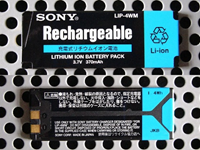
- 1991 First commercial article Li-ion, fa. Sony (Nishi, Tozawa)
- 2019 Nobel Prize in Chemistry: Yoshino, Goodenough, Wittingham, for the development of Li-ion batteries

1.2. Lithium and alkali metals
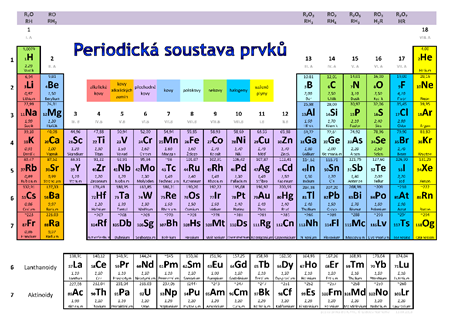
- Lithium belongs to the group of alkali metals.
- Alkali metals are soft, silvery-white substances with a low melting point and low density.
- Li is the lightest metal, lighter than water, softer than talc.
- Metal from a chemical point of view - an element that easily removes electrons and forms positively charged ions.
- Alkali metals have only one electron in the valence sphere.
- They are extremely reactive => in nature only as compound.
- Na and K are among the most common elements, but Li is very rare.
- Lithium burns in air (stored in kerosene):
4 Li + O2 → 2 Li2O
- Alkali metals react with compounds containing positively charged hydrogen H + (especially acids).
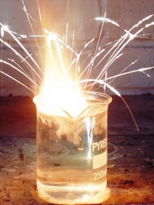
- Stormy reaction, release of heat and hydrogen H → explosiveness!
1.3. Lithium
- Production: ore mining (spodumene, Li2O.Al2O3.4SiO2) → lithium chloride production → electrolysis
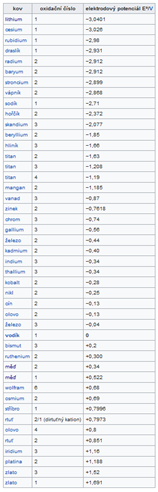
- Beketov series of metals - according to the standard electrode potential (potential related to the hydrogen electrode, H has a potential of 0 V).
- Lithium is at the top in the standard electrode potentials table, i.e. it has the highest electrode potential: -3.04 V
 |
 |
 |
|---|---|---|
|
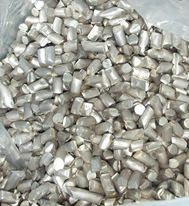
Pure lithium |
Lithium reacting in water |
Red flame of lithium |
|
Standard electrode potencials table |
1.4. Types of lithium batteries
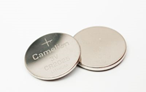
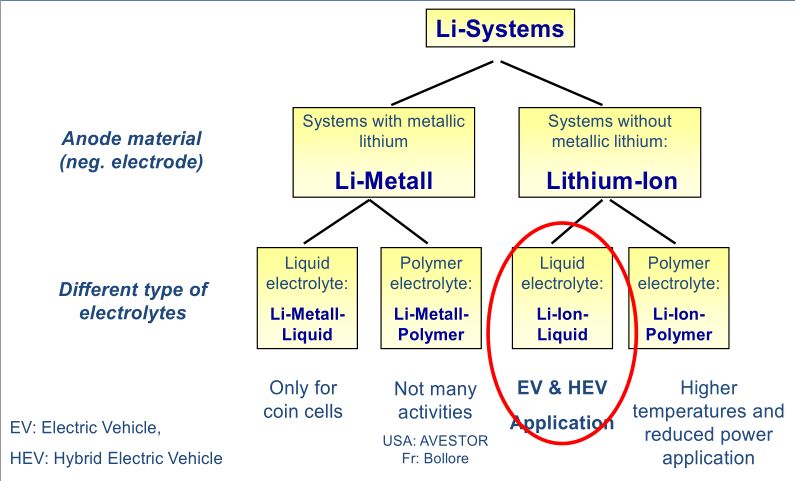
- Primary Li cells - disposable, cannot be charged.
- Charging leads to crystalline solid lithium structures, which can damage the separator and short-circuit the battery.
- Li-ion - rechargeable batteries, only lithium ions Li +
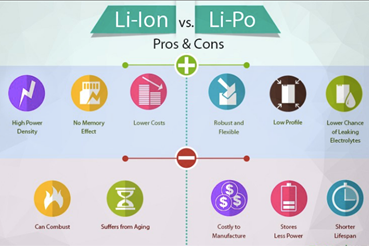
- Li-polymer - the same composition as Li-ion, the separator is replaced by a special polymer, more expensive than Li-ion
- Li-air - high energy density, space programs
- Small amount of atmospheric oxygen (20%)
- Li-S, Na,…
 |
 |
 |
|---|---|---|
|
Dendrities - crystalic structures |
Li-ion vs. Li-polymer |
Primary cells |
https://global.abb
batteries2020.eu
1.5. Li-ion cell
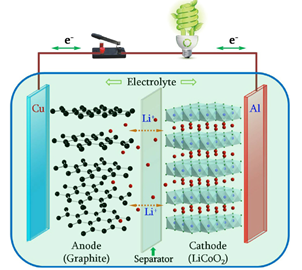
- Cathode - metal oxide (LiMO2, M… Co, Mn, Fe, Ni), collector Al
- LiMO2 - LiCoO2, LiMnO2, LiNiO2
- Anode - graphite, Cu collector
- Separator - thin porous foils (polyethylene, polypropylene)
- Electrolyte - lithium salt and organic solvent
- Li + ions travel through the separator from the anode to the cathode.
- Electrons through an electrical circuit.
- The ions penetrate the LiMO2 metal oxide lattice.
- Discharged cell = steady state
- Li+ ions travel through the separator from the cathode to the anode.
- Layered graphite structures allow Li+ intercalation.
- Graphite does not play a role in the chemical reaction, it is only the "storage medium" for Li+.
- Charged cell = unstable state
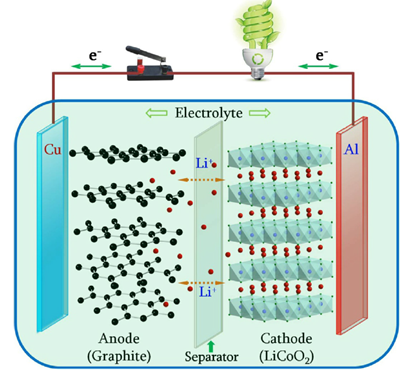
Li-ion cell
1.6. Li-ion cell II
- Temperature rise to critical values → electrolyte evaporation → internal short circuit → fire / explosion
- Separator - prevents internal short circuit, porous, through for Li+.
- Electrolyte applied to a thin separator.
- Cylindrical cell - all these layers are rolled into a roll.
- Electrons must not come into contact with the electrolyte → degradation of the electrolyte.
- SEI (solid electrolyte interphase) - a layer preventing the contact of electrons with the electrolyte and its degradation
- SEI is formed on the very first charge.
- Li+ → electrolyte → Li+ + solvent molecules → reactions with graphite → SEI
- About 5% of lithium is used to create SEI.
- Current battery life: 3000 cycles, 10 years
- R&D direction - replace graphite with Si
- Increasing energy density
- However, Si increases its volume during charging → possibly a combination of graphite and Si.
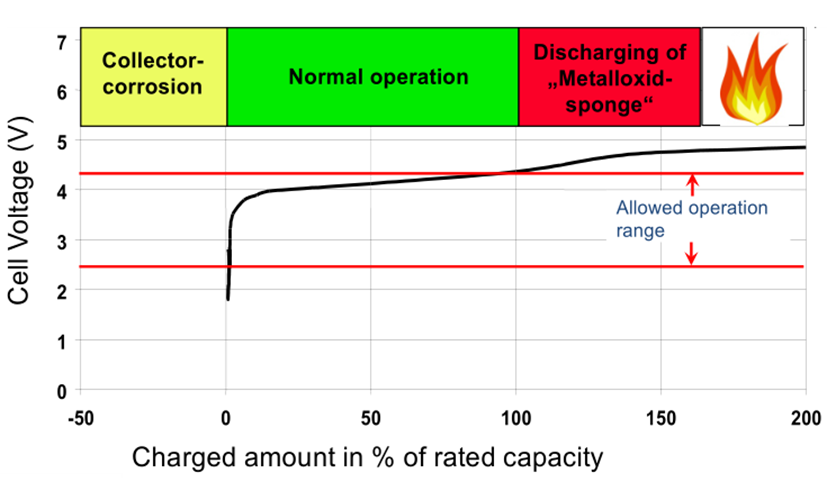
1.7. Cell voltage characteristics
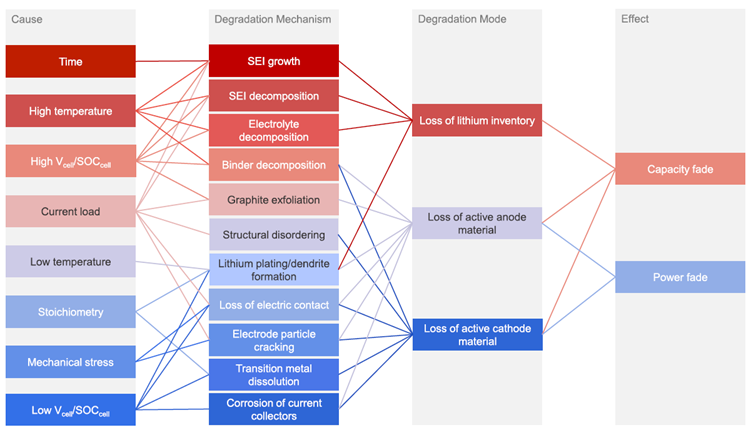
1.8. Degradation and aging
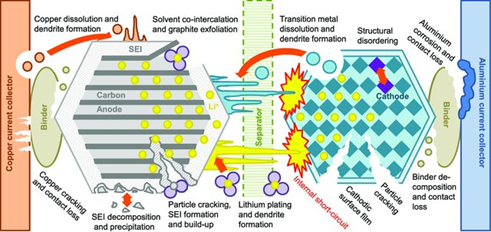
- Natural aging - the battery loses capacity spontaneously after a few years and fails without drawing power.
- Tunneling of electrons through SEI into the electrolyte.
- The electrons react with the electrolyte and form additional layers SEI → SEI increases and the electrolyte is gradually consumed.
- This process is significantly accelerated when the battery is used and current is drawn.
- Li+ passing through the electrolyte → entrains solvent molecules → reacts with tunneling electrons → SEI layer grows → electrolyte and lithium are consumed → battery destruction.
2. Energy and power density
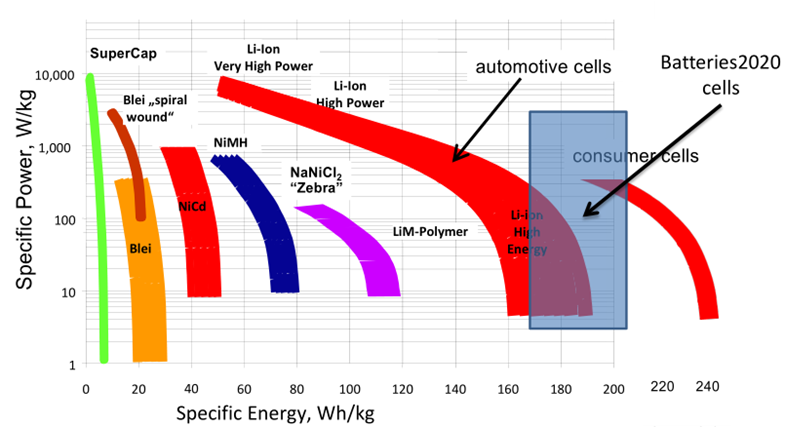
- Power density (kW/kg) is a key parameter for achieving the supply power of a traction motor at a given size of traction battery.
- Energy density (kWh/kg) is key to determining the range for a given size of traction battery.
2.1. Energy and power density of batteries
- Power density - specific power: kW/kg (alternatively kW/l)
- Energy density - specific energy: kWh/kg (alternatively kWh/l)
2.2. Comparison with fossil fuels
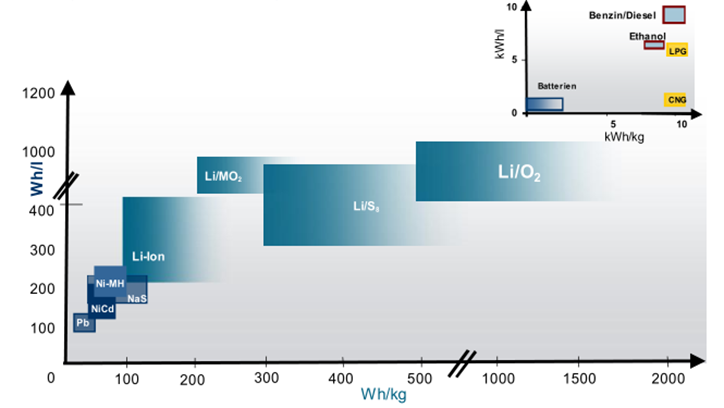
- The energy density of modern lithium batteries reaches a maximum of 200 Wh/kg.
- Compared to traditional lead batteries, it is 5-7 times more.
- The energy density of fossil fuels is many times higher.
2.3. Research and development
Metal oxide
- Many variants for metal M in LiMO2 oxide
- Ni, Hg, Co, Al,… impact on cost, energy density, number of cycles
Aquaeos Li-ion, halogen intercalation
- Electrolyte - salt in water (also solves flammability), use of halogens (F, Cl, Br, I) to improve intercalation in graphite.
- Published in the journal Nature, energy density 460 Wh/kg.
Li-air (Li-O2)
- Oxygen from the external environment
- Electrochemical cell with theoretically highest energy density - 11.7 kWh/kg (petrol 13 kWh/kg)
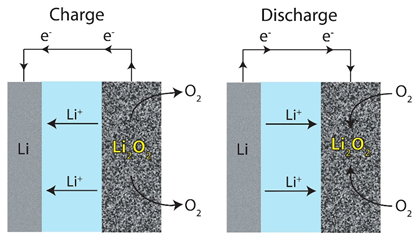
- Anode – lithium, Li → Li+ + e-
- Cathode – uhlík, Li2O2
- Li+ + e- + O2 → LiO2 + e- + O2 → Li2O2
2.4. Efficiency
Electric car efficiency vs. cars with internal combustion engine
The energy density of current electric vehicle batteries is many times lower than the energy density of fossil fuels. Thus, an electric car has less energy available than a car with an internal combustion engine. On the other hand, the electric drive achieves much higher efficiency (up to 96%) than the drive with an internal combustion engine (max. 42% diesel, 35% petrol).
Overall efficiency in operation
- Efficiency of a car with an internal combustion engine: 20%
- Electric car efficiency: 85% (without charging)
- Oxygen consumption: a car with a fuel consumption of 7 l/100 km consumes about 122 liters of O2 per 100 km.
3. Battery pack
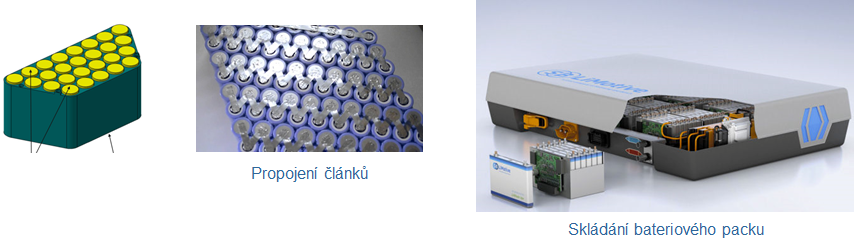
The assembly of a complete traction battery is performed by assembling the individual cells in a battery pack. By combining serial and parallel connection of a certain number of cells, the target capacity, target voltage and battery current are achieved.
3.1. Cell types
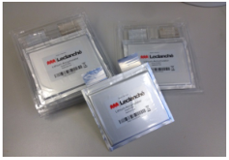
Pouch cells- Simple sandwich construction
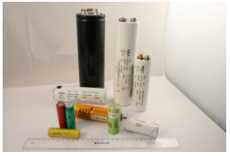
Cylindrical cells
- The electrodes are wound and placed in a cylindrical housing.
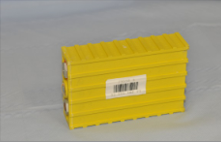
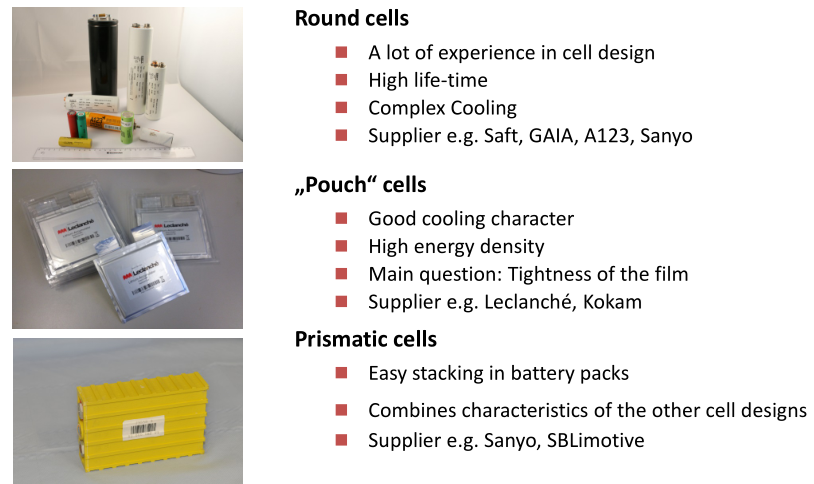
Prismatic cells
- The electrodes are wound into a coil, the coil compressed into an elliptical shape and inserted into a housing.
3.2. Traction battery assembly
Example
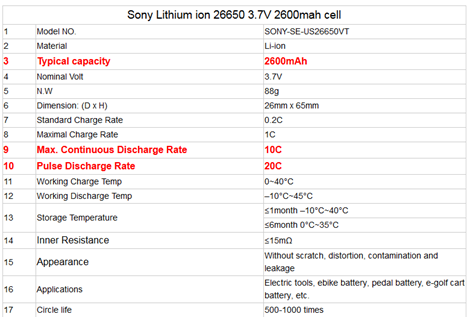
- Cylindrical cell Sony Lithium Ion 26650 3.7 V, 2600 mAh
- Maximum continuous discharge current: 10C, ie 10 * 2.6 = 26 A
- Maximum short-term discharge current: 20C, ie 20 * 2.6 = 52 A
- Maximum charging current: 1C, ie 2.6 A ... significant reduction of recuperation.
- Energy density:
- 3,7 * 2600 / 100 = 9,62 Wh (88 g)
- 9,62 / 0,088 = 109,3 Wh/kg
- Power density:
- 10C: Imax = 10 * 2,6 = 26 A
- Pmax = 26*3,7 = 96,2 W
- 96,2 / 0,088 = 1,09 kW/kg

3.3. Serial connection
- When connecting cells in series, the voltages of the individual cells are added up.
- The current of series-connected cells is equal to the current of one cell.
- The power of a serial connection is the sum of the power of individual cells.
- The capacity (Wh) of a serial connection is the sum of the capacities of the cells.
- Single cell (e.g. 3,7 V, 2600 mAh)

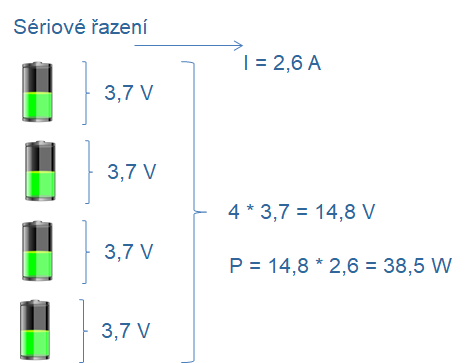
If we wanted to create a voltage of 400 V (suitable for driving an electric car), we would have to connect 108 cells in series.
Total power: P = 108 * 3.7 * 2.6 = 1040 W
3.4. Parallel connection
- When connecting cells in parallel, the currents of individual cells are added.
- The voltage of the parallel connection is equal to the voltage of one cell.
- The performance of a parallel connection is the sum of the performance of individual cells.
- The capacity (Wh) of a parallel connection is the sum of the capacities of the cells.
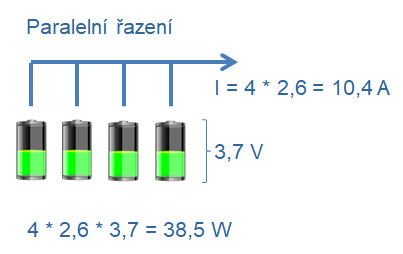
If we required a rated current of 200 A, it would be necessary to connect 77 cells (or serial branches) in parallel.
Total power: P = 77 * 3.7 * 2.6 = 740 W
3.5. 80 kW battery assembly (example)
- Single cell: continous current (10C): 26 A, rated voltage: 3,7 V
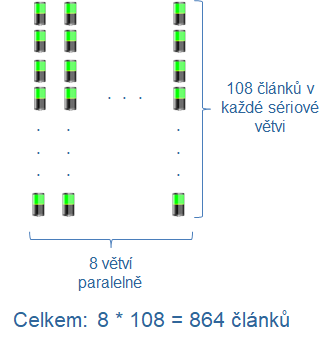
- To assemble a battery with a nominal voltage of 400 V and a continuous power of 80 kW, 864 of these cells are required (108 in series, 8 in parallel).
- Total capacity: 108 * 3,7 * 2,6 * 8= 8,3 kWh (driving range approx. 50 km?)
- Weight (cells only): 864 * 0,088 = 76 kg
- Voltage range:
- Single cell approx. 3,2 – 4,2 V, i.e. in case of 108 cells connected in series: 345 – 454 V.
- For a range of 200 km: 3,500 cells, 308 kg, approx. 350 thousand CZK (cells only).
3.6. Traction battery arrangement in EV
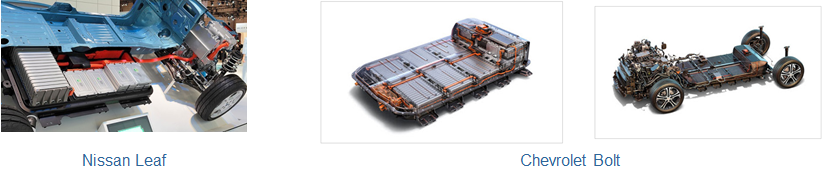
- Cell → module → battery pack
- The cells are grouped into modules, connected by welding.
- A complete battery pack is assembled from individual modules, i.e. groups of cells.
- BMS (battery management system - measurement, monitoring, balancing) integration, or battery cooling.
- In modern electric vehicles, the battery is usually part of the car floor.
https://www.nissan-global.com
http://www.sblimotive.com
4. Charging
- Charging current lower than discharging (e.g. 10x or 20x lower).
- Lithium ions Li+ must intercalate into the graphite layers → it limits the charging speed.
- By charging, we force the cell to be in unstable state.
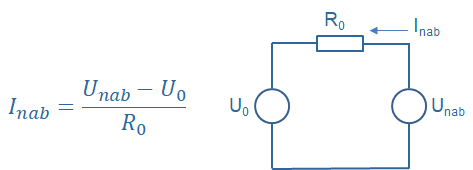
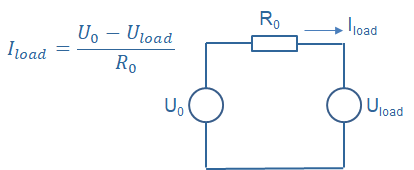
- The size of charging current Inab is given by
- difference between the charging voltage Unab and the internal voltage U0,
- the size of the internal resistance R0.
4.1. Charging steps
- Charging increases the battery voltage.
- By simultaneously increasing the charging voltage, we maintain a constant charging current = constant current charging (1st charging step).
- However, the maximum cell voltage must not be exceeded.
- When the maximum voltage is reached (Unab = Umax), the voltage must not increase further and must stay constant = charging at constant voltage (2nd charging step, so-called saturation part).
- The charging current decreases exponentially => the charging at constant voltage is time consuming.
- Manufacturers often state charging time to reach 70-80% capacity.
- Maximum cell voltage depending on technology:
- usually 4.2 V for Co, Ni, Mn, Al.
- The cell charging current is usually recommended to be 0.5-1C.
- To increase the service life, low charging currents are recommended and charging below full SoC (e.g. do not start the saturation part) → reduced voltage stress.
- A large charging current speeds up the first charging step, but it prolongs the saturation part.
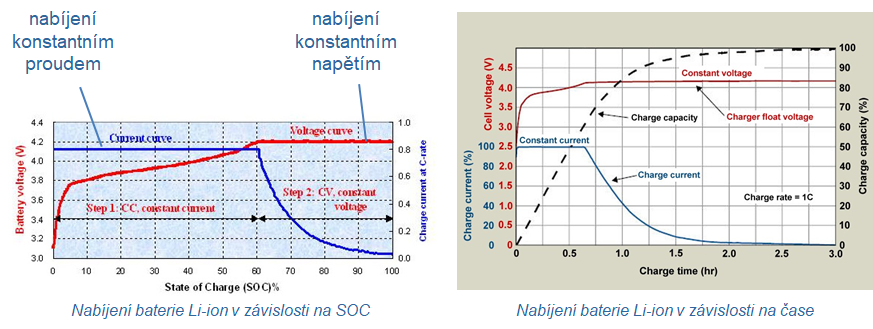
Typical charging characteristics of a Li-ion battery
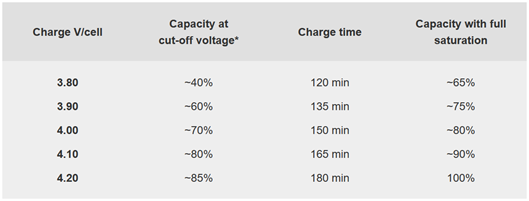
- The aging of the battery results in a shortening of the 1st part (charging with constant current) and a prolongation of the saturation part.
- SoC is practically impossible to determine according to the current voltage.
- It is possible according to the OCV characteristic for the given temperature → in steady state, i.e. sufficient time from last loading.
- Usually, the calculated charge is counted:

- Overcharging is not possible - Li-ion will not take over another charge, charging must be stopped, otherwise safety is endangered.
4.2. Influence of temperature
Low temperatures
- Charging Li-ion at temperatures below 5°C with limited current only, in frost is not allowed.
- Fast charging in the range of 5 - 45 ° C, but preferably 10 - 30 ° C.
- Charging in the cold damages the battery ("plating" the anode with lithium, permanent, irreversible changes).

High temperatures
- High temperatures are harmful for any type of battery.
- Usually, they cannot be charged at T> 50 ° C, it accelerates aging.
- Current limitation is necessary, charging with high current at high temperature reduces the capacity of the battery.
- May cause gas production and inflation.

5. Discharging
- The most favorable for Li-ion is room temperature.
- The manufacturer prescribes a discharge temperature range (eg -20 ° C to 60 ° C).
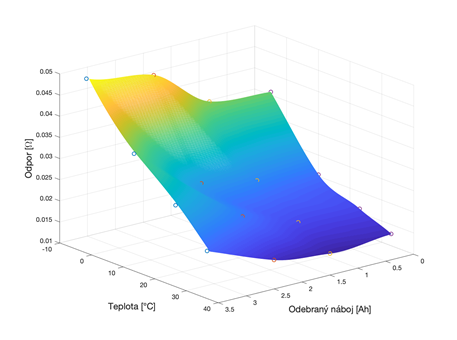
- Low temperatures → high internal resistance → driving range is shortened.
- As the temperature rises, the internal resistance decreases - the discharge power increases, but higher temperatures accelerate aging.
- Excessive or complete discharge will cause irreversible damage.
- The battery is better to discharge by low, constant current than by pulse overload.
5.1. Internal resistance
Internal resistance
- Internal resistance is a critical parameter of the battery.
- It causes a voltage drop.
- It affects the efficiency of charging and discharging → losses, consumption and range.
- It changes significantly, especially with temperature; it also depends on SoC.
Identification of internal resistance of Sanyo NCR20700A cell
5.2. Example
Cell Sanyo NCR20700A
- R0 in summer approx. 0.02 Ω
- R0 in winter approx. 0.04 Ω
Battery 32 kWh, 390 V
- 105 cells in series, 25 parallel branches, a total of 2625 cells
- R0 battery: 0.084 Ω (summer), 0.168 Ω (winter)
Battery electric vehicle,
Pmax = 120 kW

- Power losses on R0 at full power:
 ≈ 8 kW
(summer)
 ≈16 kW
(winter)
5.3. Discharge characteristics
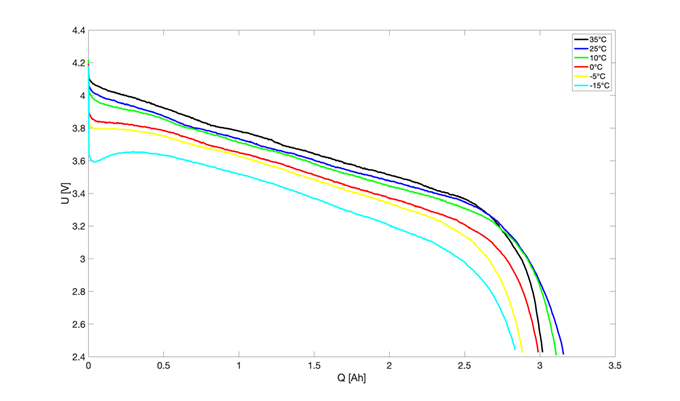
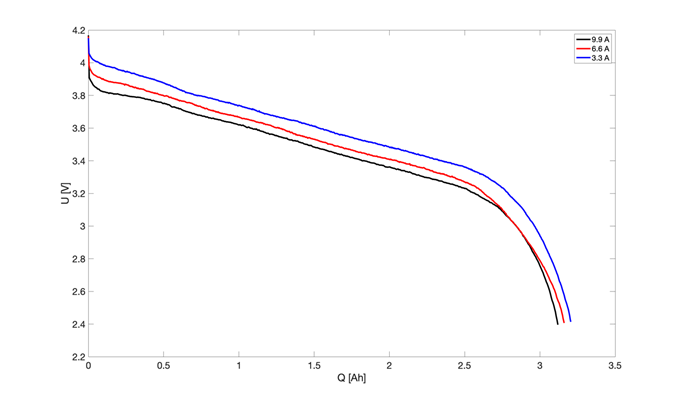
Influence of temperature
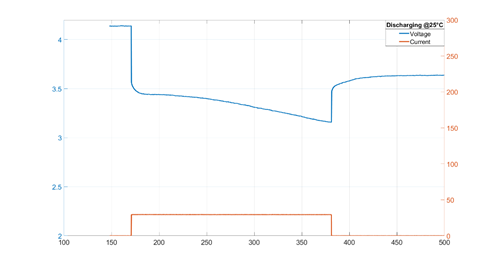
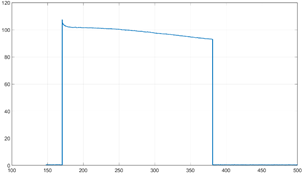
- Comparison of discharge characteristics for 25° C and 0° C
Cell discharging by constant current of 30 A at 25° C
Power
Cell discharging by constant current of 30 A at 0° C
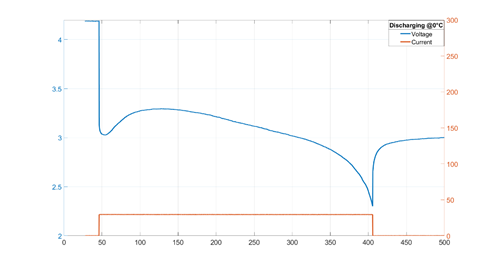
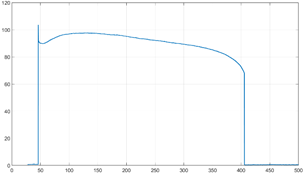
- The discharge characteristics strongly depend on the temperature.
- The discharge characteristics also depend on the magnitude of the discharge current.
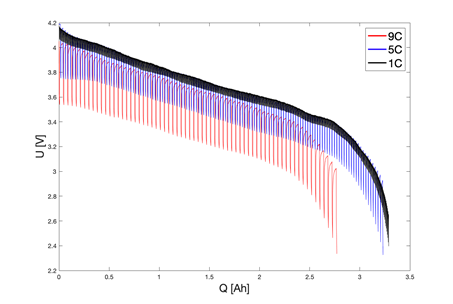
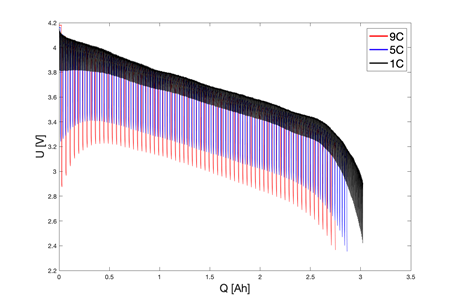
5.4. Pulse discharging
Discharge characteristics during pulse discharging for different currents at a temperature of 25° C
Discharge characteristics during pulse discharging for different currents at a temperature of -5° C
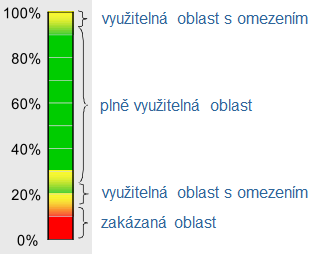
5.5. Depth of discharge
- The installed capacity is not equal to the usable energy.
- The usable window ranges from approximately 80 - 90%.
- Sometimes the usable window decreases with a new vehicle and it is expanded as the battery ages.
6. Power vs. energy cells
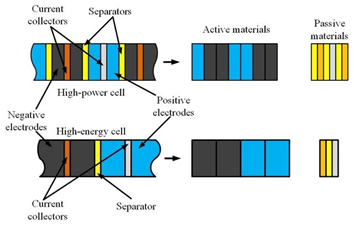
Power cells
- High power density
- Low energy density
- Small cell area, thin, porous electrodes
Energy cells
- Low power density
- HIgh energy density
- Large cell area, strong electrodes

7. Costs
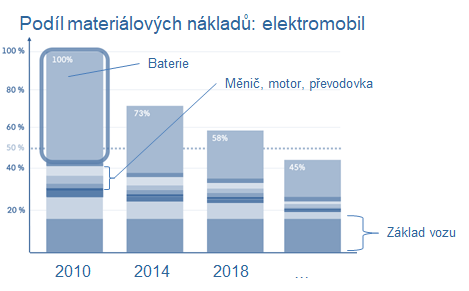
Share of car production costs
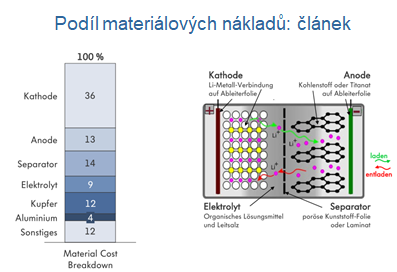
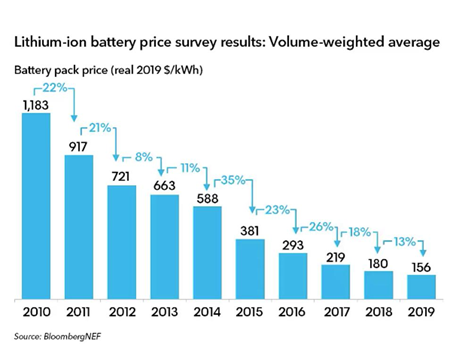
Development of costs per kWh of traction battery
https://bnef.com
8. Battery management system
Battery management system (BMS)
- The electric traction battery is a relatively sensitive system.
- To maintain durability, it must be supplemented by a comprehensive electronic system.
- BMS in particular:
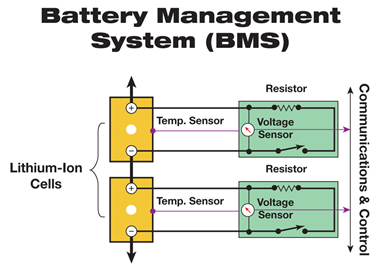
- Monitors the voltage and temperatures of individual cells / groups of cells
- Monitors the amount of energy received and consumed
- Balances articles
- Controls charging - communicates with the charging system
- Limits / enables max. Current
- Models cells, battery
- Estimates SoC, SoH
- It communicates with the control units in the car

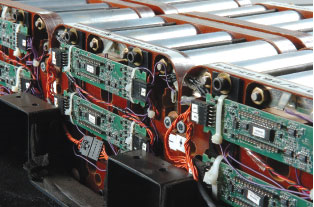
- Each cell has slightly different parameters.
- Differences in SoC occur when charging series-connected cells.
- Cell balancing is necessary
Frequent terms
- BMS – Battery management system
- SoC – State of Charge
- SoH – State of Health
- DoD – Depth of Discharge
9. Thermal management
Service life
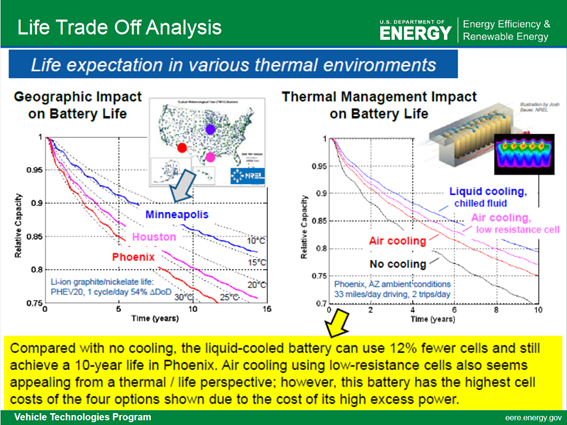
- Batteries for electric vehicles operating in colder climates achieve a longer service life for those operating at higher ambient temperatures.
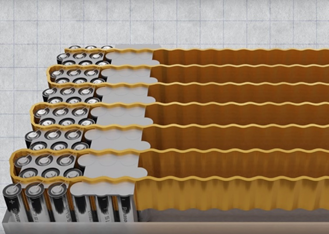
- Thermal management has a major impact on battery life.
Thermal management of Porsche Taycan
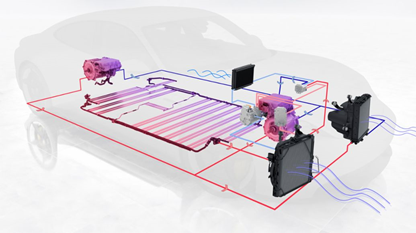
Thermal management of
Tesla Model 3
https://newsroom.porsche.com
http://www.autoracing1.com