Hybrid cars
| Website: | Moodle ZČU |
| Kurs: | KEV/EMB Elektromobilita - podklady k výuce |
| Buch: | Hybrid cars |
| Gedruckt von: | Nepřihlášený host |
| Datum: | Montag, 9. November 2026, 00:02 |
Beschreibung
Passenger cars with hybrid drive, where the drive consists of a combination of a traditional internal combustion engine and an electric motor.
1. Introduction
Hybrid cars
- Cars with more than one source of acceleration.
- Currently, the term HEV (Hybrid Electric Vehicle) is used for a solution that combines an internal combustion engine (ICE) with one or more electric motors as a source of accelerating force.
- Energy storage devices are a fuel tank and an electric battery.
- Two basic HEV structures:
- serial,
- parallel.
2. Types of hybrid drives
2.1. Serial hybrid drive
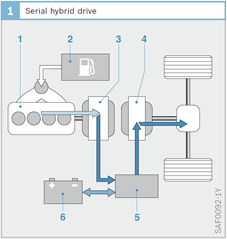
1 – ICE
2 – fuel tank
3 – electric machine (generator)
4 – electric machine (motor)
5 – power inverter
6 – battery
- Serial connection of acceleration force sources.
- The series arrangement consists of an internal combustion engine (ICE) and a pair of electrical machines.
- The internal combustion engine (ICE) is not mechanically coupled to the axle.
- The electric machine (3) works as a generator.
- All power flow to the axle is realized through an electric machine (4).
- The electric machine (4) is working
- as a motor in drive mode, energy is taken from the traction battery and ICE,
- as a generator during braking, the traction battery is charged,
- as ICE starter.

 ,

 ,

- ,

- ,


- ICE can be operated at the optimal efficiency point:
 = konst. =
 .
- ICE is not mechanically coupled to the axle → many installation options in the car.
- Low power transfer efficiency from ICE to wheel (large number of conversions).
Example
- Maximum efficiency

- Buses in city traffic, ie. stop & go driving style on a known route.
- Range extenders - practically BEV, emergency driving after discharging the battery.
2.2. Parallel hybrid drive
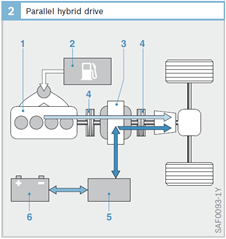
1 – ICE
2 – Fuel tank
3 – Electric machine
4 – Coupling
5 – Power inverter
6 – Battery
- Parallel connection of acceleration force sources.
- The internal combustion engine (ICE) (1) is mechanically coupled to the axle.
- Each of the drives, i.e. the internal combustion engine (ICE) (1) and the electric motor (2), can drive the axle independently.
- Alternatively, both motors can drive the vehicle at the same time → the sum of the powers allows to minimize the individual machines (i.e. ICE and electric motor).
- Many possibilities of parallel connection implementation (on separate axle, on shaft (according to location P0-P4), with planetary gearbox, etc.).
- The electric machine (3) is working
- as a motor when powered by a traction battery (6),
- as a generator when recharging the traction battery (6),
- alternatively as ICE starter.
 , alternatively

- ,

- ,

 , alternatively

- ,

- ,
 ,

 , alternatively

- ICE cannot be operated only at the optimal efficiency point.
- There is an ICE-axle connection → fewer losses than with a series hybrid drive.
Applications
- Wide use in a variety of vehicles, including hybrid passenger cars (mild hybrid, full hybrid, plug-in hybrid).
- The electric drive increases the efficiency of the drive with ICE, especially when accelerating and braking using recuperation (suitable for urban traffic).
- When driving over very long distances, the battery gradually discharges and the drive is provided only by ICE → loss of electric motor power (3).
2.3. Split-power hybrid drive
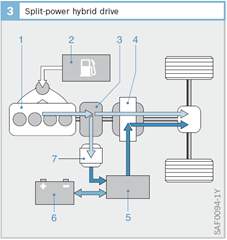
1 – ICE
2 – fuel tank
3 – planetary gear
4 – electric machine (motor)
5 – power inverter
6 – battery
7 – electric machine (generator)
- It combines both configurations, serial and parallel.
- 1x ICE (1), 2x electric machine (4) and (7)
- The variant in Fig. 3 shows the connection by means of a planetary gear (3).
- The variant in Fig. 3 with a planetary gearbox and a 2nd electric machine (7) makes it possible to realize a continuously variable transmission between the axle and the ICE (1), similarly to CVT gearboxes.
- There are a number of modes, e.g.
- the internal combustion engine (ICE) (1) can drive the vehicle independently, as well as a purely electric drive,
- part of the power of the internal combustion engine can drive the axle and the rest can recharge the battery at the same time.
- There system disposes by several degrees of freedom, requiring sophisticated management strategies to optimize efficiency.
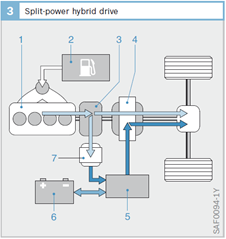
Split-power hybrid drive with planetary gearbox without clutch
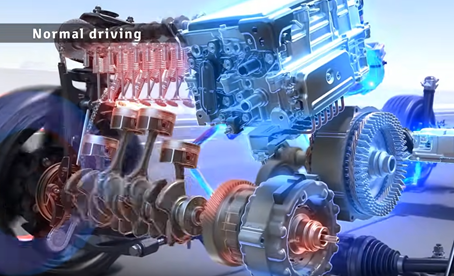
Toyota Hybrid System
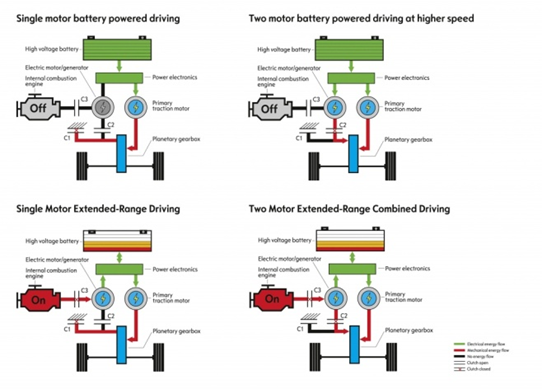
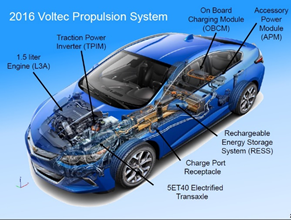
Opel Ampera/Chevrolet Volt - drive with multiple clutches
https://www.youtube.com
https://www.chevrolet.com
3. Degrees of vehicle electrification
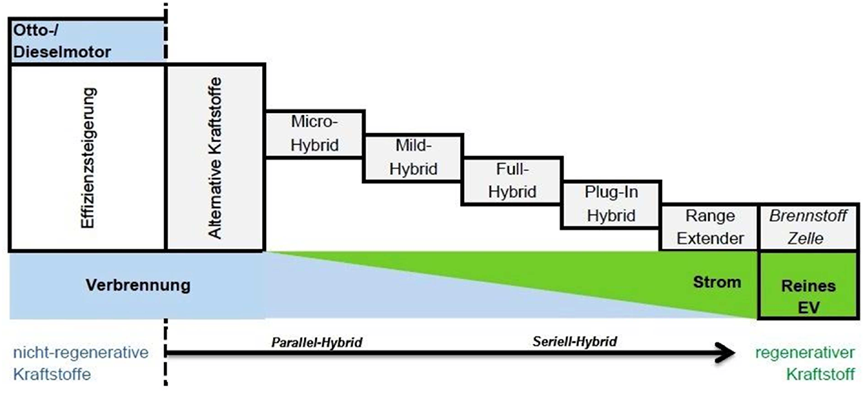
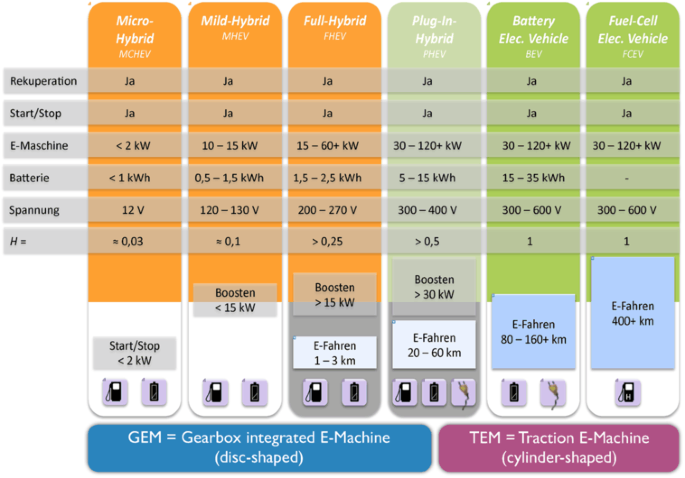
3.1. Micro hybrid
- Start & stop + ESM (Energy Smart Management)
- Turns off ICE when standing
- Uses a 12 V battery (usually Pb)
- Reduce fuel consumption with ESM
- The 12 V battery supplies the car's consumption even when the engine is running, the alternator is unloaded => reduction of fuel consumption.
- The 12 V battery is recharged when
- braking,
- in the area of maximum ICE efficiency.
- The electric machine does not contribute to the driving torque.
3.2. Mild hybrid (MHEV)
- ICE is the dominant drive
- Electric drive powered by 48 V battery (Li or Ni-MH technology)
- Battery 48 V (Li), DC-DC converter, battery 12 V (Pb)
- Electric motor: power usually max. 15 - 20 kW
- It is auxiliary system, it increases power and torque of the whole drive.
- It helps compensate problematic areas of the ICE efficiency map.
- It compensates torque generation delays from ICE.
- It does not allow a purely electric driving.
- Recuperation
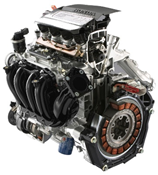
MHEV Honda IMA
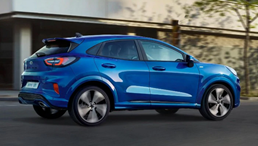
Ford Puma
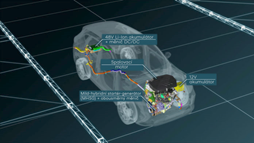
Hyundai Tucson
Hyundai Tucson
- Battery Lion 48 V, 0,44 kWh
- On-board battery 12 V, charging via DC/DC converter
- Electric motor P = 12 kW, M = 55 Nm
https://www.honda.com
https://www.hyundai.com
3.3. MHEV types according to location of electric motor
P0 - Electric machine is connected to ICE only via a V-belt- Electric machine of 12 V replaced by machine of 48 V
- ICE torque boost, recuperation, start & stop
- Cannot be mechanically separated from ICE.
- Electric driving is not possible.
- E.g. Audi A8 48V MHEV, mainstream technology, great benefit (CO2 / km) at low integration costs
P1 - Electric machine on ICE's output (couplted to crankshaft)
- ICE torque boost, recuperation, start & stop
- Higher power and torque than P0 (not limited by belt slip torque)
- Cannot be mechanically separated from ICE, same speed.
- Higher integration costs, problematic cooling, narrow installation space
- E.g. 2009 Honda Insight
P2 - Electric machine on input of gearbox
- Electric machine mechanically separated from ICE (clutch)
- Electric machine of same speed as ICE (or higher)
- Increased recuperation possibilities
- Possibility of purely electric driving (P2, P3, P4), do not allow start & stop
- Electric machine mechanically separated from ICE
- The speed is a multiple of the wheel speed.
- Higher recuperation efficiency (P3 and P4)
P4 - Electric machine is coupled to axle or placed on the wheel
- Electric machine mechanically separated from ICE
- Possibility of independent wheel drive
- Axle split hybrid topology option (ICE front axle, rear electric motor)
3.4. Full hybrid (FHEV)
- Batteries of relatively high capacity (Lithium or Ni-MH)
- Several kWh or several tens of kWh
- Voltage: several hundreds of Volts
- Traction battery 200 - 400 V (Li), DC-DC converter, battery 12 V (Pb)
- Electric motor power: several tens of kW
- Increases power and torque of the whole drive.
- Helps cover problematic areas of the ICE efficiency map.
- Covers torque generation delays from ICE.
- Purely electric driving
- Driving range: several km or several tens of km
- Recuperation
- The battery is not being charged from an external power supply.
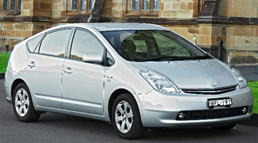
Toyota Prius 2. generation (FHEV)
3.5. Plug-in hybrid (PHEV)
- High capacity of the battery (Lithium or Ni-MH)
- Several kWh or several tens of kWh
- Voltage: several hundreds of Volts
- Traction battery of 200 - 400 V (Li), DC-DC converter, on-board battery of 12 V (Pb)
- Electric machine power: several tens or several hundrets of kW
- It drives the vehicle independently.
- Increases power and torque.
- Helps cover problematic areas of the ICE efficiency map.
- Covers torque generation delays from ICE.
- Purely electric driving
- Driving range: several tens of km
- Recuperation
- Battery recharging by
- external power supply (dominant)
- recuperation
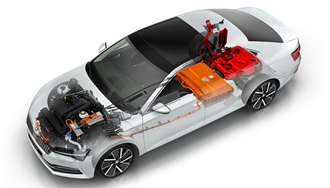
Škoda Superb iv
(PHEV)
Škoda Superb iv (PHEV)
- ICE: 1395 ccm, 115 kW, 250 Nm
- E-motor: PMSM, 85 kW, 330 Nm
- Traction battery: 13 kWh
3.6. Range extender (REEV)
- Similar to pure electric vehicles (BEV)
- The electric motor is the main drive, power of several tens or hundreds of kW
- Traction batteries of several tens of kWh, driving range of hundreds of km
- Charging from an external power supply (dominant) and by recuperation
- ICE for emergency use only
- Low power
- Driving at limited speed
- Often a serial hybrid
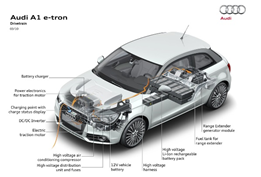
- ICE: Wankel, 254 ccm
- E-motor: 45 (75) kW
- Trakční baterie: 380 V, 12 kWh
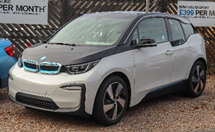
BMW i3 range extender
BMW i3 range extender
- ICE: 650 ccm, 25 kW
- E-motor: PMSM, 125 - 137 kW
- Trakční baterie: 18 - 38 kWh
https://www.autorevue.cz
3.7. Battery electric vehicle
- Traction battery of high capacity (dominant Lithium technology)
- Several tens of kWh
- Voltage: hundreds of V
- Typically 400 V (Li), DC-DC converter, 12 V battery (Pb)
- Electric motor power: several tens (several hundreds) of kW
- The only drive of the vehicle
- Purely electric driving only
- Driving range of several hundreds of km
- Recuperation
- Battery charging
- from external power supply (dominant)
- by recuperation
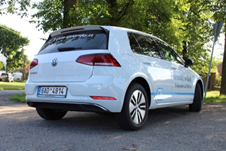
VW E-Golf (BEV)
VW E-Golf (BEV)
- E-motor: PMSM, 100 kW, 290 Nm
- Traction battery: 35,8 kWh