Consumption and driving range
| Sitio: | Moodle ZČU |
| Curso: | KEV/EMB Elektromobilita - podklady k výuce |
| Libro: | Consumption and driving range |
| Imprimido por: | Nepřihlášený host |
| Día: | lunes, 9 de noviembre de 2026, 06:07 |
Descripción
Consumption and driving range of electric cars.
1. Basic quantities
Power and energy
- Power: P = U*I [W]
- Energy: E = P*t [J], [Ws] (where P = const.)
- In the field of electromobility, kWh is given as a unit of energy.
- 1 J = 1 Ws = 1/3600 Wh = 1/3600000 kWh
Electric vehicle consumption
- The consumption of the vehicle is then given in kWh / 100km (or Wh / km) by analogy with vehicles with an internal combustion engine.
- l/100 km → kWh/100km
- standing car: l/h → kWh/h = kW (výkon)
- The driving range (km) of an electric vehicle is calculated as

Homologation
- Consumption and driving range are determined by measurements in laboratory.
- The braking force in the laboratory simulates the driving resistances of the vehicle.
- The technician follows the driving cycle during the measurement.
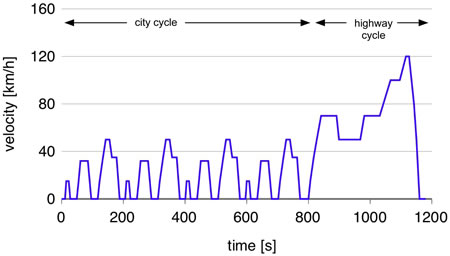
- The New European Driving Cycle (NEDC) was used in Europe
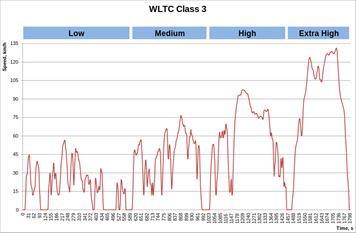
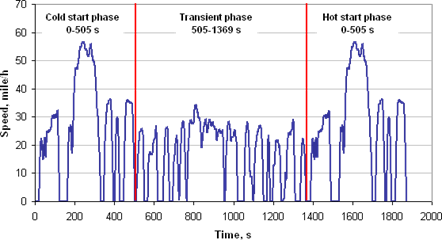
- Actually, WLTP (Worldwide Harmonized Light Vehicles Test Procedures) is a new standard.
2. Driving cycles
New European Driving Cycle (NEDC)
- This is a recently used driving cycle for determining consumption.
WLTP (Worldwide harmonized Light vehicles Test Procedures)
- This is the current standard driving cycle.
-
Power/weight ratio Pw (W/Tonne)
-
Class 1 - low power vehicles, Pw <= 22
-
Class 2 – vehicles, 22 < Pw <= 34
-
Class 3 - high-power vehicles, P > 34
3. Traction battery capacity
- Previously, the battery capacity of purely electric vehicles usually ranged from about 15 to 30 kWh, the normal range of such vehicles was about 80 - 200 km.
- Today, batteries> 30 kWh common, a normal range of hundreds of km.
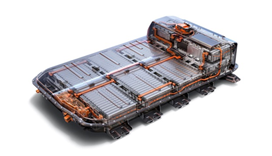
- Development of vehicles from the beginning as BEV → battery part of the car floor → increase the capacity of the traction battery
- Chevrolet Bolt: 60 kWh
- Tesla: up to 90 kWh (502 km NEDC)
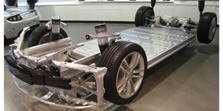
https://www.tesla.com
4. Indicative values of consumption and driving range
- The average annual consumption of a middle-class passenger car is around 20 kWh / 100 km (eg VW E-Golf).
Influence of temperature
- Consumption of electric cars increases significantly in the winter, mainly due to:
- increase in internal battery resistance,
- increase in comfort consumption (heating).
Middle class passenger electric car
- summer consumption: 11 – 18 kWh/100 km
- winter consumption: 24 – 28 kWh/100 km
The driving range of vehicles with traction batteries can be half that of winter!
5. Consumption measurement on the city ring
Consumption and driving range measurement on a selected city route depending on temperature (season).

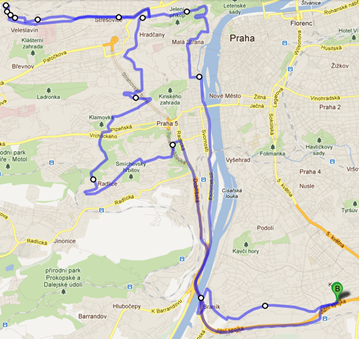
5.1. City circuit
- Capital city of Prague
- City circuit of 37 km
- Different route types and profiles:
- city circuit (Southern connection)
- city streets (numerous intersections or shorter columns)
- residential area (low speed, retarders)
- straight and hilly sections
- Average consumption: 18 kWh / 100 km (February - June)
5.2. Consumption dependence on temperature
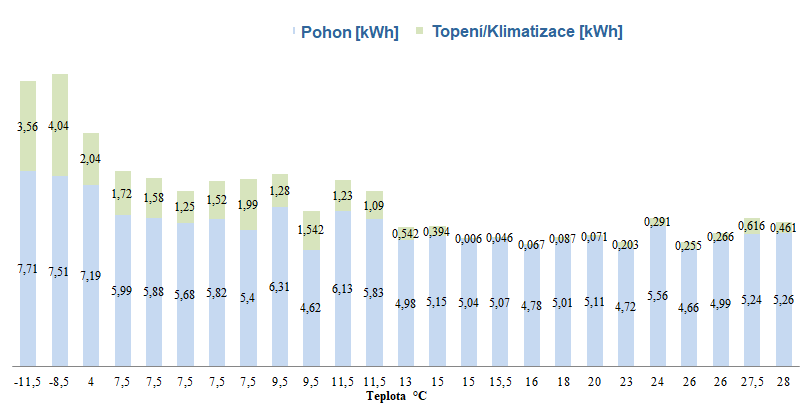
Dependence of drive energy consumption (blue) and comfort consumption (green) on temperature (kWh on urban circuit 37 km, nonlinear x-axis)
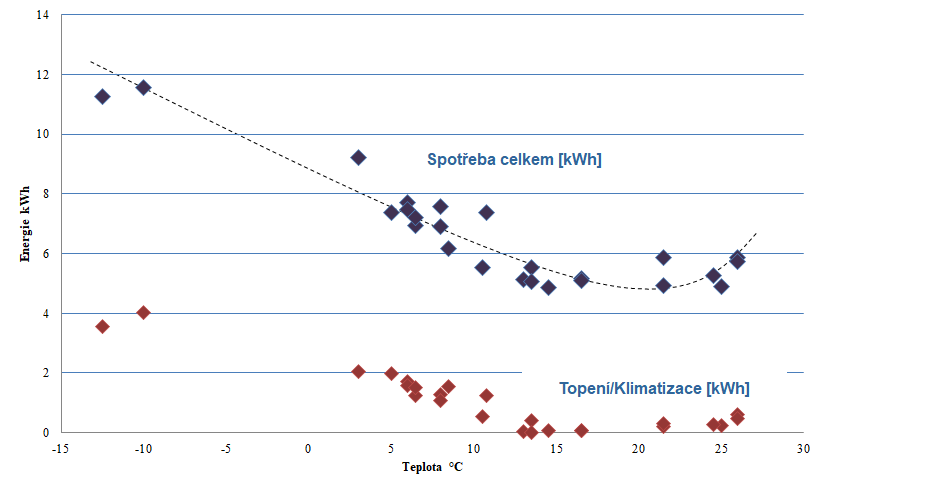
Dependence of total energy consumption (blue) and comfort consumption (red) on temperature (kWh on urban circuit 37 km, linear x-axis)
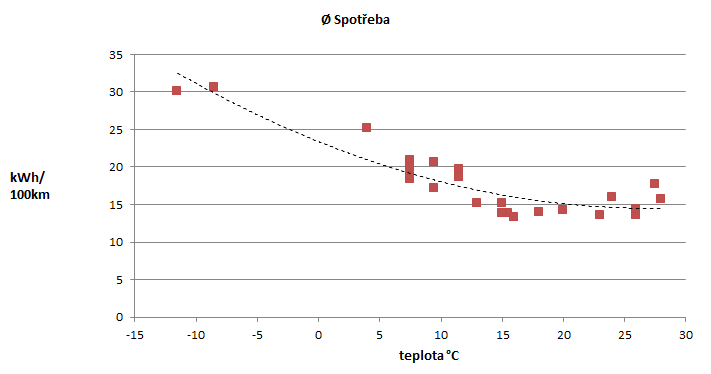
Total consumption as a function of temperature (converted to kWh/100 km, urban circuit 37 km)
Conclusion
- With each increasing temperature step, the car's consumption decreases by about 0.5 kWh / 100 km.
5.3. Driving range
Theoretical (recalculated from measurements) driving range (km)
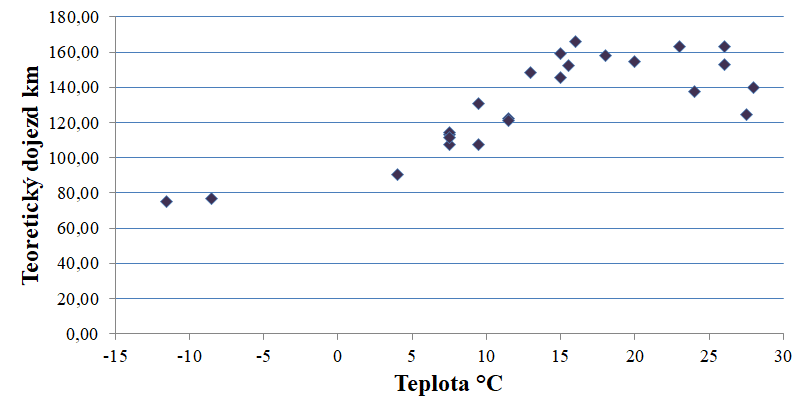
Temperature (°C)
Recalculated vehicle driving range depending on temperature
5.4. Recuperation
- The energy returned back by recuperation is the energy that recharges the battery during braking, when the electric motor is controlled as a generator.
- Recuperation significantly affects the resulting consumption and driving range, especially those rides with frequent braking and accelerations, i.e. mainly in city traffic.
- At low temperatures, the traction battery is more prone to cell disbalancing; the battery management system then limits the amount of charging current and the proportion of recuperation is lower in winter.
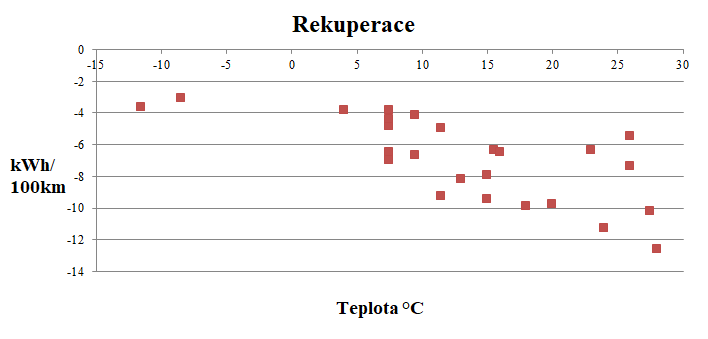
Temperature (°C)
6. Main factors influencing consumption
- Temperature
- Driving speed (aerodynamic drag)
- Car weight
- Comfort consumption
- Car aerodynamics
- Tire rolling resistance
- ….
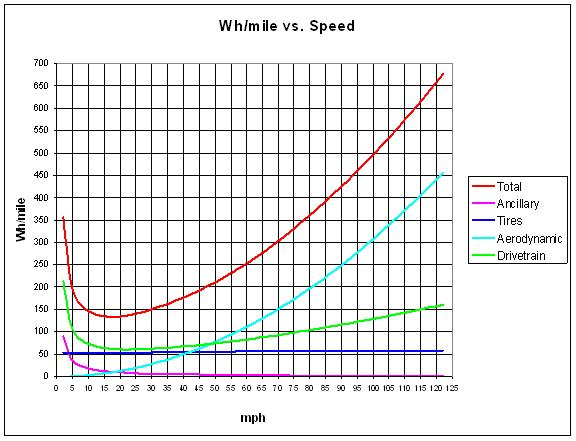
Electric vehicle consumption depending on speed
7. Comparison with cars with internal combustion engine
- Electric drives are highly efficient compared to drives with internal combustion engines.
- Diesel engine: max. 42%
- Petrol engine: max. 35%
- Electric drive: 75 - 92% in wide operation range
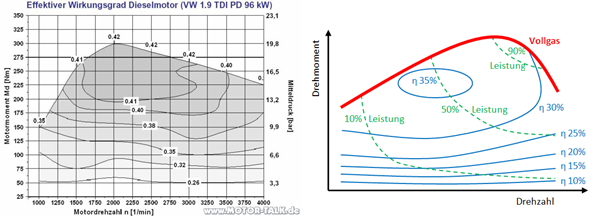
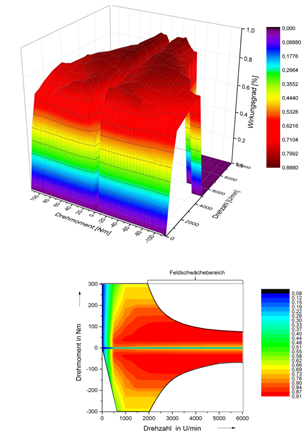
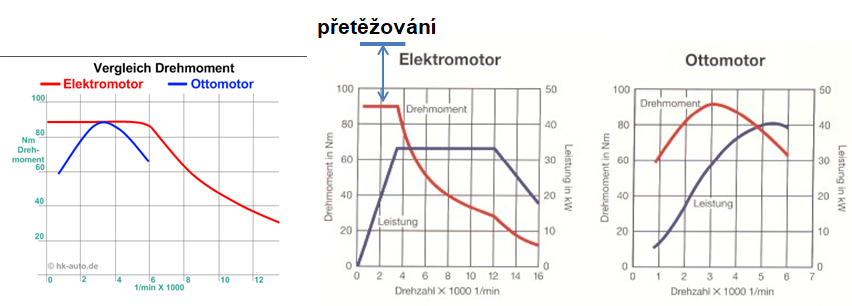
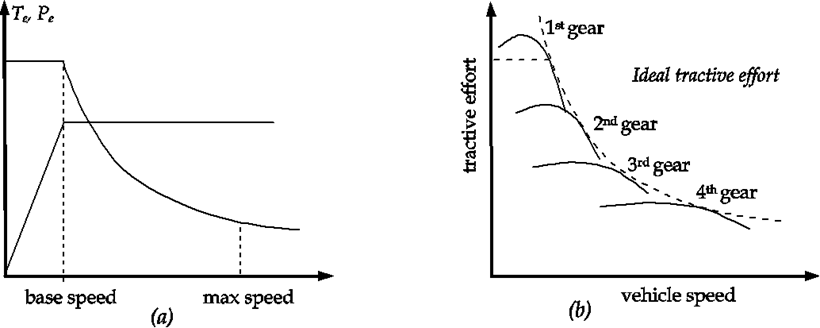
- Electric drives have a rated torque from zero speed.
- Electric motors can be overloaded for a limited time and thus significantly increase the maximum torque.
- The overload time depends on the warming time (windings, magnets).
- Air-cooled motors of the order of seconds, water-cooled motors of the order of tens of seconds.
de.wikipedia.org
hybridautos.info
https://www.gutefrage.net
https://monceau-automobiles.com
8. Driving economics
- The efficiency of an electric car per 100 km is approximately 85% (75% including charging losses).
- The efficiency of a car with an internal combustion engine per 100 km is approximately 20%.
- Thanks to electricity prices (absence of excise duty) and high efficiency of electric drive, the driving economy of electric vehicles is the most favorable of all types of drives.
- However, electricity prices are rising.

Example
- Consumption - middle class passenger car: winter 26 kWh / 100km, summer 14 kWh / 100km, average 20 kWh / 100km.
- At an electricity price of CZK 4 / kWh, the cost per 1 km of driving is based on:
- 1,04 Kč/km in winter,
- 0,56 Kč/km in summer,
- 0,80 Kč/km in average.
- At an electricity price of CZK 6 / kWh, the cost per 1 km of driving is based on:
- 1,56 Kč/km in winter,
- 0,84 Kč/km in summer,
- 1,20 Kč/km in average.
- However, the price of electricity may vary at public charging stations.
- Especially fast charging is problematic due to
- high losses,
- higher energy prices (9 up to 20 CZK / kWh).