Unit 8c Book
| Site: | Moodle ZČU |
| Course: | UJP/AEL6 Anglický jazyk pro Fakultu elektrotechnickou 6 - šablona |
| Book: | Unit 8c Book |
| Printed by: | Nepřihlášený host |
| Date: | Sunday, 8 November 2026, 4:33 PM |
Description
Start by going through the book. It will guide you through the unit material step by step.
1. Introduction
As the title suggests, Unit 8c is concerned with emergency situations, health hazards, hazardous materials management (HAZMAT) and warning labels, danger signs (diamond placards on vehicles), and panels (on vehicles) associated with them.*
According to the U.S. General Services Administration website, a hazardous material is defined as any item or chemical which is a "health hazard" or "physical hazard", including the following:
-
Chemicals that are carcinogens, toxic or highly toxic agents, reproductive toxins, irritants, corrosives, hepatotoxins, nephrotoxins, neurotoxins, agents that act on the hematopoietic system, and agents that damage the lungs, skin, eyes, or mucous membranes;
-
Chemicals that are combustible liquids, compressed gases, explosives, flammable liquids, flammable solids, organic peroxides, oxidizers, pyrophorics, unstable (reactive) or water-reactive; and
-
Chemicals that, in the course of normal handling, use or storage, may produce or release dusts, gases, fumes, vapors, mists or smoke having any of the above characteristics.
Usually, companies take the issue of occupational health and safety (OHS) very seriously because it is much easier and less expensive to take safety precautions than to deal with accidents resulting in severe injuries or even fatalities. In order to prevent these incidents, safety officers usually do the following:
-
Organize OHS training workshops for company employees;
-
Have company equipment analysed and inspected in terms of risks in accordance with valid national and EU standards;
-
Oversee if warning labels and danger signs are used both in workplaces and on trucks whenever hazardous materials are transported.
Unit 8c mainly deals with the third point listed above.
---
* Warning labels = warning information on items.
Warning/Danger signs = warning information on walls, for example, in a workplace.
Warning panels = warning rectangular signs usually with an ID number and used on vehicles.
Warning placards = diamond signs with warning symbols.
Contents
Vocabulary related to work safety.
Phrases introducing answers:
-
My answer is a strong YES: absolutely, definitely, without a doubt, certainly.
-
My answer is a strong NO: certainly not, definitely not, absolutely not.
-
My answer is partly YES and partly NO: yes and no, up to a point, to some extent.
-
My answer is slightly different from the one you are expecting: in fact, actually.
-
My answer is the opposite of the one you are expecting: on the contrary.
2. Listening
As explained in the introduction, Unit 8c predominantly focuses on the system of warning labels, danger signs and panels used on transport vehicles in the EU, US and other countries. First, you are going to see one of the many situations when warning signs are very helpful. Watch the video and complete this listening comprehension task.
3. Vocabulary: Warnings and Safety Instructions
Instead of using explanations or imperatives to warn about hazardous situations, warnings usually appear in the form of pictograms because these are understandable regardless of the language used. You can see some of them below. Do you know what they mean? Test yourself in this task. (Symbols downloaded from: https://echa.europa.eu/regulations/clp/clp-pictograms).
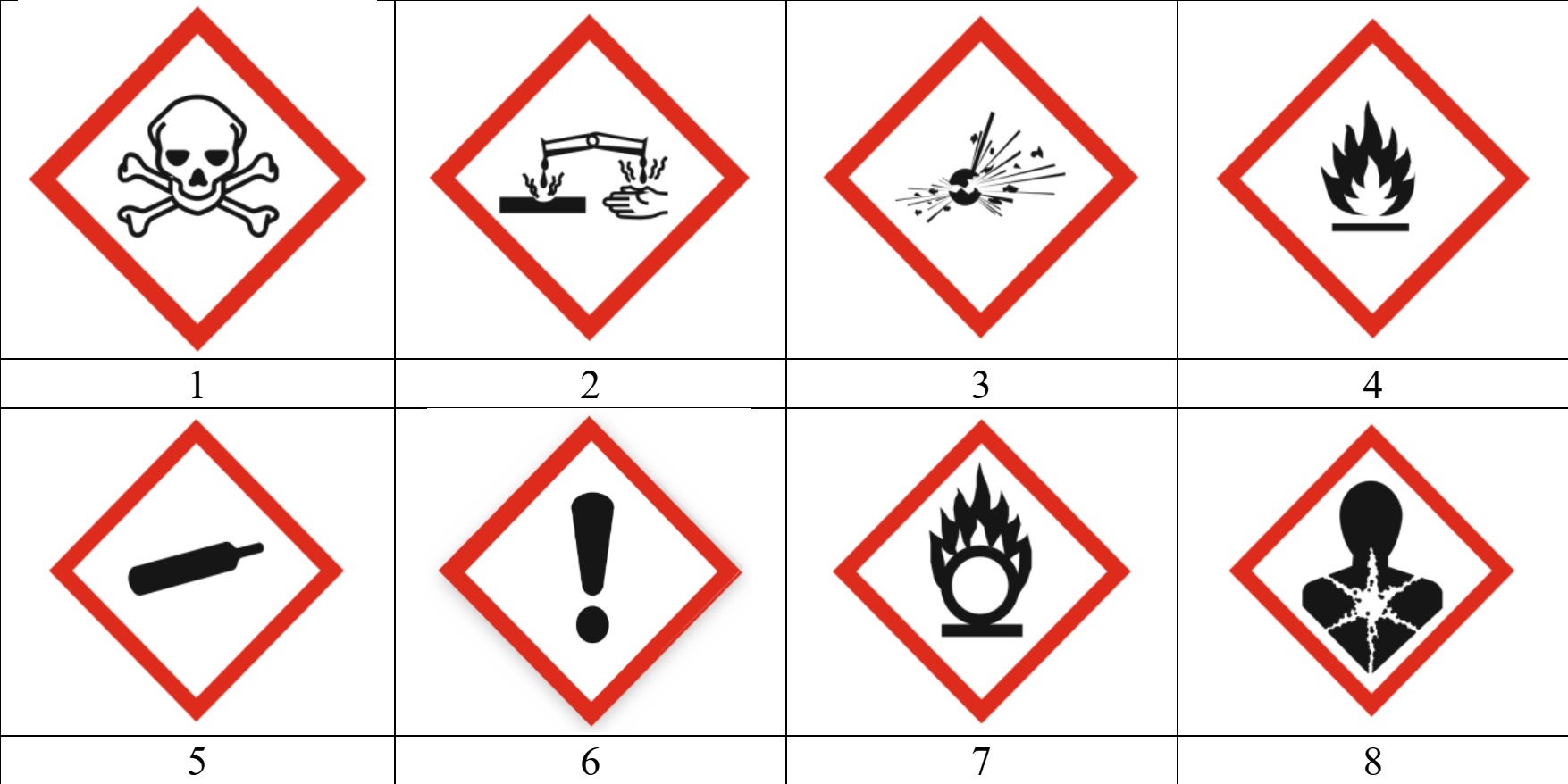
Imagine being put in the role of a safety officer. In addition to a mere recognition of the symbols in the previous task, you would probably like your employees to know exactly what the symbols mean, where they are used and how these hazardous materials should be handled and used safely. The table in this task gives this information. See if you can complete all the gaps in the table.
Now, how would the instructions from the previous task change if they were put in a written form as part of an OHS manual? Complete this task to find out. While doing this task, you will have an opportunity to revise the passive voice.
4. Reading about Warning Labels
The warning labels listed in the previous tasks are mostly used on packages containing hazardous substances. If these dangerous goods are transported, some more marking is required on all the transporting vehicles (lorries or trucks). There are three basic marking systems worldwide, as you can see in Task 1 on p. 62 of your book (Bonamy, D. (2013). Technical English Level 4 Coursebook. Pearson Longman). Read or listen to the transcript of a presentation on these symbols and answer the questions in this task.
In this text, you are going to learn more about the warning panels used on transport vehicles in the EU and UK. They are called ADR plates because these panels must conform to the European Agreement Concerning the International Carriage of Dangerous Goods by Road regulations. As you read, complete this reading comprehension task.
5. Questions and Answers
One of the previous tasks was to listen to or read a transcript of a presentation on warning signs. After this presentation, some listeners asked some questions. You can see them in this exercise. Your task is to turn them into indirect questions.
This follow-up task will tell you how the presenter answered the audience´s questions. In fact, you are only going to see how she introduced her answers, but these short phrases might sometimes be important. This is because, in a real conversation, they can help you understand what the speaker really thinks. In other words, they will help you understand the speaker´s stance.
6. Listening and Reading: Safety in Electrical Engineering
Of course, safety instructions and precautions used for electrical settings are slightly different from what is covered in this unit. To give you a typical example of an electrical safety issue, watch the video and complete the related listening comprehension task.
Can you explain what happened in the video above and why the worker was instructed not to move? Find out more in this reading comprehension task.
7. Word list
The key terms related to the topic of Unit 8c can be found:
-
in the Excel format here.
-
in the interactive flash card format here. This format is particularly good for drilling the new vocabulary.
-
in a zip file here. This file is downloadable, so that after unpacking it, you can drill the new vocabulary on your desktop, laptop or any other portable device where you have a browser installed. Important: after unzipping the zip file, make sure to keep all the related files in the same directory at all times. Do not change any file names and do not transfer or delete anything.
Recommendation: Remember that the best way to learn new vocabulary is to see each new word in a context; that is, step by step as you complete all the tasks in the unit.
8. A printer-friendly version of Unit 8c
A printer-friendly version of Unit 8c exercises and the key to these exercises can be found here.