Unit Five
| Stránky: | Moodle ZČU |
| Kurz: | UJP/AST5 Anglický jazyk pro Fakultu strojní 5 - šablona |
| Kniha: | Unit Five |
| Vytiskl(a): | Nepřihlášený host |
| Datum: | pondělí, 9. listopadu 2026, 16.53 |
Popis
Tasks for unit five.
Introduction
When visiting a company you might have to give someone some instructions on how to reach your office or you might get lost on the way. You also might have to be asked to describe a production process your visitor.In this unit you will revise and practice giving directions, and you will describe a production process.
Objectives:
After this unit you should be able to:
- used past simple active and past simple passive to describe the history of a company,
- use past simple passive or present simple passive to describe a production process,
- give directions.
Tasks and Dates
This unit consists of three tasks. In the first task you will read a text about the history of Škoda company and revise past tenses.Then you will revise some phrases used for giving directions and try to give directions yourself.
Finally, you will describe a production process.
To complete this unit you should go thought all activities. Contribute to all forums at least once. Go thought the quizzes.
Getting to a company
Reading. Before your visit, you have decided to find some information about the company. Read the short text about Škoda Holding history and answer the questions in the READING COMPREHENSION exercise.Škoda Holding started in 1859 when count Waldstein decided to transfer a part of the production from his ironworks and engineering shop in Sedlec to Pilsen. The original Waldstein workshops were located west of the city and produced steam engines, distillery, brewery and sugar refinery equipment, agricultural tools and other engineering equipment.
In 1866 Emil Škoda became the senior engineer of the workshops. He had a clear vision about the future development of the industry and therefore understood that it would be necessary to invest in the company, introduce new product lines and modernize the existing ones. The owner of the company Waldstein was not really enthusiastic about Škoda’s plans and in 1896 sold his company to him. Emil Škoda decided to invest in arms production and in 1884 he started building a modern steel works.
In 1890 an independent arms manufacturing division was established and in 1895 a new field gun was produced. The company became one of the biggest arms manufacturers in Europe. One year before Škoda’s death Škoda company, the family - owned business, became a joint stock company. The company produced more than just arms. Škoda works still manufactured steam engines, gas engines, mining equipment, food-processing machines, steel structures, and large and complex castings for the ship building industry.
Adapted from Škoda works in historical photographs by L. Nohovcová, P. Mazný and V. Krátký
Now look at the data below and write a paragraph about the further development of the company. Use the verbs from the list below. Compare your answers with the sentences in the HISTORY quiz.
become, establish, result, win, bear, implement, produce, make, acquire
 Do you remember Past Simple (active and passive)?
1904 – new product line – production of steam turbines
1907 – independent steam turbine research facility
Word War I – arms, heavy guns and Howitzers
1918 – collapse of the Austro – Hungarian Empire, company crisis
1920 – Electrial Engineering Company in Doudlevce
1923 – new Škoda trademark: a winged arrow in a circle
1925 – company Laurin and Klement part of Škoda concern
1927 – production of electric locomotives
1945 – bombing Škoda premises
1946 – national enterprise
1961 - the biggest export contract in the company’s history
1993 – privatized
Listen to the recording and complete the missing words. Click here to open the quiz.
You should remember:
Asking and giving directions:
Excuse me, …
Can you tell me how to get to …?
Go straight along here, until you get to ….., then turn left/right at the …. (go straight on) and it’s on your left/right, next to/opposite …
Giving direction when driving a car:
get on the motorway
go for 10 kilometers
take the left hand fork
get off the motorway at the next exit
roundabout
the road is signposted to Prague
Production process
Study the vocabulary from the list. Then check your progress the VOCABULARY QUIZ.Production process vocabulary list:
bulk - volně sypaný
scrap - šrot, staré železo
lance - přívodní trubka (na dmýchání kyslíku do pece),
to blow - vhánět, dmýchat, foukat
to charge - plnit, nakládat
eliminate - odstranit, vyřadit
lime - vápno, oxid vápenatý
slag - struska, škvára
ladle - licí pánev
to tilt - naklonit, naklápět
tip - špička, hrot, překlopení, převrácení
sampling - vzorkování, odběr vzorku
tapping - odpich surového železa
slagging - stahování, vypouštění strusky
teaming - odvoz na vozících
flux - tavidlo
to flux - přidávat tavidlo
pig iron - surové železo
molten iron - roztavené / tekuté železo
blast furnace - vysoká pec
basic oxygen furnace - konvertor, Bessemerův konvertor (Bessemer converter = basic oxygen furnace)
electric arc furnace - elektrická oblouková pec
Listening. After visiting Škoda Power you were interested in seeing the steel production process. Your host has arranged a visit to Pilsen Steel for you. Before the visit he explained the basic steel production process.
Listen to the recording and put the seven steps into the correct order.
Then complete the text. Use the verbs in brackets. When you finish check your answers in the BASIC STEEL PRODUCTION quiz.
First, scrap _________________ (charge) into the converter and then the hot metal ______________ (add). This _________________ (follow) by blowing with oxygen. After this fluxes ____________________ (charge) into the furnace. The melt _____________(test).
If the tests ____________(be) satisfactory, the melt _________________ (tap) and _______________(team).

Do you remember present simple passive?
Fill in the missing verbs in present active or passive. Use the verbs from the box. Then listen the recording in the LISTENING - BLAST FURNACE and check your answers.
blow, cause, flow, cool, know, charge, remove, collect
The blast furnace __________________ with iron ore, coke and limestone. Air ______________ in at the bottom of the furnace using bellows powered by a water wheel. The bellows _______________ the temperature in the furnace to rise up to 1300°C. Molten iron _______________at the bottom of the blast furnace, underneath a layer of slag. The slag ____________________ via a pipe and the molten iron _____________through a channel and into a bed of sand called a pig bed. Once it _____________, this metal _____________as a pig iron.
Describe the process of producing steel as if you are just walking around with your visitor. Use the diagram below. Use present simple (passive). Use sequencers: first, after that/this, then, finally … Publish your description in the STEEL PRODUCTION forum.
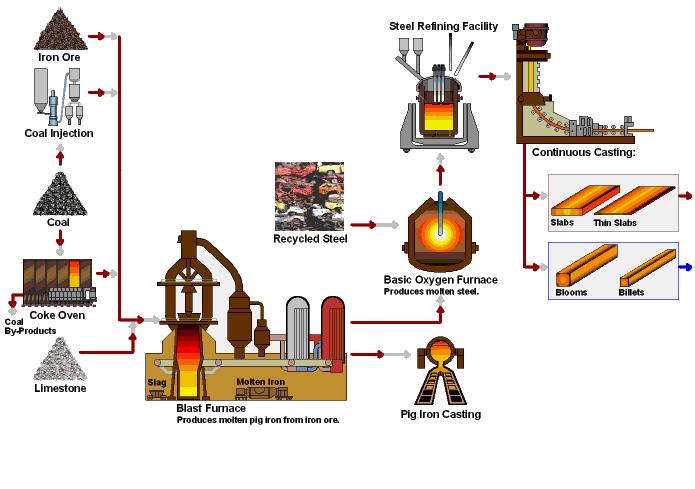
Downloaded from http://www.arinternational.net/about_steel.asp on 12.9. 2011