Unit 4a Book
| Sitio: | Moodle ZČU |
| Curso: | UJP/AEL5 Anglický jazyk pro Fakultu elektrotechnickou 5 - šablona |
| Libro: | Unit 4a Book |
| Imprimido por: | Nepřihlášený host |
| Día: | domingo, 8 de noviembre de 2026, 16:33 |
Descripción
1. Introduction
This unit will show you how phrasal verbs, i.e. verbs consisting of a verb and a particle, are used to sound less formal. Although most phrasal verbs have a one-word more formal synonym, you are very likely to come across them because in everyday life, informal speech is much more common.
Surprisingly, the context used to demonstrate phrasal verbs is not typically technical. Usually, technological innovations and achievements are used in practical applications, for example, to make something more effective, more efficient and less laborious. This is not the case of the machine discussed in this unit though. Considering its costs amounting to billions of dollars and the need for the cooperation of numerous countries, the absence of a practical application may be surprising. This largest and most powerful machine in the world is simply used to do just one thing: increase human knowledge. Scientists just use it to learn more about how the laws of nature work. This is sometimes called “pure research”. But, who knows? Maybe in the future, the machine will help the scientists to make significant discoveries which will find their applications later.
Contents:
- Phrasal verbs:
carry out (= conduct, do); put off (= postpone), use up (= finish it all), clean up (= clean sth completely), let out (= allow to escape), rule out (= eliminate), bring down (= lower), bring about (= cause), shut down (= close), set off (= trigger), keep down (maintain at a low level), take up (= consume), slow down (= decelerate), speed up (= accelerate), let in (= allow to enter), let out (allow to escape)
- Nouns derived from phrasal verbs:
to set up → setup, to melt down → meltdown, to build up → buildup, burst out → outburst
2. Context: Basic Facts
As you can see above, the introduction did not give you enough clues to guess what machine is used as context in this unit. Look at the pictures below to see if you can identify the machine. If not, don´t be sad; by doing this task, you will get enough information to be a 100% sure what machine is discussed. Be careful: the task is designed for you to practise scanning, which is one of the methods of speed reading. Therefore, unlike other tasks, this one has a time limit set.


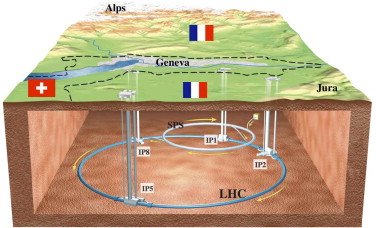


(Sources of pictures: livescience.com, nature.com, sciencedirect.org, universetoday.com, medium.com)
3. Listening: Inside the Large Hadron Collider
Now that you know some basic facts about the LHC, completing this listening comprehension task should not be so difficult for you. To watch the video, go here.
Although the video is a few years old, it is special because it will allow you to experience a 360 tour of the collider facility.
4. Listening and Reading: The Problem with the LHC
The final part of the previous listening indicated a problem with the collider. Now, you are going to find out more about it, including its causes. You can either listen to the recording or read Transcript 10 on p. 120 in your book ((Bonamy, D. (2013). Technical English Level 4 Coursebook. Pearson Longman). While doing so, complete this task.
5. Grammar: Phrasal Verbs and Nouns Derived from Them
Look back at the transcript from Section 4 above (transcript 10 on p. 120 in your coursebook). Read it carefully and find all phrasal verbs + all nouns derived from them. While searching for the phrasal verbs and nouns, complete this matching exercise. Your task it to match the two parts of phrasal verbs and verbs derived from them (small letters are used for phrasal verbs while nouns are CAPITALIZED. Finding all these words in the transcript is definitely going to help you to finish the task successfully.
Phrasal verbs are verbs consisting of two separate parts: a verb and a particle, e.g.: build up, set up. Nouns derived from these phrasal verbs then form one word consisting of two united parts: outburst, build-up, setup. Whether or not the parts need a hyphen depends on the natural development of the language. For example, the originally hyphenated word on-line is currently spelled without the hyphen: online. Clearly, the development of English is heading towards simplification. Read more about phrasal verbs in this grammar overview. This grammar overview explains why phrasal verbs are important and how they are used. However, it lists only phrasal verbs you can come across in this unit. You will have a chance to learn more phrasal verbs in the AEL6 course. Nouns derived from phrasal verbs will be covered in detail in the following unit – Unit 4b.
Almost all phrasal verbs have a one-word more formal synonym, e.g.:
Take the labels off. = Remove the labels.
Now read the article in Task 7 on p. 27 of your coursebook. It gives a detailed explanation of the problem occurring soon after the opening of the collider in 2008. You can see that there are lots of phrasal verbs in the text. Match them with their one-word synonyms listed in this matching task. Similarly, rewrite sentences in this task to give the same meaning, replacing the CAPITALIZED words and phrases with phrasal verbs listed above the task.
6. Your Turn to Write
Look at the phrasal verbs listed in the table of contents at the very beginning of this unit. Choose 8 out of the 16 phrasal verbs listed and write 8 full sentences illustrating the meaning of the phrasal verbs you have selected. Submit your sentences as a Word document here.
7. Word List
The key terms related to the topic of Unit 4a can be found:
- in the Excel format here.
- in the interactive flash card format here. This format is particularly good for drilling the new vocabulary.
- in a zip file here. This file is downloadable, so that after unpacking it, you can drill the new vocabulary on your desktop, laptop or any other portable device where you have a browser installed. The recommended one is Mozilla Firefox. Important: after unzipping the zip file, make sure to keep all the related files in the same directory at all times. Do not change any file names and do not transfer or delete anything.
Recommendation: Remember that the best way to learn new vocabulary is to see each new word in a context; that is, seeing it in the contexts provided in the tasks you complete in the unit.
8. A printer-friendly version of Unit 4a
A printer-friendly version of Unit 4a exercises and the keys to these exercises can be found here.