
Topic 12: Dead End?
Osnova sekce
-
-
- Hagmann, Tobias, Reyntjens, Filip, eds. Aid and authoritarianism in Africa: development without democracy. London: Nordiska Afrikainstitutet, 2016.
- Bodomo, Adams. The globalization of foreign investment in Africa: the role of Europe, China and India. U.K.: Emerald Publishing Limited, 2017.
- Hagmann, Tobias, Reyntjens, Filip, eds. Aid and authoritarianism in Africa: development without democracy. London: Nordiska Afrikainstitutet, 2016.
-
-
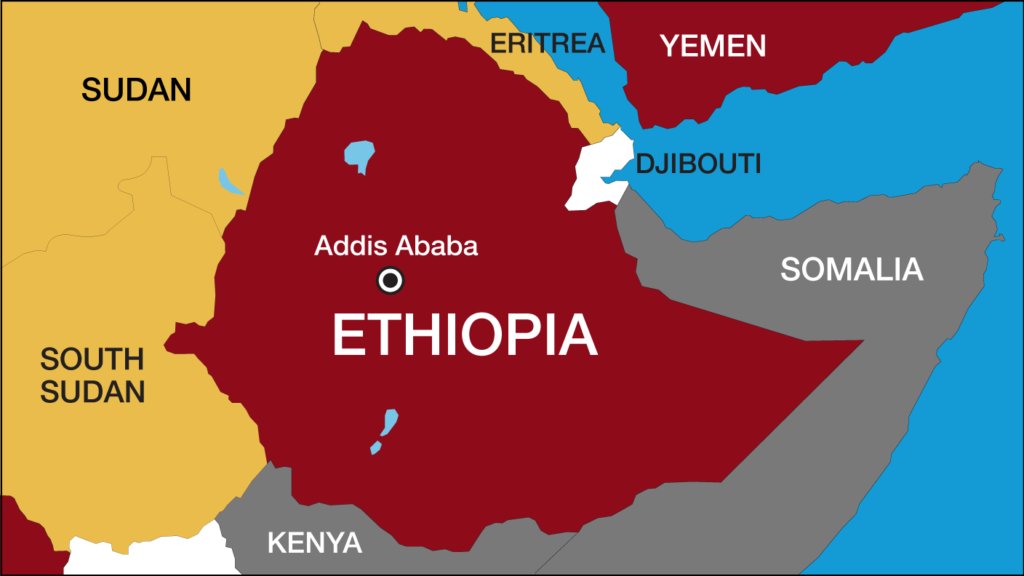
In last fifteen years, Ethiopia has become a synonym for economic growth in Africa. One of the fastest growing economies on the continent shows promising records in elevating poverty, growth of infrastructure, as well as improvements in educational sector. However, despite all these positive signs of development, the policy of developmental state in Ethiopia also shows significant limits in terms of human rights, social dialogue and democratization which can bring, and already brings visible challenges to the supremacy of the ruling party. Therefore, it is no exaggeration if we say that Ethiopia is a country full of multiple paradoxes and contrasts which, on the other hand, are more or less typical for developing economies around the world.
During the last half century, Ethiopia has witnessed three regimes that differed from each other in ideology, internal composition, ethnic and social policies as well as foreign policy. While the Imperial and Socialist Ethiopia were characterized by a high level of centralization, since 1991, a post-Socialist Ethiopia is characterized by its would promise of a new setting that was supposed to open the door for ethnic and religious equality, and some kind of decentralization so that the decision-making process would get closer to the people. The initial hopes and anticipation was great as Ethiopia was exhausted by the Eritrean war and groups which struggle the regime of Mengistu such as the Tigray People’s Liberation Front, Oromo Liberation Front, and many others. The two mentioned parties also played significant role in the political roundtable talks in 1991 and 1992, but failed to find a mutual understanding.
The Ethiopian Peoples’ Revolutionary Democratic Front (EPRDF) rules the country since 1991 after it was established in 1989 at the end of the war against the Derg. The Derg regime didn’t meet the needs and demands of Ethiopia’s diverse population in terms of ethnicity and religion. The federal constitution
For instance, Oromia and Somali regions show a significant level of inter-state conflicts which mostly derive from the fact that the boundaries are ill-defined and do not respect local realities. In the case of the Somali regional state, major conflict obviously take place along Oromia and Afar borders having historical roots going back to the Imperial times. One of those most visible places of conflict lies in the town of Moyale, on Ethio-Kenyan borders where both Oromia and Somali regional states’ claims are evident since the early 1990s. The dispute has brought severe challenges to Oromo and Somali groups with dual identities as ethnic identity at this place has become an instrument of inclusion and exclusion. In the case of Benishangul-Gumuz and Amhara regions, the border is still rather vaguely delineated but perhaps surprisingly no major conflict is seen over there while disputes between the former and Oromia regions are more tangible due to the history of relationship between Oromo Liberation Front and groups inhabiting the neighboring areas of what is now Benishangul-Gumuz. As the author discusses, OLF wanted to incorporate groups like Gumuz, Mao, and Komo into ‘independent Oromia’ as the so-called ‘Black Oromos’. Moreover, recent trend which involves bringing more Oromo farmers to Benishangul-Gumuz gives rise to disagreement and possible conflict between the two entities.
EPRDF Government
Since 1991, EPDF is ruling the country and due to rather fragmented, oppressed, and marginalized opposition, it has had no major rival since then. The political system of EPRDF is based on a strong control over the economy, and military. Federalism has not been developed to the extent which would allow a real decentralization, autonomy, self-rule and shared-rule. From 1991 to 2012, politics in Ethiopia were more or less synonymous with Meles Zenawi whose diplomatic skills are sometimes acknowledged even by critics of the regime. It was the late Prime Minister who came up with the concept of developmental state as the most useful for the development of Ethiopia.
Meles Zenawi’s vision was derived from South Asian economies including South Korea, Taiwan and China, each for a little different purpose. Meles Zenawi’s thesis on “African Development: Dead Ends and new Beginnings” rejected neoliberalism and stressed the necessity of government ownership of land. Ethiopia’s problems lie in the fact that only 17 per cent of population live in urban areas so the country has one of the biggest rural populations in Africa. Therefore, large parts of annual budget go to “poverty reduction programmes” that are divided roughly into three spheres including food security and agriculture, health and education, and infrastructure.
One of the main features of Ethiopia’s developmental state is construction of huge projects such as the railways, highways, hydroelectric dams, or, recently, the plan for the extension of the capital city known as Addis Ababa Master Plan. Ethiopia is a land of water and thus it is no surprise that by 2015 it will most probably be in possession of the largest operating hydro-electric facilities in Africa. The Great Renaissance Dam, as well as two Gilgel Dams on the Omo river, will become its latest suppliers of power, despite all the resulting costs, including the relocation of approximately 200,000 people in the area of the Omo Valley. However, construction of these infrastructural projects has not caused such antagonism and outrage as the already mentioned Addis Ababa Master Plan. The reasons why can be seen in local politics, ethnicity, nature of federalism in Ethiopia, and general frustration of especially younger generation that sees no future in Ethiopia. Another difference between these huge projects and Addis Ababa Master Plan is the government’s effort to demonstrate to the world and the political opposition that there was overwhelming support emanating from “ordinary” people for the construction of giant projects such as hydroelectric-dams which thus in a certain sense form a part of national identity. Addis Ababa Master Plan, due to its local meaning and ethnic consequences lacks this real or alleged public support. In this article, I will address the interrelated issues of land, social frustration, and ethnicity that lie behind the politics and seriously affect fragile political climate in Ethiopia with possible serious connotations for the future development in a country that is at the same time an important ally of the USA and the West in the fight against terrorism and relatively stable actor of the Horn of Africa. The main two features of recent political turmoil in Ethiopia, according to my opinion, are the clashes of two different perspectives, the developmental concept on one hand, followed and articulated by the government, and the social and ethnic equality concept formulated by the protestors.
The end of the Cold War brought significant change to the Horn of Africa with the fall of the Somali and Ethiopian governments and military coup in the Sudan. A wave of democratization swept over most parts of Africa (with varying outcomes) and Ethiopia was not different. The Derg the regime (1974-1991) was not able to react effectively, despite enormous military assistance from the Soviet Union, to the more and more coordinated strategies of regional liberation fronts, primarily the Tigrayan and Eritrean insurgencies. It was mainly the Tigray People’s Liberation Front (TPLF), that felt the need to establish an all-Ethiopian party that would not bear any ethnic affiliation in its name. Thus, in 1989 the Ethiopian Peoples’ Revolutionary Democratic Front (EPRDF) was born under the supremacy of the TPLF and included several minor parties. The early transitional period in Ethiopia was marked by more or less a promising and democratizing environment in which all major parties and organizations that had fought against the previous regime took part. Very soon, Ethiopia began to come under the rule of the EPRDF, or better to say TPLF/EPRDF that based the future of Ethiopia on the idea of ethnic federalism and the concept of developmental state. However, attempts to promote a true federal system failed as the state began to be fully controlled by the EPRDF and did not include a genuine self-rule and shared-rule system.
Inequality and unequal access to basic rights, needs and demands, as well as citizenship, combined with the newly found hegemonic rhetoric from the emerging EPRDF regime, characterized the period after 1991. The rise of nationalist movements and the politicization of ethnicity and national identity became increasingly evident during the Oromo Liberation Front (OLF) – the TPLF crisis in 1992-1994, after which OLF was forced to leave the country, and especially during the war with Eritrea (1998-2000) when ‘Greater Ethiopia’ nationalism re-emerged, even though former cadres of the EPRDF had been fighting against this for many years during the Mengistu regime.
The weakness of latent democratization was fully uncovered during and after the 2005 elections, which eventually resulted in the suppression of the opposition politicians, journalists, and students who were calling for the introduction of democratic processes into the political system. One of the few moments in the history of Ethiopia when civilians and politicians were more or less able to freely express their opinions ended up in kind of a ‘normalization’ period, during which the EPRDF did everything to ensure that the same situation never occurred again. After 2005, the EPRDF government focused its attention even more on ‘external issues’ so as to divert the attention of the Ethiopian and international public away from the internal actions it was taking against all forms of opposition to the regime. At the same time, the developmental policy, based on construction of infrastructure, huge condominiums, and foreign investors to get access to land and business was on the rise but it was evident that the fragile ‘social contract’ would not last long. Manipulated elections of 2010 and the death of Meles Zenawi two years later in a certain sense ended the twenty years of post-Derg development and the ruling EPRDF had to define its position within the political system. The inauguration of Prime Minsiter Hailemariam Desalegn was welcomed by some but criticized by many as in reality the EPRDF politics was fully controlled by the men from behind, a group of Tigrayan advisors that have been the true decision-makers.
Developmental State: Theory and Practice
the current political turmoil can be examined as a clash of two perspectives, the developmental state (or modernization) perspective and social and ethnic equality perspective. While the government focuses on modernization of the country no matter what the cost, public protests and resentment are based in unresolved social and ethnic issues. In this part, let us focus on three interlinked aspects of the political crisis that can help us explain the Oromo protests.
The first one and probably the most important is the land issue which is now also associated with the Addis Ababa Master Plan. In modern and recent history of Ethiopia, better to say never in history of Ethiopia the land was a property of farmers. It means that throughout the last three regimes, the Imperial, Socialist, and federal, the land issue remained more or less unchanged and deprived farmers to free access to land. This not only continues to keep the land intact by any modernization and mechanization but also keep farmers in the state of dependency on the government. As some Oromo people say, the situation in Ethiopia can be described as a change from the “Land to the Tiller” slogan during the Derg years to the “Land to the Investor” in contemporary Ethiopia where an individual farmer is not part of a decision-making process and can be removed in the name of “development policy”. Land is not only a common property of the nations, nationalities, and peoples of Ethiopia, but in combination with state arrogance and domination of one ruling party, there is little space for farmers to develop their livelihood. Individuals in Ethiopia are, therefore, “declared perpetual tenants of the state.” In previous years, Ethiopia became known for large scale land investment projects known as “land-grabbing”. The agricultural sector in general has failed to meet the needs and demands of the population and is facing severe problems despite the government’s seeming tendency to modernize the economy. Despite government’s efforts to implement various programs targeting sustainable development, serious droughts are affecting millions of farmers and pastoralists in 2015 and 2016. Addis Ababa Master Plan is viewed by the Oromo protestors as an attempt of the government to grab the land of the Oromo people in order to marginalize them even more. The governmental position, publicized frequently in the media, follows the developmental or modernization path arguing that the Oromo people will benefit from the enlargement of the capital city. While the government officials stressed the benefits of surrounding towns of Addis Ababa such as Burayu, Sabata, Sululta, and many others from being connected with wider Addis Ababa urban scheme, Oromo activists and observers were concerned about government’s systematic strategy of incorporation of Oromo towns into Addis Ababa.
The second issue is the socio-economic situation because despite the seemingly impressive economic development since the beginning of the 21st century, Ethiopia has not been able to offer any prosperous future to its younger generation, especially the university graduates who very often remain unemployed and frustrated because their expectations have not been fulfilled. This “no future generation” stands at the forefront of recent and future protests and changes in the country because the demand for better paid jobs and relevant employment will is and will be the main factor of mobilization against the government. Their bare crossed hands gesture became almost immediately a symbol of the protests and began to spread on the social media.
The third issue is the ethnic issue as the Oromo people claim they have been marginalized, if not oppressed by three consecutive regimes ruled by ‘Northerners’. Recent protests against the Addis Ababa Master Plan and against government show that the Oromo people lost any kind of trust in the EPRDF government as well as in the OPDO party that is ruling Oromia under the shelter of EPRDF. The long-lasting combination of ethnic, social, and economic factor has now resulted in protests against the government after the Addis Ababa Master Plan was proposed.
One of the ways how the government has reacted on the Oromo protests was to place the federal police units within university campuses. This was the case of Jimma University in the time of my visits there in spring 2016. The staff of the university has had no control over where the policemen would be placed. Any kind of doubt or question regarding their presence at the university campus would have serious consequences and would be labeled as anti-democratic or even terrorist. Military and police presence at the university campuses throughout Oromia only support persuasion of many Ethiopians that the university campuses are here to serve the armed forces in case of troubles as they are well equipped with everything that the army might need. Generally, the anti-terrorist rhetoric has become a frequent part of government statements against any kind of opposition movements or protests. The visit of President Obama in Ethiopia in July 2015 gave this rhetoric a certain approval, at least in the eyes of many Ethiopians, not only Oromo people. Lack of international attention given to the Oromo protests and mounting number of dead and even greater number of imprisoned and ‘disappeared’ can be explained by the fact that the protests are limited to Oromia region and are held peacefully, therefore the number of victims has not been so high to attract attention of Western media to the extent as they would deserve.
It is thus no surprise that the main feature of current situation is fear and lack of willingness to speak about politics at all. However, fragile social situation has led to more or less another unprecedented act which was the strike of taxi drivers in Addis Ababa due to the new law that came to existence at the end of February 2016.
-
Use the text on Ethiopia above to discuss the advantages and disadvantages od devlopment state, development aid and centralized economy. Be ready for discussion the class. Use as many available sources as possible for your analysis.
-