Unit 1c Book
| Website: | Moodle ZČU |
| Kurs: | UJP/AEL5 Anglický jazyk pro Fakultu elektrotechnickou 5 - šablona |
| Buch: | Unit 1c Book |
| Gedruckt von: | Nepřihlášený host |
| Datum: | Sonntag, 8. November 2026, 23:27 |
Inhaltsverzeichnis
- 1. Introduction
- 2. Unit 1c Forum
- 3. Revision: The Function
- 4. Laser Light vs. Ordinary Light
- 5. Basic Components of a Laser
- 6. Explaining a Principle: How a Laser Works
- 7. Your Turn to Write
- 8. Presenting Lasers
- 9. Technical Collocations
- 10. Revision
- 11. Word list
- 12. Printer-friendly version of exercises + key to exercises
1. Introduction
Every now and then, a scientific breakthrough occurs that has a revolutionary impact on daily life. One example of this is the invention of a system for light amplification by stimulated emission of radiation. Few people realized at the time of its invention that it would prove to be such a useful (and lucrative) device, but it ultimately launched a new scientific field and opened the door to what is today a multi-billion dollar industry. Today, the system is ubiquitous in the commercial marketplace, used in CD players, corrective eye surgery, tattoo removal, industrial assembly lines, supermarket scanners, optical communications, and optical data storage. The system is well known under its abbreviated name. Do you know this abbreviated term? If not, continue to read the following paragraph copied from https://www.aps.org/publications/apsnews/200312/history.cfm to get some hints.
The principle of the device dates back to 1917, when Albert Einstein first described the theory of stimulated emission, but the practical device has its roots in the 1940s and early 1950s, particularly in the work on microwave spectroscopy – a powerful tool for discovering the characteristics of a wide variety of molecules – by physicists Charles Townes and Arthur Schawlow. Townes realized that the wavelengths of infrared and optical light, because they were shorter, would be powerful tools for spectroscopy. Schawlow came up with the idea of arranging a set of mirrors, one on each end of the device's cavity, to bounce the light back and forth, thus eliminating the amplification of any beams bouncing in other directions. Eight months later, the two men wrote a paper on the proof of concept for their work, published in the December 1958 issue of the Physical Review (Vol. 112, No. 6, pp. 1940-1949), and received a patent for the invention of the system two years later. Still, while Townes and Schawlow are the names most often associated with the invention because of their 1958 paper and subsequent patent, numerous others made vital contributions. Perhaps that is why the question of who really invented the system has proven to be a fairly litigious one. (…)
Now, you should know that the text talks about a laser. This device will provide context in this Unit through which you will practise describing the working principle of a device and its functions, which is a vital skill for a future professional engineer. In addition, you are going to learn and use some useful presentation phrases used to make your explanations as clear as possible.
Contents:
Unit 1c revises and introduces some grammar points and signposting phrases used to give a presentation to describe how a system or machine works:
- Describing how something works using the Present Simple tense
- Describing functions of a device: to be used to/for/in/during
- Collocations (= set expressions), for example, a laser beam, a field magnet
- Presentation phrases, for example: Let´s move on to the next section. Now, I am going to hand over to…
2. Unit 1c Forum
This forum is going to cover the three basic topics Unit 1c deals with, i.e. lasers and their use and technical principle, technical collocations and giving presentations.
- What are lasers used for? Where? While answering this question, try to be as specific as possible, listing as many uses of a laser as possible.
- Like many other technical fields, the domain of lasers has generated lots of technical vocabulary and collocations (i.e. set expressions consisting of words that often occur together). Sometimes you may know these technical terms in Czech, but what if you need to use the technical term in English but don´t know the correct translation? Do you use a conventional bilingual dictionary, monolingual dictionary, translator, online dictionary or other websites? How exactly do you search for the term?
- Have you ever given a presentation? If so, was it in Czech or in English? What was it about? Was everything OK, or were there any problems? Are there ways to make a presentation more understandable for the listeners? List some tips.
Answer these questions in this forum.
3. Revision: The Function
Before talking about the principle of a laser, let´s revise some good phrases used to describe its function. First, complete this grammar overview and then practise the material by completing this gap-fill task. Finally, watch the video to see one of the many laser applications. Complete this listening task as you watch it.
4. Laser Light vs. Ordinary Light
How does laser light differ from ordinary light? First, complete the overview in this task and then read about laser light in more detail here. The text is taken from an American source, so the American English spelling is used, for example, AE: color, whilst BE: colour). Differences in vocabulary may also occur, such as AE: flashlight vs. BE: torch).
5. Basic Components of a Laser
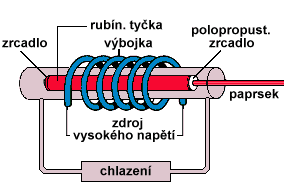
Look at the picture on p. 9 in your book (Bonamy, D. (2013). Technical English Level 4 Coursebook, Pearson) to see what components a laser consists of. Label the individual parts by completing this task. After you finish, compare your answers with the Czech labels in this diagram downloaded from: https://www.cez.cz/edee/content/microsites/laser/obr/ruby.gif.

6. Explaining a Principle: How a Laser Works
Now that you know what a laser consists of, it is time to find out about its principle. To get to know how a laser works, complete the text in this task by choosing the correct option from the drop-down list.
After you finish and check your answers, focus again on the words you used to complete the text. You can see that some of them are sequencers indicating the order in which something happens, thus making the explanation more understandable. Some of them are expressions showing cause-effect relationships, which are crucial for explaining the technical principle. And, most importantly, the verb tense used to explain how a machine or a system works is the Present Simple tense. The reason is logical: when talking about a principle, you explain something which remains unchanged and is always true. If you think you need to revise the Present Simple tense, download its grammatical overview here.
Based on the tasks you have completed so far, how would you sum up what you have learned about an effective way of describing a machine or a principle? Well, it is a good idea to follow a kind of outline: after specifying the name of the machine/system and perhaps referring to its diagram, you should explain what the machine/system is for; in other words, what its function is. This information on the importance of the system/machine provides readers (or listeners) with a hook giving them a reason for either reading on or continuing to listen to your presentation. After that, a list of its components should follow; if need be, supplemented with the location of the parts and the way they are attached or mounted. Once your reader/listener is aware of the machine/system parts, you can start talking about the technical principle of the machine/system, using the Present Simple tense, sequencers and appropriate cause-effect expressions. You can see the outline for describing a machine or a system here. If you feel that a simple outline is not enough for you, you can download its extended version here.
7. Your Turn to Write
Now it is your turn to describe how a device works. To make the task a bit easier for you, look at this document, which gives descriptions of two devices that both use a laser beam: a CD player and a laser printer. The document talks about both these devices in a mixed-up text. First, separate the two texts and then choose one of them to describe the principle of either a CD player or a laser printer in your own words, following the outline for describing a machine. To submit your text, click here.
8. Presenting Lasers
Sometimes explaining something in writing may not be enough. Sometimes you may need to describe the principle of a machine or a system in an oral presentation. Do this task to see the main differences between a written and oral explanation given as a presentation.
While completing the task, you will see that in order to deliver a high-quality presentation, you need to: (1) introduce a visual before talking about it in detail, and (2) use signposting phrases. By using these transition phrases, you just indicate to your audience that you are going to comment on your following slide.
Now it is your turn to give a short three-minute presentation based on your essay from the previous task. This means that you will talk either on the principle of a laser printer, or explain how a CD player works. If you need more presentation phrases to complete the task, download this document. Submit your presentation as a video here. Remember that your file should not be bigger than 40 MB.
9. Technical Collocations
The word “laser” is often part of technical collocations, for example: a laser beam, a laser pointer, a high-precision laser, and so on. Sometimes, the word “laser” can be used as an adjective, for instance, in a laser spectrometer, laser technology, and the laser industry. As you can see, collocations are set expressions of words that frequently occur together to form a phrase which is felt to be a unique technical phrase. This means that if you need to look up such a phrase in a dictionary, you should NOT look for each of the two words separately, but rather find a dictionary that provides a list of these collocations. In reality, you will hardly ever be successful: most dictionaries do not have such a collocation section. Although some online collocation dictionaries exist, for example, on link, they only cover general English, not technical English. Therefore, a much more effective way is to come up with a tip on the correct collocation and google it using quotation marks. If the number of hits is in the order of millions or hundred thousands and if the collocation is used in technical contexts written by native speakers, you can be a hundred percent sure it is correct. On the contrary, if there are only a few hits or none at all and Google displays results of a search without the quotation marks, you can be a hundred percent sure that your tip was not correct. However, if you look at the results for the collocation without the quotation marks, you should get an idea of the correct collocation. Then you should just take this new tip, put it in quotation marks and repeat the googling process to see whether this new tip is correct. Now try Task 1, Task 2 and Task 3 focusing on collocations.
10. Revision
Finally, try this task to see what you remember about lasers. The task is more challenging, requiring a good grasp of English vocabulary and grammar.
11. Word list
The key terms related to the topic of Unit 1b can be found:
- in the Excel format here.
- in the interactive flash card format here. This format is particularly good for drilling the new vocabulary.
- in a zip file here. This file is downloadable, so that after unpacking it, you can drill the new vocabulary on your desktop, laptop or any other portable device where you have a browser installed. The recommended one is Mozilla Firefox. Important: after unzipping the zip file, make sure to keep all the related files in the same directory at all times. Do not change any file names and do not transfer or delete anything.
Recommendation: Remember that the best way to learn new vocabulary is to see each new word in a context; that is, seeing it in the contexts provided in the tasks you complete in the unit.
12. Printer-friendly version of exercises + key to exercises
A printer-friendly version of Unit 1c exercises and the keys to these exercises can be found here.