Unit 7b Book
| Stránky: | Moodle ZČU |
| Kurz: | UJP/AEL6 Anglický jazyk pro Fakultu elektrotechnickou 6 - šablona |
| Kniha: | Unit 7b Book |
| Vytiskl(a): | Gast |
| Datum: | pondělí, 9. listopadu 2026, 05.40 |
Popis
Start by going through the book. It will guide you through the unit material step by step.
Obsah
- 1. Introduction
- 2. Revision: Comparatives and Superlatives
- 3. Making Comparisons and Contrasts Using Adjectives, Nouns, Verbs, and Adverbs
- 4. Comparison vs. Contrast
- 5. How Not to Confuse So Many Comparison and Contrast Expressions
- 6. Forum: Touch Screens
- 7. Two Types of Touch Screen
- 8. Resistive vs. Capacitive Touch Screens
- 9. Most Popular Types of Touch Screens
- 10. Writing: Comparison and Contrast Essay
- 11. Word List
1. Introduction
Unit 7b deals with comparing and contrasting things or phenomena. Comparing and contrasting is a very important skill, as to a certain extent, our life is based on choice. Very often, we need to weigh alternatives, evaluate them and choose or recommend the most appropriate one for a particular purpose. We usually do this by measuring the alternatives or items against some criteria such as quantity, and cost. And this is where comparison and contrast phrases are used. In this unit, you will first revise some basic ways used to compare and contrast. Then, more complex phrases for comparison and contrast will be introduced and used in technical contexts.
Contents:
Unit 7b revises some basic phrases to make a comparison or contrast. In addition, it introduces some other ways to compare and contrast:
-
Comparative and superlative adjectives: (much) cheaper than..., the greatest, more reliable, the most expensive, best of all.
-
Connectives: although, whereas, while, however.
-
Other expressions: differ, difference, similar to, different (from/than/to), in comparison with/to, like/unlike, instead of, on (the) one hand, on the other hand, compared with.
2. Revision: Comparatives and Superlatives
Imagine you would like to buy a new car. Which criteria would you use to choose the most suitable for you? As you can see in this table, four criteria have been chosen: price, fuel mileage, number of cylinders and overall dimensions. These cars have been compared/contrasted in this task, using the criteria mentioned above. Complete the task by using suitable/appropriate comparatives and superlatives of the words given in brackets. Using comparatives and superlatives is the basic method of comparing and contrasting things. If you think you did not do well in the task above, look at this grammar overview.
3. Making Comparisons and Contrasts Using Adjectives, Nouns, Verbs, and Adverbs
In addition to adjectives, other word classes can also be used to make comparisons; namely nouns, verbs and adverbs. Revise some of them in this gap-fill task.
4. Comparison vs. Contrast
As you can see, there are numerous comparison and contrast phrases. Basically, they can be categorized according to their meaning and in terms of grammar. If grouped by meaning, we distinguish between comparison expressions, which are used to describe similarities, and contrast expressions, which are used to talk about differences. Test how many of these expressions you know by doing Task 1 and Task 2, which ask you to distinguish between phrases used to express comparison and contrast. After you finish these two quizzes, make sure to do Task 3 and Task 4, in which you are going to see the same expressions in the context of full sentences. Notice that the same idea can be expressed by using a variety of comparison or contrast expressions.
5. How Not to Confuse So Many Comparison and Contrast Expressions
In the previous section, the phrases were categorized into two groups depending on their meaning. Basically, comparison expressions are used to talk about similarities, while contrast words and phrases express differences. Lexically, both comparison and contrast expressions also differ in their level of formality. For example, "however" is considered more formal than "but", which is more informal.
Grammatically, comparison and contrast phrases fall into several categories based on their word class. They can function as connectives, verbs, nouns, adjectives, or adverbs. To a certain extent, the word class influences the position of comparison/contrast expressions in a sentence and their associated punctuation, as you can see in the previous exercise:
A... , but B... - Chrysler has a roof luggage rack, but Ford doesn’t have one.
A... . However, it (A)... - Chrysler has a roof luggage rack. However, it is not very big.
A... ; however, it (A)... - Chrysler has a roof luggage rack; however, it is not very big.
A… . B, however,… - Chrysler has a roof luggage rack. Ford, however, doesn’t have one.
Surprisingly, the position of comparison/contrast expressions in a sentence is very often the same in Czech and in English. Therefore, with compare/contrast expressions, it is worth remembering their Czech meaning precisely, as the meaning will help you to position a compare/contrast expression in a sentence correctly.
You can find a list of comparison and contrast expressions here. On the first two pages of this document, comparison/contrast expressions are sorted out according to their lexical meaning, while on page three, they are categorized based on their grammatical meaning + the associated punctuation is indicated. Do not feel overwhelmed by seeing so many comparison and contrast expressions and do not try to memorize them just by looking at this list. Instead, use this document while doing the following technically-related tasks and highlight the expressions you come across.
6. Forum: Touch Screens
After having revised some basic comparison and contrast phrases in a general context, it is time to use these expressions in a technical setting. Look at the following picture and answer the following questions in the Forum.
-
Have you experienced a disaster like this?
-
Are there any quick fixes that might help?
-
Why can´t we operate a smartphone while wearing gloves?
-
In your opinion, what type of touch screen is best?

Picture from: https://pxhere.com/cs/photo/833175 (Creative Commons)
7. Two Types of Touch Screen
Look at the two diagrams below, which depict the two types of touch screen that are covered in the book. Which of them is resistive and which one is capacitive? How many metallic layers does each screen have?
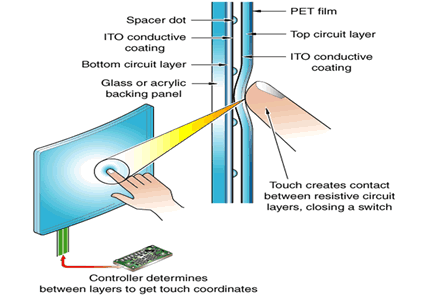
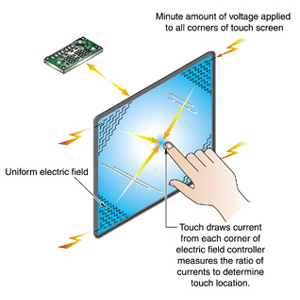
Pictures downloaded from:
http://bhushan-surve.blogspot.com/2015/02/resistive-and-capacitive-touch-screen.html
and
https://scienceline.org/wp-content/uploads/2011/12/capacitive_electrotest2.gif
8. Resistive vs. Capacitive Touch Screens
Now, your task is to find out more about these two types of touch screen. First, listen to or read the transcript on pp. 122-123 in the coursebook (Bonamy, D. (2013). Technical English Level 4 Coursebook. Pearson Longman.). Identify the seven criteria according to which the two touch screens are compared and contrasted and complete this task.
Then read more about these two types of touch screen. Fill in all the gaps in the text while reading.
9. Most Popular Types of Touch Screens
Of course, there are more types of touch screens than just the capacitive and resistive ones. First, read this product comparison report on the infrared and surface acoustic wave touch screens. As you read, complete all the related tasks. Finally, watch the video which summarizes the key features of all the touch screen types mentioned in this unit.
Complete this listening comprehension task as you watch. This time, you are going to listen for detail.
10. Writing: Comparison and Contrast Essay
Now, it is your time to compare and contrast. Your task is to compare and contrast two technical systems in a minimum of 300 words. For example, you can compare and contrast two types of motor, means of transport, printer, power plant, electrical circuit or anything else. It really doesn´t matter what topic you choose, but:
1) it must be related to your field of study somehow;
2) it must be clear what criteria you are using to compare and contrast the two systems;
3) your preferences for one of the systems must be clear (+ your reasons for this preference).
Your essay should have three main parts: an introduction, body and conclusion. The introduction should inform the reader what the essay is going to be about and serve as an attention-getter to present your topic: you should give general introductory information followed by an explanation of why the topic is interesting or important. You should also provide a clear thesis statement, informing the reader what the essay will be about and which of the systems you are going to advocate.
In the body, compare and contrast the two systems in detail. First, choose two or three criteria according to which you will compare and contrast the systems. Then write the essay body, choosing one of the following approaches:
Either:
1) The point-by-point method, i.e. proceeding from one criterion to another, comparing and contrasting the two systems according to one criterion at a time. This means that the number of your body paragraphs will basically be the same as the number of criteria.
Or:
2) The block method, in which you first talk about all the similarities and then about all the differences. This means that the number of body paragraphs should be at least two.
Make sure not to mix the two methods.
In the conclusion section, you should summarize what the essay was about and indicate your preference for one of the systems + give reasons by referring back to the body section.
Submit your essay here.
11. Word List
The key terms related to the topic of Unit 7b can be found:
-
in the Excel format here.
-
in the interactive flash card format here. This format is particularly good for drilling the new vocabulary.
-
in a zip file here. This file is downloadable, so that after unpacking it, you can drill the new vocabulary on your desktop, laptop or any other portable device where you have a browser installed. The recommended one is Mozilla Firefox. Important: after unzipping the zip file, make sure to keep all the related files in the same directory at all times. Do not change any file names and do not transfer or delete anything.
Recommendation: Remember that the best way to learn new vocabulary is to see each new word in a context; that is, seeing it in the contexts provided in the tasks you complete in the unit.
A printer-friendly version of Unit 7b exercises and the keys to these exercises can be found here.