Introduction
4. Situation in the EU
4.1. European legislation
The results of the review of the Community's emission reduction strategy are evaluated in 2007, showing that progress has been made towards achieving the emission target of 140 g CO2 / km for new passenger cars by 2008/09. However, the following target of 120 g CO2 / km by 2012 is at risk and the Commission proposes a legislative framework to reach the Community target and sets a limit of 130 g CO2 / km for category M1 (passenger cars) for 2012. However, the limit is not fixed. from the weight of the cars.
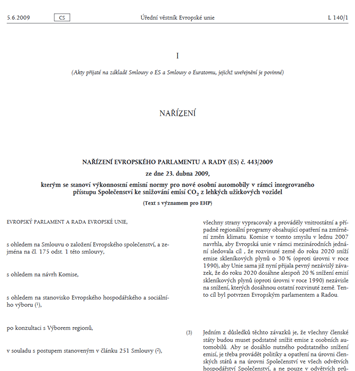
Regulation No 443/2009 of the European Parliament and of the Council setting emission performance standards for new passenger cars is adopted in 2009 as part of the Community's integrated approach to reduce CO2 emissions from light-duty vehicles. The regulation calculates a 30% reduction in greenhouse gas emissions by 2020 compared to 1990 and sets a limit for the average new fleet emissions of 95 g CO2 / km for 2020. At the same time, the regulation declares that a sufficient amount should be allocated from the budget. and that the regulation aims to create incentives for the car industry to invest in new technologies. The regulation sets a basic limit of 130 g CO2 / km for the years 2012 - 2015, which is recalculated according to the weight of the vehicle. The regulation already provides for fines for exceeding emission limits.
In addition, car manufacturers can obtain so-called supercredits for each vehicle with emissions of less than 50 g CO2 / km. For automakers, this practically means a significant reduction in the emissions balance and the risk of exceeding the limits for each electrified car that appears in the fleet.
In the following years, the first test prototypes and prototype fleets of electric cars began to appear at most car manufacturers, testing took place, experience was gathered, including analyzes of competition solutions, and new development departments were built. Although there are many test projects and prototype cars from previous decades, the beginnings of modern electromobility with massive development and a real impact on the product portfolio can be dated to the years 2009-2010.
The Paris Agreement, which is the output of the Paris Climate Conference (2015), aims to keep the increase in global average temperature well below 2°C above pre-industrial levels. In this context, the European Union aims to reduce domestic greenhouse gas emissions by at least 40% by 2030 compared to 1990. This target has been endorsed as the intended contribution of the Union and its Member States to the Paris Agreement.
REGULATION (EU) 2019/631 of the European Parliament and of the Council of 17 April 2019 laying down CO2 emission performance standards for new passenger cars and new light commercial vehicles is issued in 2019. With effect from 1 January 2020, this Regulation sets an average emissions target for EU fleets of new EU-registered passenger cars of 95 g CO2 / km and an average emissions target for new light commercial vehicles registered in the EU of 147 g CO2 / km. . In addition, the regulation states that, for example, for passenger cars, these targets will be further reduced by 15% for 2025, and by 37% for 2030 (compared to 2021). The regulation also sets charges for exceeding the emission targets: each additional gram of CO2 / km x EUR 95 x the number of newly registered vehicles.