
Traction battery
Requisitos de finalización
1. Basic properties and characteristics of Li-ion batteries
1.5. Li-ion cell
- Cathode - metal oxide (LiMO2, M… Co, Mn, Fe, Ni), collector Al
- LiMO2 - LiCoO2, LiMnO2, LiNiO2
- Anode - graphite, Cu collector
- Separator - thin porous foils (polyethylene, polypropylene)
- Electrolyte - lithium salt and organic solvent
- Li + ions travel through the separator from the anode to the cathode.
- Electrons through an electrical circuit.
- The ions penetrate the LiMO2 metal oxide lattice.
- Discharged cell = steady state
- Li+ ions travel through the separator from the cathode to the anode.
- Layered graphite structures allow Li+ intercalation.
- Graphite does not play a role in the chemical reaction, it is only the "storage medium" for Li+.
- Charged cell = unstable state
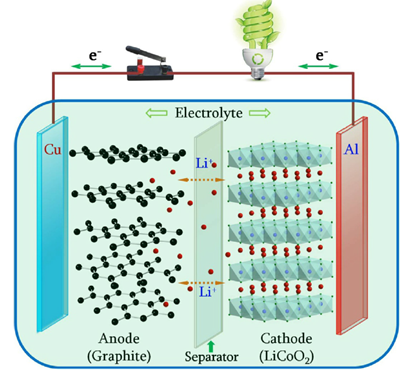
Li-ion cell