Traction battery
Completion requirements
1. Basic properties and characteristics of Li-ion batteries
1.6. Li-ion cell II
- Temperature rise to critical values → electrolyte evaporation → internal short circuit → fire / explosion
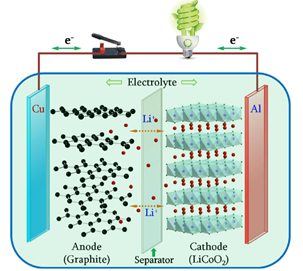
- Separator - prevents internal short circuit, porous, through for Li+.
- Electrolyte applied to a thin separator.
- Cylindrical cell - all these layers are rolled into a roll.
- Electrons must not come into contact with the electrolyte → degradation of the electrolyte.
- SEI (solid electrolyte interphase) - a layer preventing the contact of electrons with the electrolyte and its degradation
- SEI is formed on the very first charge.
- Li+ → electrolyte → Li+ + solvent molecules → reactions with graphite → SEI
- About 5% of lithium is used to create SEI.
- Current battery life: 3000 cycles, 10 years
- R&D direction - replace graphite with Si
- Increasing energy density
- However, Si increases its volume during charging → possibly a combination of graphite and Si.