
Traction battery
Požadavky na absolvování
4. Charging
4.1. Charging steps
- Charging increases the battery voltage.
- By simultaneously increasing the charging voltage, we maintain a constant charging current = constant current charging (1st charging step).
- However, the maximum cell voltage must not be exceeded.
- When the maximum voltage is reached (Unab = Umax), the voltage must not increase further and must stay constant = charging at constant voltage (2nd charging step, so-called saturation part).
- The charging current decreases exponentially => the charging at constant voltage is time consuming.
- Manufacturers often state charging time to reach 70-80% capacity.
- Maximum cell voltage depending on technology:
- usually 4.2 V for Co, Ni, Mn, Al.
- The cell charging current is usually recommended to be 0.5-1C.
- To increase the service life, low charging currents are recommended and charging below full SoC (e.g. do not start the saturation part) → reduced voltage stress.
- A large charging current speeds up the first charging step, but it prolongs the saturation part.
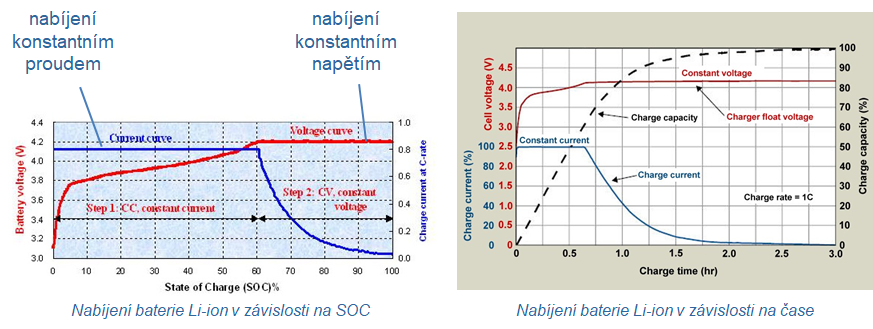
Typical charging characteristics of a Li-ion battery
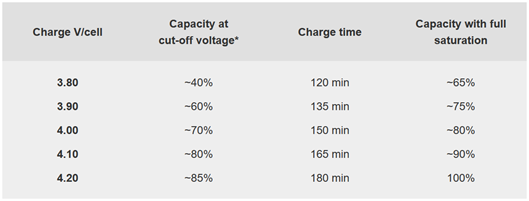
- The aging of the battery results in a shortening of the 1st part (charging with constant current) and a prolongation of the saturation part.
- SoC is practically impossible to determine according to the current voltage.
- It is possible according to the OCV characteristic for the given temperature → in steady state, i.e. sufficient time from last loading.
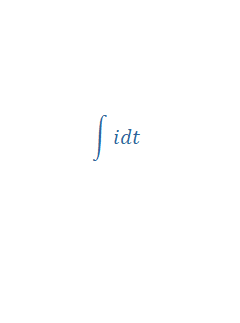
- Usually, the calculated charge is counted:
- Overcharging is not possible - Li-ion will not take over another charge, charging must be stopped, otherwise safety is endangered.