Traction battery modeling
Požadavky na absolvování
1. Electrical properties and modeling
1.4. Parameter identification II
Determination of RC cell parameters
Thévenin models of first and second order
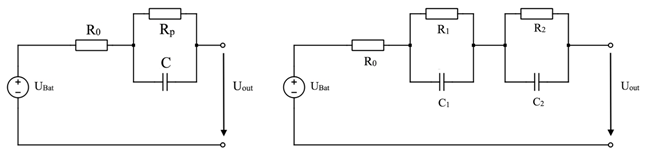
First vs. second order model
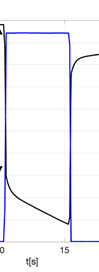
- The voltage stabilization transient does not correspond to a single exponential function → better modeled by a combination of two or more exponential functions.
- On the other hand,
 is an unambiguous problem => the dependence of R1 and C1 on T and SOC can be determined.
- Instead,
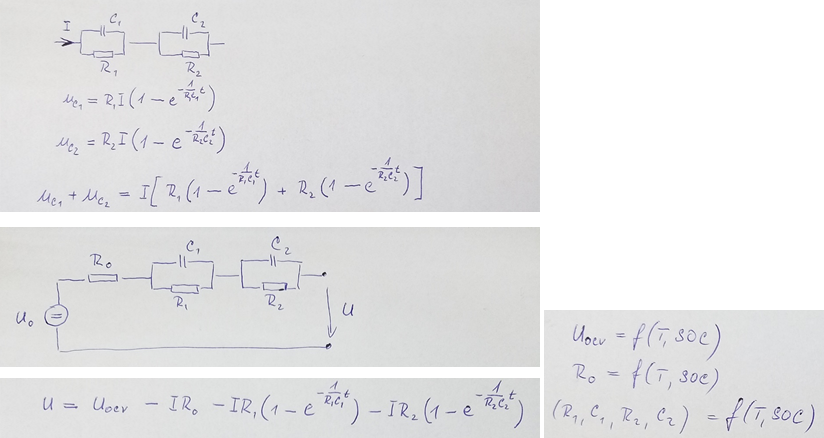
 there is no unambiguous problem, ie. more combinations R1, C1, R2, C2 lead to the same curve => very problematic determination of dependence on T and SOC.
- However, the first-order model provides sufficient accuracy.
Derivation
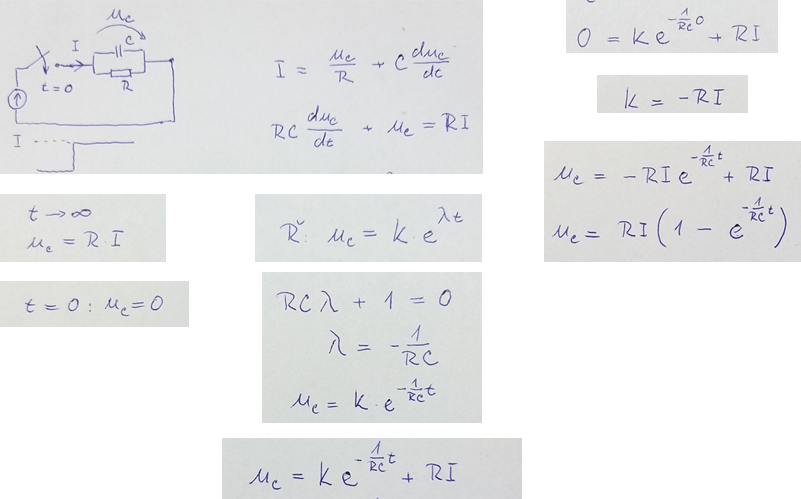
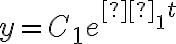
We derive the model for the RC cell by solving a first-order differential equation. Assume an RC cell to which we connect a constant current source I at time t = 0. We compile a differential equation where the total current I is divided into a current by a resistance Uc divided by R and a capacitor current, ie C duc according to dt. We convert the first-order differential equation into a standard form. We assume a general solution in the form 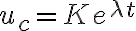 .
. from where lambda equals -1 / RC and add it to the general solution.
For a particular solution, we use a steady state, where the voltage across the capacitor equals the resistance drop, i.e.
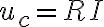 . So we get the solution

We determine the constant K using the state at time zero, when the voltage on the capacitor is equal to zero. Substituting into the equation we get the constant  .
.Výsledné
řešení je tedy