
Unit 5 bc Book
4. Language Study: Safety Precautions
Safety precautions
are measures taken to prevent accidents. However, what should people do AFTER
an accident happens?
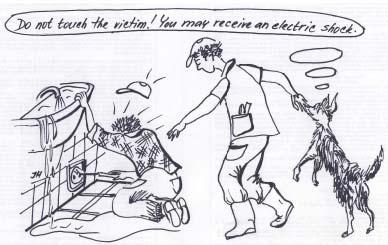
Look at the picture. The electrician on the left has not been using safe work practices. He has just received an electric shock. The witness to the accident wants to help. Below, you can see some advice on how to treat the victim. Study the language forms in the table carefully to make sure you understand them fully and are able to distinguish between all the nuances in meaning the listed modals may have. They can be used to give recommendations and advice as well as to express permission and prohibition. Also, notice how a single meaning can be expressed in various ways using a variety of verb forms.
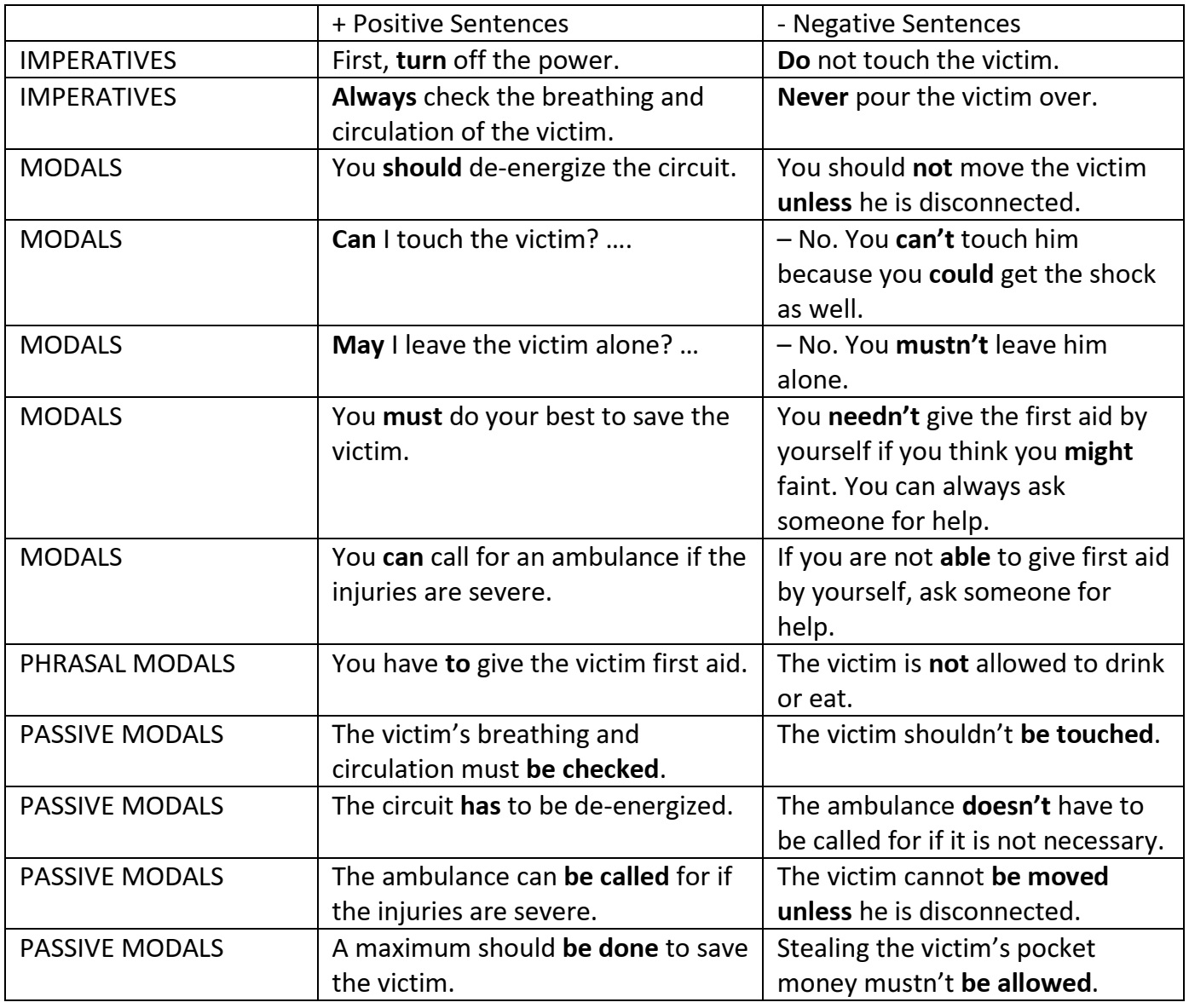
If you think you fully understand all the verb
forms, complete this task
without looking back at the table above. You will see if you drilled this
grammar point sufficiently. If you think you fully understand this grammar,
practice it by completing this
exercise. Fill in the blanks in the sentences with a
correct verb from the brackets. Sometimes you will need to change the form of
the given verbs. After you finish, practise the same grammar point by trying to
rephrase the sentences in this
exercise. Rewrite the instructions using the expressions in
brackets.
So far, you have used imperatives and active and
passive modals to give instructions, recommendations, and advice. However,
apart from modals, you can also use time clauses to express the same meaning.
Study the table below:

At first sight, the sentences above do not seem to be difficult or any special. However, three tricky grammar rules are hidden within them. They will become more obvious and clearer when the sentences are converted into the Future Simple tense:

1) First, focus on the words in italics. You will notice that unlike in Czech, where both the main clause and the subordinate clause are in the future tense, in English, only the main clause is in the future tense. The subordinate time clause is in the present tense.
2) Now, focus on the underlined -ing verb form. This is called the present participle and is used for the reduction of the subordinate time clause. However, this reduction is only possible if the two clauses have the same subjects; here, it´s “I”. This rule is logical: as the reduced -ing form is not able to express the person, it is automatically assumed that the person is the same as in the main clause, i.e. I.
3) Finally, focus on unless (= ledaže(by)) and until (dokud/pokud ne). If you translate the sentence into Czech, you can see that the Czech sentence has negative particles in both the main clause and the subordinate time clause. (Nedotknu se oběti, dokud nezkontroluji, že…). English, however, only has the negative particle in the main clause. (I will not...). The subordinate clause is positive (I check). This is because the connectives unless and until carry a negative meaning themselves, so no other negative particle can be used after them in the subordinate time clause.
Although this grammar is a bit tricky, it has one advantage. It allows you to express one idea in more ways, thus improving your texts stylistically. Now, try this magic in this task. Finally, do this quiz.