
Part 2 – Aspects of grammar
1. Tenses in academic writing
Watch the following video on how to use tenses accurately and consistently in academic writing.
Manchester Metropolitan University https://www.youtube.com/watch?v=lRx4TryQ8Pg
Exercise 2: Read the following paragraph through, and determine the main tense. Then reread it and circle the three verbs that shift incorrectly from the main tense.
For the past seven years, I have called myself a swimmer. Swimming, my one sport, provides a necessary outlet for my abundant energy. I have always drawn satisfaction from exertion, straining my muscles to their limits. I don't know why pushing forward in the water, as my muscles cried out in pain, sets off a booming cheer in my head. Many times when I rounded the turn for the last lap of a race, my complaining muscles want to downshift and idle to the finish. My mind, however, presses the pedal to the floor and yells, "FASTER!" The moment that I touched the wall my muscles relax; the pain subsides. I am pleased to have passed the point of conflict. (adapted from Brendon MacLean, "Harder!")
Source: PurDue Owl Website, accessed on Nov 13, 2021 at https://owl.purdue.edu/owl_exercises/grammar_exercises/tense_consistency/tense_consistency_exercise_4.html
University of Carolina at Chapel Hill Writing Center discusses the difference between present simple and past simple for reporting research results:
Past simple limits your claims to the results of your own study. E.g., “Our study found that teenagers were moody.” (In this study, teenagers were moody.)
Present simple elevates your claim to a generalization. E.g., “Our study found that teenagers are moody.” (Teenagers are always moody.)
Source: University of Carolina at Chapel Hill Writing webpage accessed on Nov 13, 2021 at https://writingcenter.unc.edu/tips-and-tools/verb-tenses/
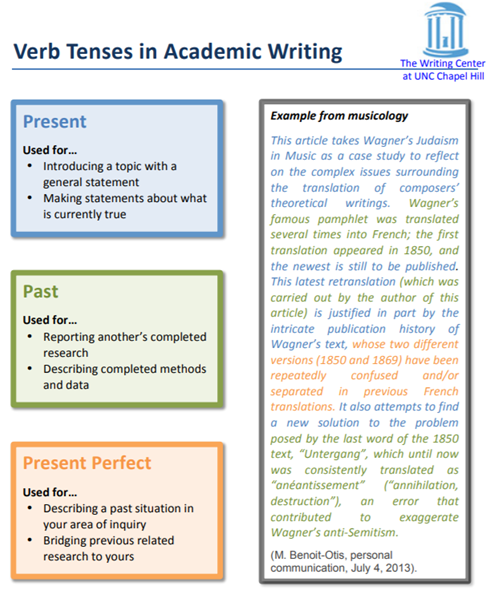
Source: University of Carolina at Chapel Hill Writing webpage accessed on Nov 13, 2021 at https://writingcenter.unc.edu/wp-content/uploads/sites/346/2013/12/Verb-Tenses-in-Academic-Writing.pdf