
General information on Relative Clauses
1. Clauses types
There are defining, non-defining, participle, infinitive and wh-clauses covered in this module.
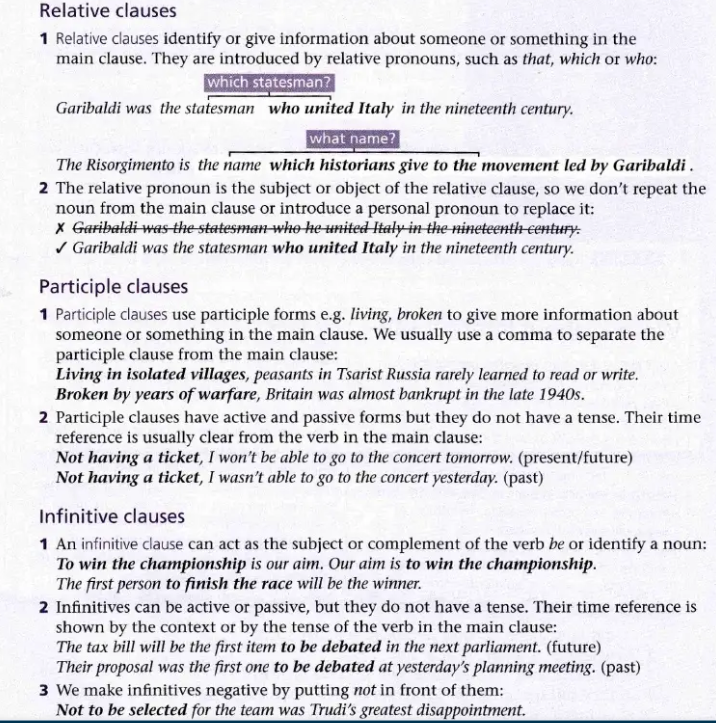
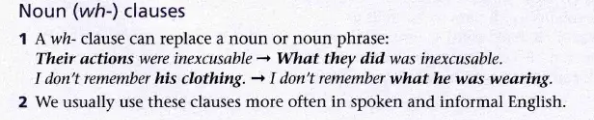
Read the following rules on using infinitive clauses (Source: Module 12 (p.234) of My Grammar Lab Advanced C1-C2 by Pearson):
According to the Cambridge dictionary online,
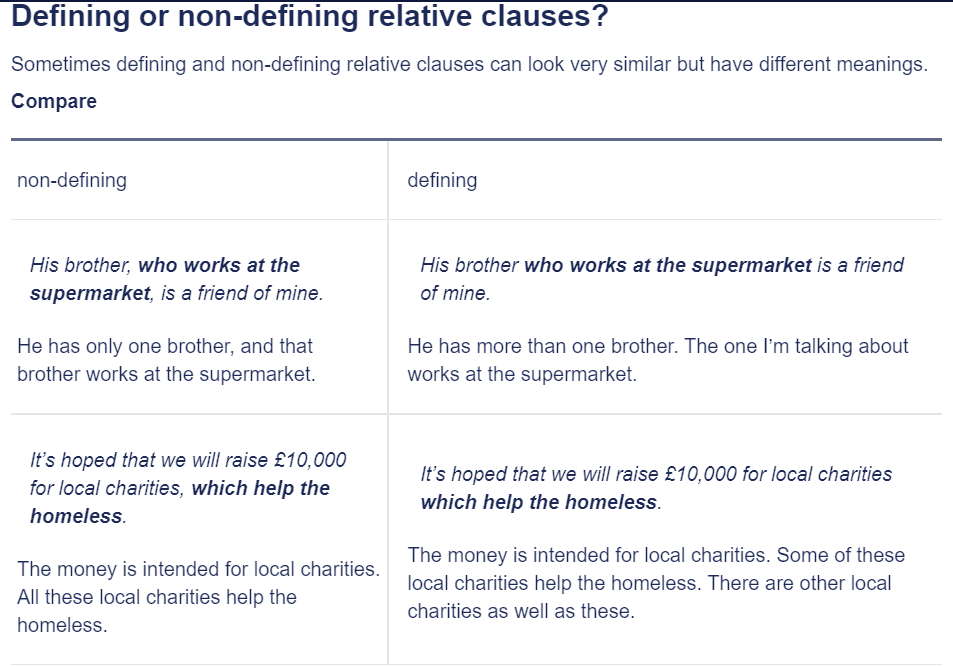
"We use defining relative clauses to give essential information about someone or something – information that we need in order to understand what or who is being referred to. A defining relative clause usually comes immediately after the noun it describes.
We usually use a relative pronoun (e.g. who, that, which, whose and whom) to introduce a defining relative clause (In the examples, the relative clause is in bold, and the person or thing being referred to is underlined.):
They’re the people who want to buy our house.
Here are some cells which have been affected.
They should give the money to somebody who they think needs the treatment most.
[talking about an actress]
She’s now playing a woman whose son was killed in the First World War.
We use non-defining relative clauses to give extra information about the person or thing. It is not necessary information. We don’t need it to understand who or what is being referred to.
We always use a relative pronoun (who, which, whose or whom) to introduce a non-defining relative clause (In the examples, the relative clause is in bold, and the person or thing being referred to is underlined.)
Clare, who I work with, is doing the London marathon this year.
Not: Clare, I work with, is doing the London marathon this year.
Doctors use the testing kit for regular screening for lung and stomach cancers, which account for 70% of cancers treated in the western world.
Alice, who has worked in Brussels and London ever since leaving Edinburgh, will be starting a teaching course in the autumn.
In writing, we use commas around non-defining relative clauses:
Etheridge, who is English-born with Irish parents, replaces Neil Francis, whose injury forced him to withdraw last week.
In speaking, we often pause at the beginning and end of the clause:Unlike American firms – which typically supply all three big American car makers – Japanese ones traditionally work exclusively with one maker. (formal)
This is the end of the direct quotation from the Cambridge Dictionary online website.
Please proceed to the following section.