
Topic 6: OAU, economic decline, and neo-patrimonial rule
Osnova sekce
-
Neo-patrimonial Rule in Africa
Besides family-nation discourse, there exist enough evidence that the newly independent states in their majority valued security over democracy. Not only such countries as the Congo, or Nigeria, but also Tanzania where the fears of division and fragmentation were quite significant and almost tangible among the TANU party leaders. Julius Nyerere’s vision was to create a state of “multiracial unity” in order to avoid conflicts similar to those in Rwanda/Burundi, or the Congo.
Typical institutional characteristic of African regimes is neo-patrimonialism. The main feature of this lies in the fact that the main authority in the state is not related to an institution, but to a person. Rulers of such regimes sought to gain presidential seat not because of public interests but only for their own enrichment. Governmental administrative posts, licenses, contracts, projects and employments depended on ruler’s personal preferences or even actual mood. In theory, some of the observers called these political systems private instruments of those in power rather than states.
One of the common features of post-colonial states in Africa that significantly contributed to a formation of opposition political and military movements was the phenomenon of personal rule. States with strong dominant person at the forefront were a proof and consequence of colonial policy of “divide and rule” in which there was no space for formation of wide and erudite political elite. On the contrary, newly independent countries ruled by leaders usually maintained frequent contacts with former colonial metropolis or in other cases with newly established power blocs such as the Soviet Union and its allies. Context of the Cold War contributed to impossibility to create truly functional democratic plural political systems respecting opinions of majority. Strong personal rule either based its power on ethnic majority or dominant political subject (Senegal, Côte d’Ivoire), or on ethnic minority or region that dominated military and economic sectors of the country (Gabon, Congo).
Very often such an autocrat came to power after military coup that became one of the basic (although simplified) features of postcolonial Africa. Nigeria is in this matter probably the most notorious country as the majority of governments in postcolonial period came into being after military coup. Especially in the first three decades of independence (Cold War era) the military type for rule prevailed and military coup as means to get to power was dominant in many African countries. Strong personal and neo-patrimonial rule in a certain sense followed a tradition of chieftainship in pre-colonial Africa with the difference that neo-patrimonial post-colonial rule was based on violation of law, oppression and clientelism while pre-colonial era on the basis of clearly limited set of rules. Instead of democratization, many African independent states underwent decades of neo-patrimonial rules characterized by relationship between a leader and administrative apparatus chosen and controlled by him. Neo-patrimonial state has three main features: personal rule, clientelist system and kleptocracy. Other forms of governance are sometimes labelled as Satanist due to the fact that power of the ruler was unlimited and ruler himself took the state and its inhabitants as his own property.
Another feature of modern African state is elections. However, ever since the independence, vast majority of African states had experience with elections, most of them already from the era of decolonization. While during the Cold War, the elections did not make sense in most of the countries due to authoritarian nature of their governments, after 1991 with the wave of democratization, space has been opened for multiple political parties and actors. In some cases, this has led to repeated electoral crises as a result of ethnically divided societies such as in Niger, Nigeria, or Côte d’Ivoire. Already mentioned electoral violence in Kenya that associates the elections basically since the 1990s is an evidence of how fragile the elections can be in a state with institutions and power based on ethnic exclusion and privileges. Nigerian elections, for instance, have been usually surrounded by suspicion of corruption and fraud and contributing to occasional violence committed by armed youth militias.
Elections in Ethiopia are relatively new phenomenon. On one hand, it coincides with the introduction of seemingly “democratic” environment after 1991 but at the same time elections in Ethiopia have been limited to the technical process repeated after every five years.
Photo: Jan Záhořík (rally in Addis Ababa, Ethiopia, 2011)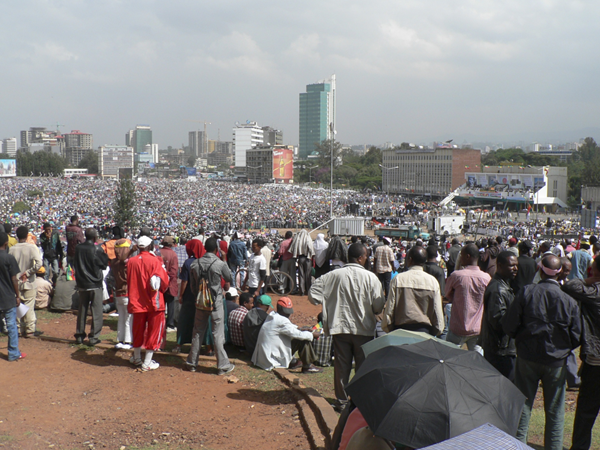
-
1) Organization of African Unity
2) External Debt Burden and Economic Decline
-
Take a look at the attached map of Africa. Select one country or a region (Horn of Africa, West Africa, South Africa, Equatorial Africa, East Africa) and try to find out as many information as possible in regard to its economic growth or decline in since independence with particular focus to minerals, natural resources, and resource curse.
-
After watching the video and reading the texts, be ready for the following set of topics/questions:
1) What is the main difference between OAU/AU and the EU?
2) Can Africa be developed given the fact that it is still mostly dependent on external powers including former colonial ones?
3) What can, in your opinion, China and BRICS bring to Africa?