
Topic 9: Cold War in Africa
Section outline
-
The end of the Cold War in Sub-Saharan Africa was characterized by fall of authoritarian regimes and efforts leading towards national conferences that would include all relevant parties. State controlled centralized economic systems stepped away as new liberal trends entered Africa and in many cases former frequently existing dominance of one particular group was replaced by multi-ethnic and multi-party governments respecting ethnic diversity.
While the newly formed African independent states showed high level of centralization and absence of civil society, after the end of the Cold War decentralization entered Africa together with creation of regional and local governments and provincial responsibility. In last two decades, about 80% of all developing countries have undergone a process of decentralization. In Sub-Saharan Africa only a minority of countries did not start or left the decentralization process. Although mainly in former British colonies a system of local governments emerged, these were only rarely responsible for education, health care, and infrastructure in reality. Only after 1990 with the fall of oppressive regimes it was possible to apply earlier theoretical principles of “self-rule” and “shared-rule.” For authoritarian regimes, it was not desirable to talk about leaving absolute control over state institutions and regional resources with the exception of Nigerian military regime in 1976 that initiated so far unseen decentralization program.
If we talk about democratization and decentralization in Africa as expected concepts bringing economic growth, prosperity and stability, it is perhaps a legitimate question which type of democracy we should apply. Despite being difficult to define democracy as a concept applicable on all types of society, there exist several attributes universally accepted for all types of democratization processes. There we talk primarily about good governance, where we could put pluralism, transparency, rule of law, and decentralization. On the other hand, in many African states (for instance, Ethiopia), there exist a huge difference between decentralization in theoretical and practical level. The same goes in many other issues.
Democracy or decentralization is usually considered one of the main conflict preventions (not only) in Africa. Nevertheless, many of African countries encounter several other problems, therefore it is first necessary to focus on territorial, economic, and political inequalities. Peace and justice is thus a condition to the development of democracy. Participation in civil society or engagement of all relevant subjects in the peace process, elimination of marginalization of any of participating parties, and strengthening of civil society has had to follow.
Accordingly, the global context was manifested in the use of telecommunication technologies that made action readiness easier and more effective for many guerilla and rebellion movements. On the other hand, it is now easy to trace satellite telephones used by various warlords. After the end of the Cold War, attention of world powers turned towards the failed states as possible sources of global terrorism after 9/11. Possible asylum that terrorist could gain in Africa made a lot of concern in the West especially after the Somali experience. Some of the African leaders soon after 9/11 declared their preparedness to stand side by side with Washington, D.C. and Pentagon in the ‘war on terror’. However, some of these governments could use their anti-terrorist campaigns against political opposition or regional disturbances.
On the other hand, the end of the Cold War generally contributed to a decrease of importance of Africa in global terms as its role of a ‘Cold War laboratory ended’. Western powers lost any motivation to be militarily engaged in regions that did not belong to their priorities. Similarly, an early OAU principle of inviolability of borders in Africa vanished when already in 1979 the Tanzanian forces crossed Ugandan borders in order to overthrow Idi Amin regime, and so when in 1998 a war broke out in Democratic Republic of Congo, almost all neighboring countries were involved in one way or another. Civil conflicts and wars were affected by the fall of the Iron Curtain in one more way: it was a lack of ability of international community to understand and react on changing dynamics of violence in Africa that can be documented on examples of Rwanda and Somalia in the first half of the 1990s. Cold War was replaced by different reality but transnational links, global challenges and local conflicts remained more or less the same or became intensified.
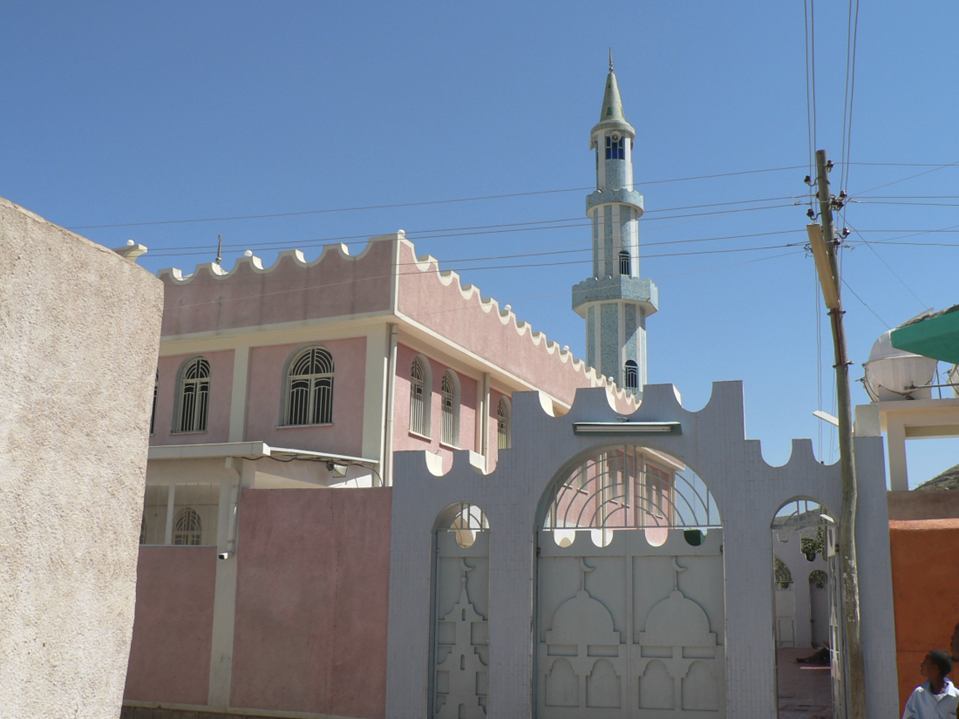
Photo: Jan Záhořík (Somali mosque, Dire Dawa, Eastern Ethiopia)
-
1) Biafra War
2) Soviet Model in West Africa
3) Soviet Union, China in Southern Africa
-
Take a look at the blind map of Africa attached to Week 1. Print it and try to mark all major Cold War hot spots in Africa, prepare a brief account or survey of Cold War battlefields in Africa to be discussed during the class.
-
After reading the text and watching the video, prepare yourself for discussing the following:
1) How would you evaluate the legacy of the Cold War in Africa?
2) Why the Soviet model of development had difficulties to penetrate Africa?
3) What is the legacy of the Biafra war in Nigeria until today?