
Topic 12: Emerging Africa
Perfilado de sección
-
Industrialization
The topic of Africa's industrialisation is still a highly debated topic for many reasons. Africa is the poorest continent in terms of a number of indicators, especially in terms of economic output, GDP per capita, etc., and the continent's economic performance is comparable to that of, say, France. It is clear that industrialisation must be linked to the overall transformation of society, as pointed out, for example, by the Nobel Prize winner in economics, Joseph Stiglitz. According to his judgement and the available data, it turns out that countries that have relied on universally accessible primary education, and especially girls' education, are doing much better economically. In many African countries, however, the percentage of girls in school is still relatively low because poor families do not have enough money to pay for schools. Countries such as Uganda, which has abolished school fees, are experiencing higher economic growth and more promising future prospects than countries that have not abandoned school fees and where the proportion of girls in school is lower.
Industrialization is not a new phenomenon in Africa. The first phase of industrialisation took place in the 1920s, still under European colonialism, but despite considerable progress in industrial production, most African countries remained dependent on primary commodity exports after independence, which threatened their economic stability in relation to the movement of world prices for any given commodity. The emphasis on industrialisation in Africa has been presented in many different fora in Africa in recent decades as a means of lifting the continent out of the cycle of poverty and war, increasing employment and raising living standards. However, according to UN data, the share of manufactures in GDP has declined from 12% to 11% between 1980 and 2013. This, according to some courts, relativises some of the myth of a 'rising Africa', but industrialisation remains the main means of boosting the economic strength of African countries.
Countries such as Ethiopia, Rwanda and Tanzania are the main drivers of industrialisation on the African continent. In Ethiopia, in particular, industrialization has been driven by a confluence of several factors. Firstly, there is a government-led system of economic control (developmental state), focused on economic growth in key areas of the economy and infrastructure, overseen by the government, which at the same time encourages and attracts foreign investment into the country, not only Chinese, but also Turkish, German, Swiss, etc. Secondly, Ethiopia has long had an economic growth rate of around 10% annually, which attracts foreign investors who have confidence in the local market. Thirdly, Ethiopia has a very young population and a cheap labour force, making it worthwhile for foreign investors to shift part of the production of one or another product or sector there.
Africa is the continent with the lowest electrification rate, although in recent years some countries have been trying to change this trend. Ethiopia has begun construction of the Grand Ethiopian Renaissance Dam (GERD), which is expected to have a capacity of 6 GW when it comes online in 2021, at a cost of US$4.7 billion. An even larger dam is planned for the Democratic Republic of Congo, whose government's proposed Grand Inga Dam is expected to have a capacity of 39 GW and cost around USD 80 billion.
Given Africa's natural wealth, most industrial production remains mineral-based. Moreover, around 70% of investment in industrial production takes place in four countries in Africa (South Africa, Egypt, Nigeria, Morocco). Even so, industrial production grew by 3.5% per year between 2005 and 2014, higher than in the rest of the world. In 2016, industrial exports, i.e. trucks, electronics, appliances and other industrial products, grew by 14%. The aforementioned CFTA may be a key factor in continuing these trends, as it will create a single continental market with free movement of capital, thus leading to continental integration. If all this is successful, it could mean an increase in industrial output from USD 500 billion in 2015 to double that in 2025, creating an additional 14 million jobs. However, intertwined with this is the issue of education, as Africa suffers from a shortage of a quality and educated workforce, which should prompt African governments to change or modify education curricula to strengthen business-oriented skills, entrepreneurship, engineering and mathematics, as well as apprenticeships and vocational training.
In North Africa, one of the leaders in industrialisation is Morocco, where industrial production accounts for about 15% of GDP and employs 10% of the population, with about a third in textiles. The country has a strong aeronautics industry, with a number of companies, including Boeing and Bombardier, operating in Casablanca's Midparc free zone, for example. The same can be said of the Tangier-Med industrial park, which is linked to the port of Tangier and is home to a concentration of companies producing automotive components. The French carmaker Renault opened a USD 1.5 billion factory here in 2012. Similarly, Japan's Nissan and India's Tata operate here. In Kenya, manufacturing employs about 12.5% of the population and accounts for about 20% of all economic activity, with pharmaceuticals, leather processing, and motor vehicle or component manufacturing dominating alongside textiles. Zambia is Africa's third most competitive economy, after Seychelles and Ghana, and industrial production grew by 30% between 2009 and 2013 alone. Zambia is extremely rich in minerals, with copper leading the way, but other industries are also booming, particularly agricultural processing. In West Africa, Nigeria is the leader, but despite a considerable economic boom in the last 20 years, the country remains too low on the Human Development Index, as well as other statistics. Indeed, a traditional problem in many African countries, and typically oil-producing countries, is social inequality, and high unemployment rates.
Infrastructure
Infrastructure is important for economic development in any country, and this is doubly true for landlocked countries, or countries not blessed with any quite substantial mineral wealth. Infrastructure is also the basis of industry and is also an important part of the development of services, on which, for example, the advanced European economies are based. Many African countries inherited railway networks that during colonialism were mostly used for mineral exports and usually linked an inland mining town to a port. In East Africa, for example, where extensive railway construction is now taking place, mainly under Chinese supervision or with Chinese investment, both the Germans in the former Tanganyika and the British in Kenya and Uganda began building railways as early as the 1890s. All the railway lines terminated at lakes Victoria and Tanganyika and served to promote trade with central and equatorial Africa, which were thus linked by rail to ports on the Indian Ocean. As a result, some of the most important towns in East Africa and beyond grew up, such as Nairobi, which became the main transhipment point and railway station in Kenya, and the French, when building the railway linking Djibouti with Addis Ababa in Ethiopia, gave rise to Dire Dawa, which was originally intended as a stopping point but eventually grew to become one of the largest towns in Ethiopia. The design of East African railways has been occasionally disturbed, for example by the man-eating Tsavo lions, about which several films have been made and books about their stories can be bought in Nairobi.
Above all, the construction of the Kenya-Uganda railway in the early 20th century encouraged European (British) settlers to settle both countries, with the associated issue of land grabbing and hence displacement of indigenous people. After Kenya's independence, the railway sector slowly began to collapse, whether due to corruption, mismanagement or the global economic crisis of the 1970s. The East African Community, in an attempt to speed up interconnectivity, agreed on a project called the East African Railway Master Plan (EARMP). The Kenyan government's Vision 2020 envisages the construction of a modern 3,100km railway by 2025, linking Mombasa on the Indian Ocean coast to the hinterland and connecting East Africa in later stages.
Ethiopia's capital Addis Ababa, which is the seat of the African Union, a kind of African Brussels, is also the first city in sub-Saharan Africa since 2015 to have a metro or overground line, whose two lines, the North-South and West-East, have a total of 39 stations and, according to initial ideas, will carry up to 15,000 passengers per hour in one direction at a top speed of 70 km/h. Construction took three years and cost nearly $500 million, with the Ethiopian government receiving a loan from the Export-Import Bank of China. Until the metro was launched, traffic in Addis Ababa looked like any other African capital. It was provided exclusively by taxis, either old Toyota minibuses that could hold over fifteen passengers or even older blue Ladies. This, however, accounted for both the air pollution and the constant traffic jams we know from other cities like Nairobi, Dar es Salaam and the like. This is a trend that follows the efforts of many African countries, especially those in East Africa, to build rail links, to rely more on trains and less on cars, which contribute a great deal to air pollution, which in turn affects the quality of life in general.
Photo_ Jan Záhořík (Light Rail, Addis Ababa, Ethiopia)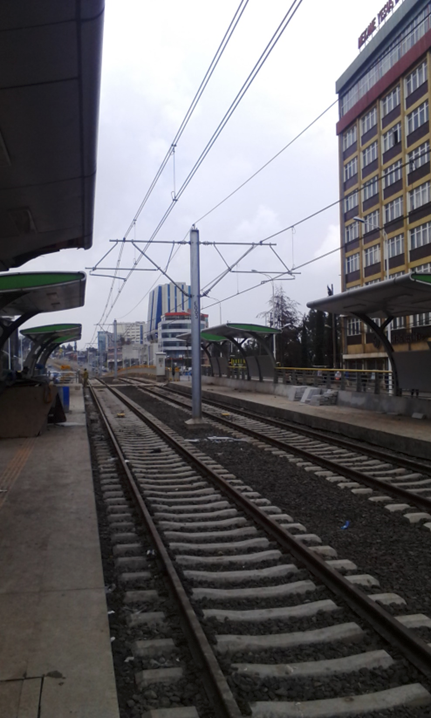
-
1) Ethiopian Great Renaissance Dam Disputes
2) Ethiopia's Ethnic Federalism
-
1. Which of the following countries are the most stable/democratic? 2pts
a) Central African Republic
b) Botswana
c) Ghana
d) Democratic Republic of Congo
2. Which of the following statements are false? 2pts
a) Ghana has one of the most dictatorial regimes in Africa.
b) Nelson Mandela was the first the President of post-Apartheid South Africa.
c) Omar Bongo (Gabon) had very close ties with France.
d) Eritrea is a former French colony.
3. In which country you would meet the Hausa, Igbo, and Yoruba people? 1pt
a) Senegal
b) Ethiopia
c) Nigeria
d) DRCongo