AEL5 Unit 5b Book
| Stránky: | Moodle ZČU |
| Kurz: | UJP/AEL5 Anglický jazyk pro Fakultu elektrotechnickou 5 - šablona |
| Kniha: | AEL5 Unit 5b Book |
| Vytiskl(a): | Nepřihlášený host |
| Datum: | neděle, 8. listopadu 2026, 19.43 |
1. Introduction
The cause-effect relationship is one of the most important logical relationships in our lives. Although not many people seem to think about this relationship, it definitely exists everywhere around us. Especially in technical fields, all phenomena appear to have a kind of cause and a follow-up effect, whether we talk about problems and bugs or about a technical principle of a machine. In this unit, you will come across some of the cause-effect expressions and this topic will be further developed in Unit 11a in the AEL6 course.
Contents:
Expressing cause and effect relationships:
- Cause: because, as, since, as a result of, due to, thanks to...
- Effect: lead to, cause, make, bring about, result in...
2. Forum: Causes and Effects All Around
Unit 5b deals with cause and effect relationships,
which seem to be integral parts of our lives. To illustrate, you can see some
typical areas associated with causes and effects. In this
forum, answer at least two of the following questions and respond to at
least one contribution of a fellow student.
3. Reading and Listening: Carbon-Free Steelmaking
Do you remember? Unit 5a discussed some applications of electrolysis, one of which was extracting aluminium from the aluminium oxide found in bauxite. Some experts believe that electrolysis should even be used in steelmaking. Read the article on p. 36 of your coursebook (Bonamy, D. (2013). Technical English Level 4 Coursebook. Pearson Longman) to find out why. As you read, answer the questions in this task. Now, listen to recording 12 which comes with your book (alternatively, you can also read its transcript on pp. 120 and 121 in your coursebook. You will hear workshop participants discussing causes of carbon emissions from steelmaking. The possible causes are also depicted in the fishbone diagram in Task 2 on p. 36 in your coursebook. However, it is not complete. As you listen, complete it by choosing the correct phrases from the list above the diagram and matching them to the correct numbers in this task. Then listen again and choose the correct connector in these cause-effect sentences.
How did you feel about the last task? Sometimes the proper use of cause-effect sentences may be tricky because it involves a bit of logic. Definitely, the cause and effect must not be confused and the order of cause and effect depends on the type of connector you use. For example, consider this sentence:
‘Further education has become more accessible for a wider range of people. As a result, an increasing number of people have degrees.’
1. Why do more people have degrees? - This is because further education has become more accessible.
2. What has happened because of the increasing accessibility of further education? - More people have degrees.
3. What words connect the answers to (1) and (2)? - ‘as a result’
Based on the answers to the questions above, we can identify the cause, the effect and the connector:
The cause: Further education has become more accessible for a wider range of people.
The effect: An increasing number of people have degrees.
The connector: as a result
However, if the order of information in the sentence changed, the connector would have to be changed as well:
An increasing number of people have degrees because further education has become more accessible for a wider range of people.
As you can see, the ability to distinguish between a cause and effect is vital in order to make yourself understood. This grammar point is therefore going to be further practiced in the following section using a technical context.
4. Specialist Reading and Cause-Effect Phrases
As you probably know, there are various sources of energy. One of them is solar radiation. To convert solar radiation into electricity, photovoltaic (PV) panels are used. However, for the system to work, several PV panels are needed. On the one hand, PV panels consist of smaller units, but on the other hand, they make up much bigger units, as you can see in the following diagram. In this task, there is a description of the individual parts of the diagram. Look at the picture carefully and complete the table with the names of the individual parts of the diagram.
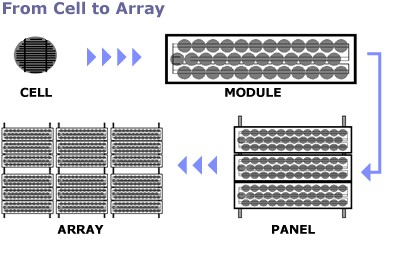
Diagram from: https://www.solardirect.com/archives/pv/pvlist/pvlist.htm
As you can see above, the fundamental part of a PV panel is a PV cell. Now, let´s find out about the principle of the cell. Scan the explanation in this reading comprehension task and answer the accompanying questions as quickly as possible.
Now that you understand the fundamental principle behind PV panels, you can look at the text from the grammatical point of view. Read the text again and focus on the cause-effect relationships. In this task, you can see the same information as in the text, but in the form of phrases. Mark each of them as a cause (C) or an effect (E) or an effect and a cause (E / C). Be careful: three of the phrases function as both a cause and effect, which is known as a causal chain. If you have problems distinguishing between causes and effects, look back at the original sentences in the text.
As you can see, the cause is not always the first in a sentence. In other words, causes and effects can be swapped if some appropriate connectives are used. However, the cause-effect relationship can be expressed not only by using a connective, but also using a relative clause, a present participle or a mere verb. In this task, you can see the same sentences as in the text in previous exercise, but rephrased a little bit. Use the new connectives to fill in all the gaps. While filling in the gaps, pay special attention to punctuation in the sentences. Also, notice that even though the connectives have been changed, it is still clear what is a cause and what is an effect.
The basic expressions introduced so far are not the only ones used to express cause-effect relationships. For example, you can also use prepositional verbs, i.e. verbs followed by a preposition. In this grammar overview, you can find a list of cause-effect expressions. The list is rather long, but you will have a chance to practise these expressions not only in this unit by doing tasks A, B and C, but also later in Unit 11a in the AEL6N course. After finishing Task C, leave it open and listen to the related recording here to check your answers.5. Writing: The Eco Wave Power System
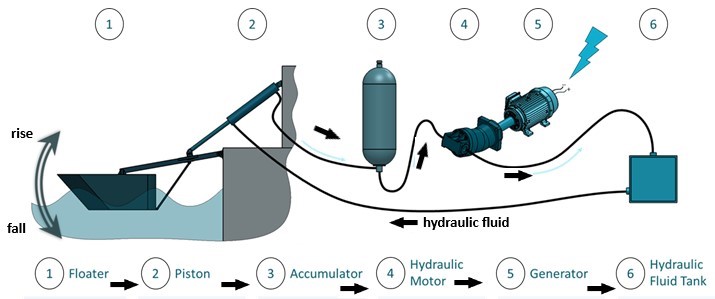
Now that you know a lot of phrases for expressing a cause and effect, it is high time to use these expressions in a text explaining a technical principle.
6. Word list
The key terms related to the topic of Unit 5b can be found:
· in the Excel format here.
· in the interactive flash card format here. This format is particularly good for drilling the new vocabulary.
· in a zip file here. This file is downloadable, so that after unpacking it, you can drill the new vocabulary on your desktop, laptop or any other portable device where you have a browser installed. The recommended one is Mozilla Firefox. Important: after unzipping the zip file, make sure to keep all the related files in the same directory at all times. Do not change any file names and do not transfer or delete anything.
Recommendation: Remember that the best way to learn new vocabulary is to see each new word in a context; that is, seeing it in the contexts provided in the tasks you complete in the unit.
A printer-friendly version of Unit 5b exercises and the keys to these exercises can be found here.