
Hybrid cars
Požadavky na absolvování
Passenger cars with hybrid drive, where the drive consists of a combination of a traditional internal combustion engine and an electric motor.
2. Types of hybrid drives
2.2. Parallel hybrid drive
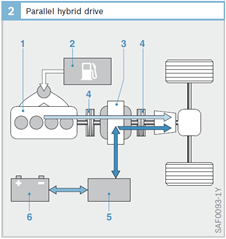
1 – ICE
2 – Fuel tank
3 – Electric machine
4 – Coupling
5 – Power inverter
6 – Battery
- Parallel connection of acceleration force sources.
- The internal combustion engine (ICE) (1) is mechanically coupled to the axle.
- Each of the drives, i.e. the internal combustion engine (ICE) (1) and the electric motor (2), can drive the axle independently.
- Alternatively, both motors can drive the vehicle at the same time → the sum of the powers allows to minimize the individual machines (i.e. ICE and electric motor).
- Many possibilities of parallel connection implementation (on separate axle, on shaft (according to location P0-P4), with planetary gearbox, etc.).
- The electric machine (3) is working
- as a motor when powered by a traction battery (6),
- as a generator when recharging the traction battery (6),
- alternatively as ICE starter.
Drive mode
 , alternatively

 ,

 ,

Brake mode
 , alternatively

- ,

- ,
 ,

Drive mode and charging
 , alternatively

- ICE cannot be operated only at the optimal efficiency point.
- There is an ICE-axle connection → fewer losses than with a series hybrid drive.
Applications
- Wide use in a variety of vehicles, including hybrid passenger cars (mild hybrid, full hybrid, plug-in hybrid).
- The electric drive increases the efficiency of the drive with ICE, especially when accelerating and braking using recuperation (suitable for urban traffic).
- When driving over very long distances, the battery gradually discharges and the drive is provided only by ICE → loss of electric motor power (3).