
Charging
Požadavky na absolvování
Methods of charging electric vehicles.
2. Recharging by recuperation
The vehicle's kinetic energy is used to recharge the battery by the recuperation. The electric drive is in generator mode, where the electric machine is controlled as a generator and the vehicle is braked. Power is taken from the electric machine, which is then used to recharge the battery.
Charging by the recuperation can be used for
- traction battery charging (Li-ion, Li-pol, Ni-MH, etc.),
- HEV, PHEV, BEV,
- on-board lead acid battery (12 V) charging,
- especially µHEV: start&stop + ESM (Energy Smart Management).
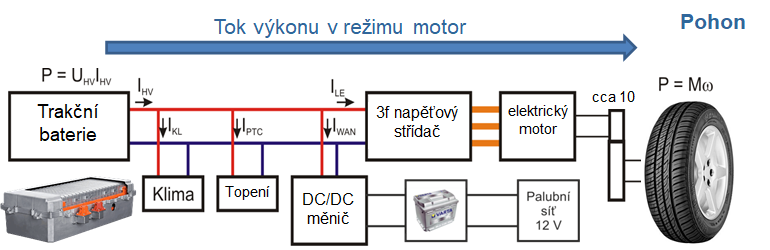
Driving mode
Power flow in driving mode
Braking mode (recuperation)
Power flow in braking mode
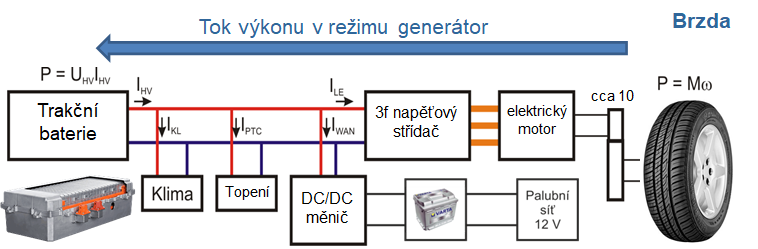
- During braking, the polarity of the torque changes compared to the drive mode. This changes the polarity of the mechanical power and recharges the traction battery.
-
Driving mode

Braking mode

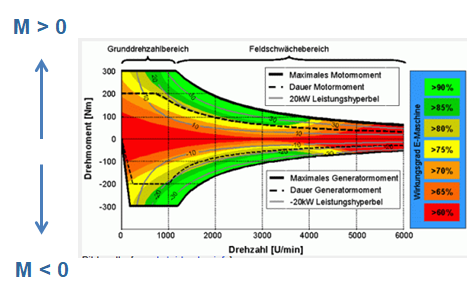
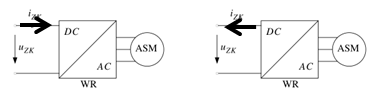
Change of current polarity on the DC side of the drive (traction battery side)
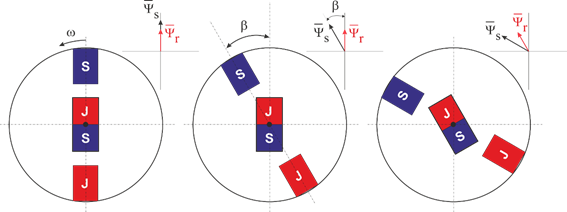
Motor vs. generator mode for electric synchronous machine with permanent magnets
- Rated power of the machine in motor and generator mode is practically the same.
- However, the rated charging current of the cell is about 10 times smaller than the rated discharging current!
- => Charging power is less than power of the generator or the battery must be oversized in terms of discharge current.
- Remaining braking torque must be provided by mechanical brakes.
- Often, recharging power is limited by battery management (BMS),
depending on set limits or battery condition (cell disbalancing,
temperature, etc.).
https://www.hybrid-autos.info