
Charging
Požadavky na absolvování
Methods of charging electric vehicles.
1. Cell charging
- Charging current lower than discharging (e.g. 10x, 20x, etc.).
- Lithium ions Li + must intercalate into the graphite layers → it limits the charging speed.
- By charging, we transfer the cell to an unstable state.
- The total charging current
 is given by
- difference between the charging voltage and internal voltage,
- the size of the internal resistance
 .
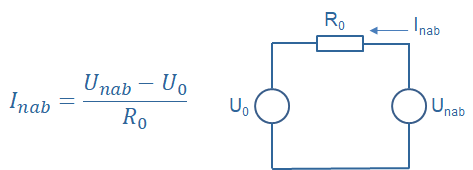
- Charging increases the battery voltage.
- By simultaneously increasing of
 , we maintain a constant charging current = constant current charging (1st charging step).
- However, the maximum cell voltage must not be exceeded.
- If reaches the maximum level (
 ), the voltage does not increase further and is constant = charging with constant voltage (2nd charging step, so-called saturation part).
- The charging current decreases exponentially => this charging is time consuming.
- Manufacturers often publish charging time needed to reach 70-80% capacity.
- Maximum cell voltage depends on technology:
- usually 4.2 V for Co, Ni, Mn, Al.
Step 1: constant current Step 2: constant voltage
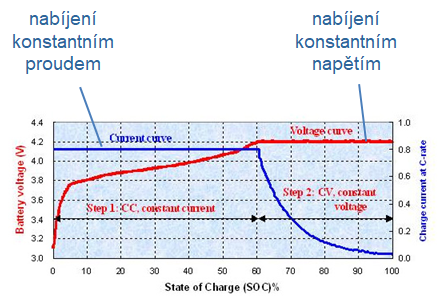
Li-ion battery charging
- The cell charging current is usually recommended to be 0.5-1C.
- To increase the battery service life, small charging currents are recommended.
- In parallel, do not charge to full SoC (e.g. do not start the saturation part) → reduced voltage stress.
- High charging currenta speed up the first part, but prolongs the saturation part.