Study material - book
Abschlussbedingungen
3. Structure of causes of specific learning disabilities
Etiology of SLD - history and current concepts in our country and in the world
basic premise: the intellect is not affected
Traditional division in modern form:
- internal influences: damage, heredity (autosomal dominant transmission, 35–45%) 60–70% heredity 30–40% of damage
- external influences: inappropriate teaching, family
- Traditional model of SLD etiology according to O. Kučera (1961)
- Minor brain damage (MBD, formerly encephalopathy) - a neurological finding mentions more minor conspicuousness, the anamnesis points to possible brain damage in the prenatal, perinatal or postnatal period - 50% of individuals with SLD
- Hereditary etiology - history of typical occurrence of communication disorders in relatives - 20% of individuals with SLD
- Hereditary encephalopathic etiology - a combination of both previous types - 15% of individuals with SLD
- Neurotic or unclear etiology - 15% of individuals with SLD. Neurosis as a cause is incomparably rarer than neurosis as a consequence of SLD
1980s: neurological-biological etiology
Etiological factors
- interacting internal and external factors
- development of views on the causes of failures
- genetic factors ---> partial deficits
- Current etiological models: e.g.
- phonological
- visual
- magnocellular
- cerebellar
- neurobiological
- common significant etiological context
- deficits of partial functions
- risk types of laterality
- perceptual, motor, memory
- within MBD/ HKD/ ADHD
- deficits of partial functions
- risk types of laterality
- perceptual, motor, memory
- within MBD/ HKD/ ADHD
Neurobiological approach
- demonstrated the difference in the brain of dyslexics
- enabled by the development of imaging techniques since the 1980s.
- monitoring of normal and diseased structures and performance, especially in the left hemisphere
- post-mortem analysis (dead brains) - prof. Galaburda
- dyslexia as a disorder of neuronal migration
- analysis by imaging methods - detected metabolic changes in various parts of the brain, identification of nerve circuits involved in reading, especially in the left hemisphere
- analysis of evoked potentials - monitoring of electrical reactions of the brain to a stimulus (word or picture), detection of intermodal deficit, good possibilities of prediction of dyslexic difficulties
Phonological model
significant mainly in the Anglo-Saxon language environment
I. Libermanová
- inverse concept replaced by language concept
- key concept of phoneme awareness
= ability to recognize in the overall sound form of a word its parts - phonemes (the smallest, indivisible units of language), are achievable by analysis
- the child needs phonemic awareness (segmentation) only in connection with reading,
- phoneme-grapheme relationship: complex process of character identification and sounding = grapheme - phoneme correspondence (disturbed in dyslexics)
- revealing the importance of short-term memory for reading and deviations in dyslexics (mainly in verbal memory)
- Libermanová: timely search for children at risk of reading according to differences in phoneme awareness and verbal short-term memory
- phonological skills: analysis, synthesis and short-term phonological memory
- factors stable over time, with a high predictive connection with reading
- manifested in phonological decoding - recognition of words and their parts (easier in transparent orthographies)
Double deficit theory (N. Geschwind)
- originated in the solution to phonological reeducation of resistant cases of dyslexia
- dyslexia is caused by two deficits: phonological awareness and rapid automated processing of stimuli
- problems in the sound processing itself and the resulting inability to create a link between the grapheme and the phoneme
- dyslexics are unable to perceive short or rapidly changing sounds.
- use of the quick naming test - detects visual-verbal discontinuity
- Norman Geschwind: founder of behavioral neurology
Theory of visual deficit
- pointed out the deficits, which were subsequently explained by magnocellular theory
- deals with the share of visual disorders in reading problems
- monitors deficits in the analysis and differentiation of visual perceptions
- emphasizes in particular unstable binocular fixations and incorrect perception of object boundaries, which leads to difficulties with processing letters and words on the text page, a specific deficit is the so-called iconic persistence (visual persistence)
- related mainly to abnormalities in the right hemisphere
Magnocellular theory
- in the brain there are two different nervous systems related to reading: magnocellular and parvocellular, controlled from the subcortical (thalamus) - transfers information to superior structures in the cerebral cortex
- magnocellular system (magnus = large, cellular = cellular) - strongly myelinated cells that transfer excitations well
- responsible for the speed and timeliness of information processing, allows vision in low light and low contrast, the system is sensitive to changes in time, predominates in peripheral vision
- parvocellular system (parvus = small)
- small cells capable of processing even small distances between stimuli
- specialized in color perception and detailed object viewing
- handles short words accurately when reading
- dyslexics are not able to process a large number of short visual stimuli in a small area, there is a merging of characters
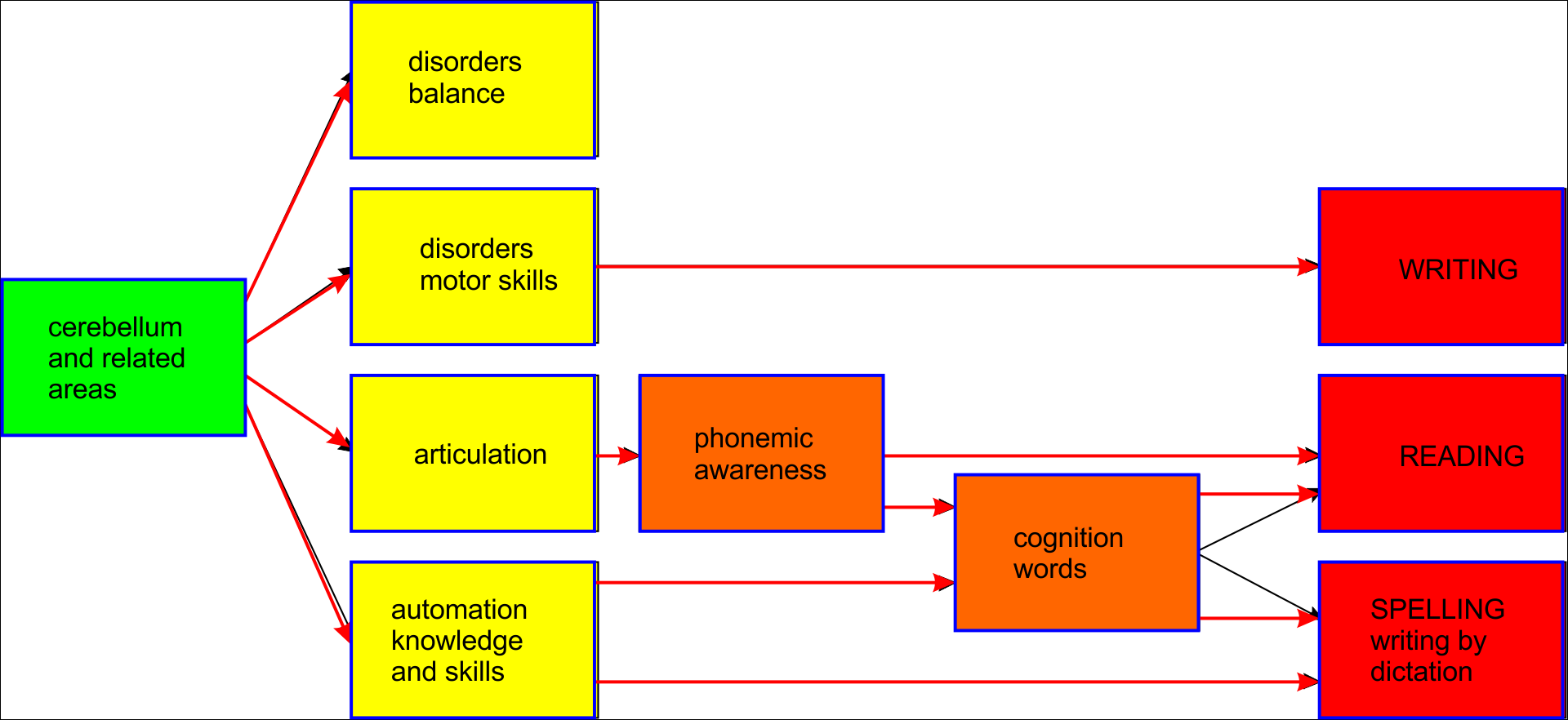
Cerebellar theory
- seeks the cause of dyslexia in mild cerebellar dysfunction ensuring motor coordination
- Disruption of the cerebellum leads to reduced ability