
Study material - book
5. Laterality - types, ontogenesis of laterality
5.3. Ontogenesis of laterality
Hemispheric asymmetries (e.g., structural or functional differences between the left and the right cortical hemisphere), pervade practically all major neural systems of the human brain.
Laterality is a theory of the dominance of the use of one side of paired organs based on the differences in the function of the right and left cerebral hemispheres . The most well-known manifestations of laterality are right - handedness and left-handedness .
Dominance is the predominance of one cerebral hemisphere over another. The previously widespread view that left-handers have a dominant right hemisphere and left-handers for all activities has been overcome. In the 1960s, J. Wada discovered that almost 100% of right-handers and 60-70% of left-handers had a dominant left hemisphere for speech .
Connection of cerebral hemispheres
The left and right hemispheres are connected by a complex network of nerve fibers called the corpus callosum . The ancient Egyptians noticed that the left hemisphere controls the right side of the body, while the right hemisphere controls the left side of the body.
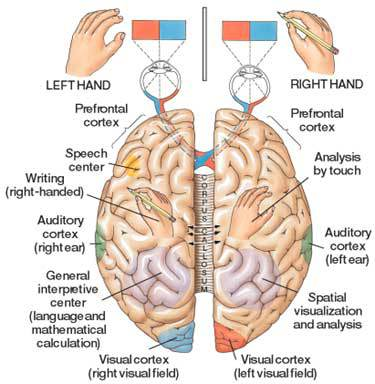
https://wikisofia.cz/wiki/Lateralizace_mozkov%C3%BDch_hemisf%C3%A9r
- significant hereditary influences
- prenatal development (ultrasound examinations show in the uterus 90% of children prefer the right thumb)
- after birth: the first signs of the future development of laterality from the tonic neck reflex
- around the 4th month 1. intentional movements: in most children symmetrical use of both hands
- around the 7th month shift to asymmetric, lateralized power (maturation of nerve pathways)
- long fluctuations between symmetry and asymmetry
- laterality stabilization after the 4th year of life
- if the laterality (especially of the hand) is not clear before the age of 6 - diagnosis is necessary
- related development of orientation in space and right-left orientation
- the child is aware of the basic axes of space in order: vertical, anteroposterior, horizontal
- development of right-left orientation: simple - in the body scheme - mirror orientation