
Study material - book
6. ADHD / Hyperkinetic disorder
Hyperkinetic syndrome / ADHD - development of cognition, terminology, etiology
- 1960s: Mild pediatric encephalopathies: minor diffuse disorders of permanent brain tissue arising prenatally, perinatally or postnatally before adulthood. (Kucera in Cerna, 1999)
- 70s: mild brain dysfunction also minimal brain dysfunction (MBD)
- minimal brain dysfunction
- 80s: specific behavioral disorders
- school adaptability disorder
- 90s: hyperkinetic syndrome
- hyperactive syndrome
- Attention Deficit Hyperactivity Disorder (ADHD)
- Attention Deficit Disorder (ADD)
Mild brain dysfunctions - definition
Mild cerebral dysfunction syndrome refers to children of near-average, moderate, or above-average general intelligence with certain learning or behavioral disorders, ranging from mild to severe, which are associated with abnormalities in central nervous system function. These deviations can manifest themselves in various combinations of impairments in perception, conception, speech, memory, and control of attention, instincts, or motor skills.
Hyperkinetic disorder (HKD) - ICD-10
A group of disorders characterized by early onset (usually in the first five years of life), lack of perseverance in cognitive-intensive activities, and a tendency to move from one activity to another without completion, along with disorganized, poorly regulated, and overactivity.
A number of other abnormalities may be present at the same time. Hyperkinetic children are often undisciplined and impulsive, prone to injury, and easily conflict with discipline for thoughtless breaking of rules rather than intentionally resisting. Their relationship with adults is often socially disinhibited due to a lack of normal caution and distance. They are not very popular with other children and may become isolated.
Cognitive abilities are commonly impaired and specific delays in motor and language development are disproportionately common. Secondary
complications are antisocial behavior and low self-esteem.
ADHD is a developmental disorder characterized by a child's age with an inappropriate degree of attention, hyperactivity and impulsivity.
The problems are chronic and cannot be explained by neurological, sensory or motor disabilities, mental retardation or severe emotional problems.
Deficits are evident in early childhood and probably chronic. Although they may alleviate with CNS maturation, they persist compared to individuals of the general population of the same age. Difficulties are often associated with the inability to follow the rules of conduct and perform certain tasks for a long time. These obviously biological deficits affect the child's interaction with family, school and society.
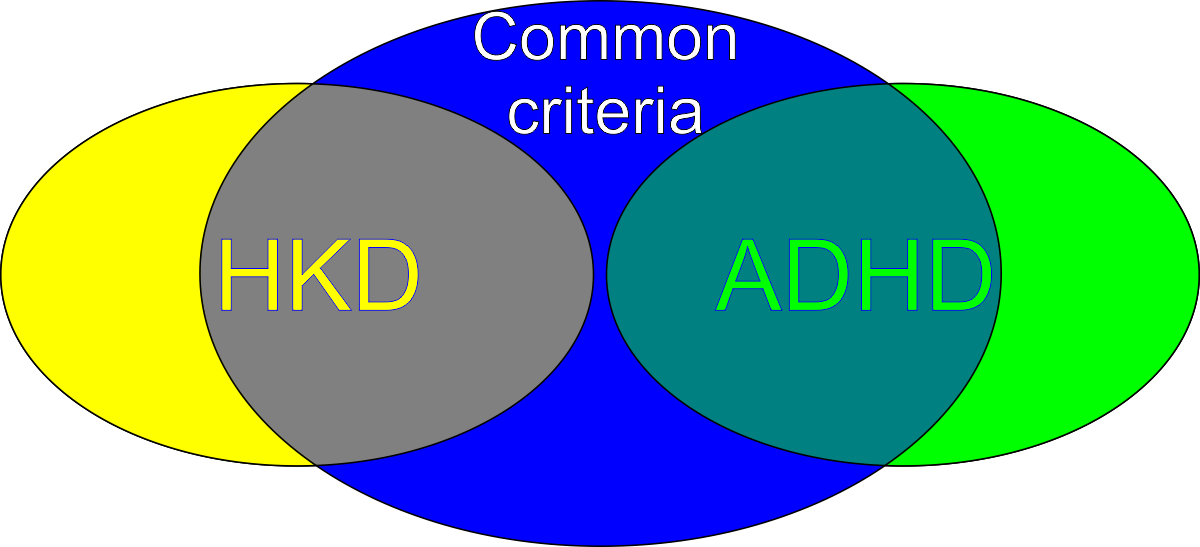
A very simplified picture highlights common criteria HKD and ADHD.
Keywords:
mild pediatric encephalopathy, mild (minimal) brain dysfunction, hyperkinetic syndrome, ADHD, ICD-10, DMS-5, specific behavioral disorder, symptom triad, attention deficit hyperactivity-impulsivity, symptomatic diagnosis, pharmacotherapy , symptomatic therapy, biofeedback, VTI, episodic behavioral control disorder