
Study material - book
Requisitos de finalización
8. Diagnosis of ADHD syndrome
8.3. Symptoms of the syndrome in the drawing of the figure
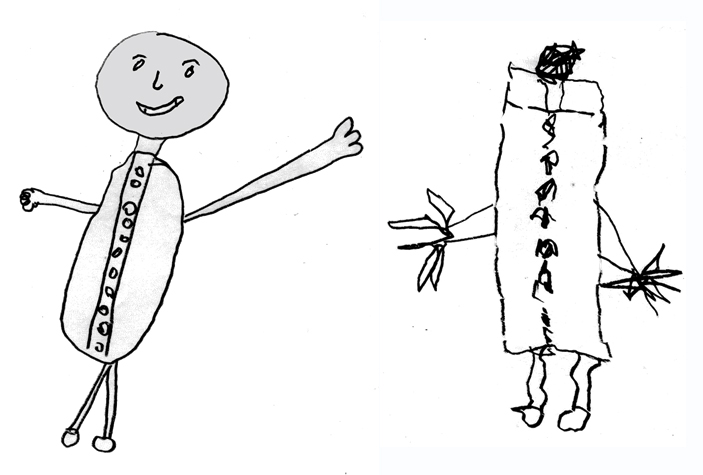
Typical features and peculiarities of drawings of children with MBD
- There are noticeable disproportions of individual parts of the body, eg each hand is different, one shoe is noticeably smaller than the other, etc.
- The individual parts are usually attached in the wrong place, such as the arm at the neck or waist.
- There is an omission of essential details that the child knows about the overall condition and can draw at least approximately, eg missing nose or mouth, hair is only half a head, missing one limb. The authors conclude that this is probably a consequence of attention deficit disorder.
- There are symptoms of rigidity, stereotypes, sticky attention, eg long rows of buttons, excessive number of fingers, etc.
- The technique of scribbling details is often used, usually inadequately, sometimes the whole character consists of scribbled areas.
- Bizarre shapes of individual parts of the body appear.
- The processing of individual parts of the body is usually at a primitive level, such as forked hands, bird's feet, etc.
- Poor coordination prevails, line quality is low, lines are crooked, jagged, often double, crossed out. The drawing is often asymmetric. ,
- Sometimes there is a conspicuous position of the figure in space, children with MBD have difficulty dividing the surface of the paper, the inclination of the figure is usually oblique.
- The profile occasionally appears, but it is noticeably or bizarrely processed. (Trpišovská, 1997, p.63)