
Kinetic analysis
4. Force platforms
The basic instrument used to measure the reaction force of the pad is the force platform. Force platforms are most often used for the assessment of postural stability (balance) in static and dynamic situations, for the evaluation of the magnitude of the applied force in the support phase of walking and for the evaluation of the explosive force of the lower limbs during a vertical jump. In these cases, the platform is built into the floor so that its surface is at the same level as the floor surface.The platform is usually covered with a material of the same color as the color of the surrounding floor. This procedure is used to minimize environmental disturbances.
When approaching biomechanical analysis, whether it’s in a clinic or
research institution, it would be impossible to rely on a singular tool
to perform a truly comprehensive evaluation. To determine which system
best fits your needs, it’s important to understand the capabilities of
force plates and pressure mapping solutions.
Force plates (or force platforms) are systems designed to record motion
of the body mass and muscular output changes on top of the plate’s
surface over time. Researchers and clinicians can use this information
to interpret how forces are generated and transferred during a variety
of different movements.
A force plate measures the ground reaction forces over time during
static or dynamic motions such as gait. They provide information on the
three dimensional components of force (X, Y and Z), which can then be
used to look at more in depth joint loadings. While force plates are
considered the gold standard, they do have some limitations. For
example, force plates are rarely large enough to capture
multiple/consecutive foot strikes and typically cannot describe the
location of peak force/pressure under the foot. In order to overcome
this limitation, and to develop a broader, more objective view of a
patient’s lower extremity function, pressure measurement solutions are
often used in tandem with force platform systems.
Pressure
measurement systems are used by the medical community to investigate
and rehabilitate foot and gait problems. However, pressure is only one
of the many parameters calculated with these solutions. Contact area,
ground reaction force, and derivatives of force, such as center of
force, trajectories and impulse (force-time relationship), can also be
measured to better understand muscular imbalances, deficits, and
instabilities.
Utilizing a pressure mapping system in the lab or clinic allows you to
measure multiple points of contact simultaneously in a dynamic, detailed
pressure map, which provides contact and peak pressure data across an
area. This information is unattainable from force platforms.
Pressure measurement solutions offer the ability to segment views by
foot and even isolate ground reaction force and center of pressure by
foot region, thereby furthering analysis into foot function, balance,
sway. For deeper dive into the force plate, see ebook bellow.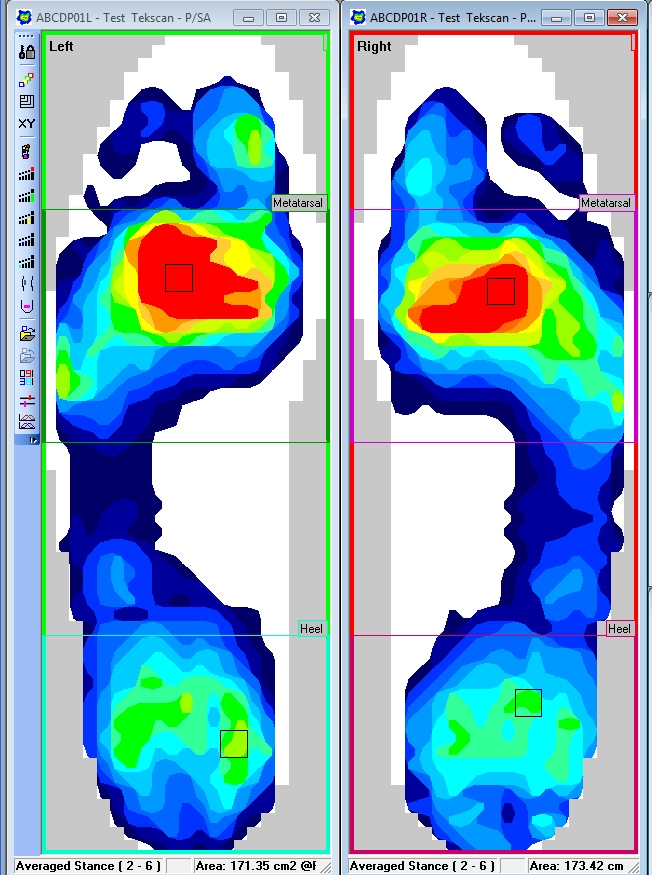 The ability to segment the foot for detailed analysis is one difference from a force plate.
It’s essential for researchers and clinicians with a focus on biomechanical analysis
to rely on a number of tools to gather objective information for
assessments. Due to its versatility and capacity to isolate force
measurements, pressure mapping should be considered an important element
in biomechanical analysis alongside conventional force plates.