
Vegetation and animals
1. Vegetation
1.2. Altitudinal vegetation belts
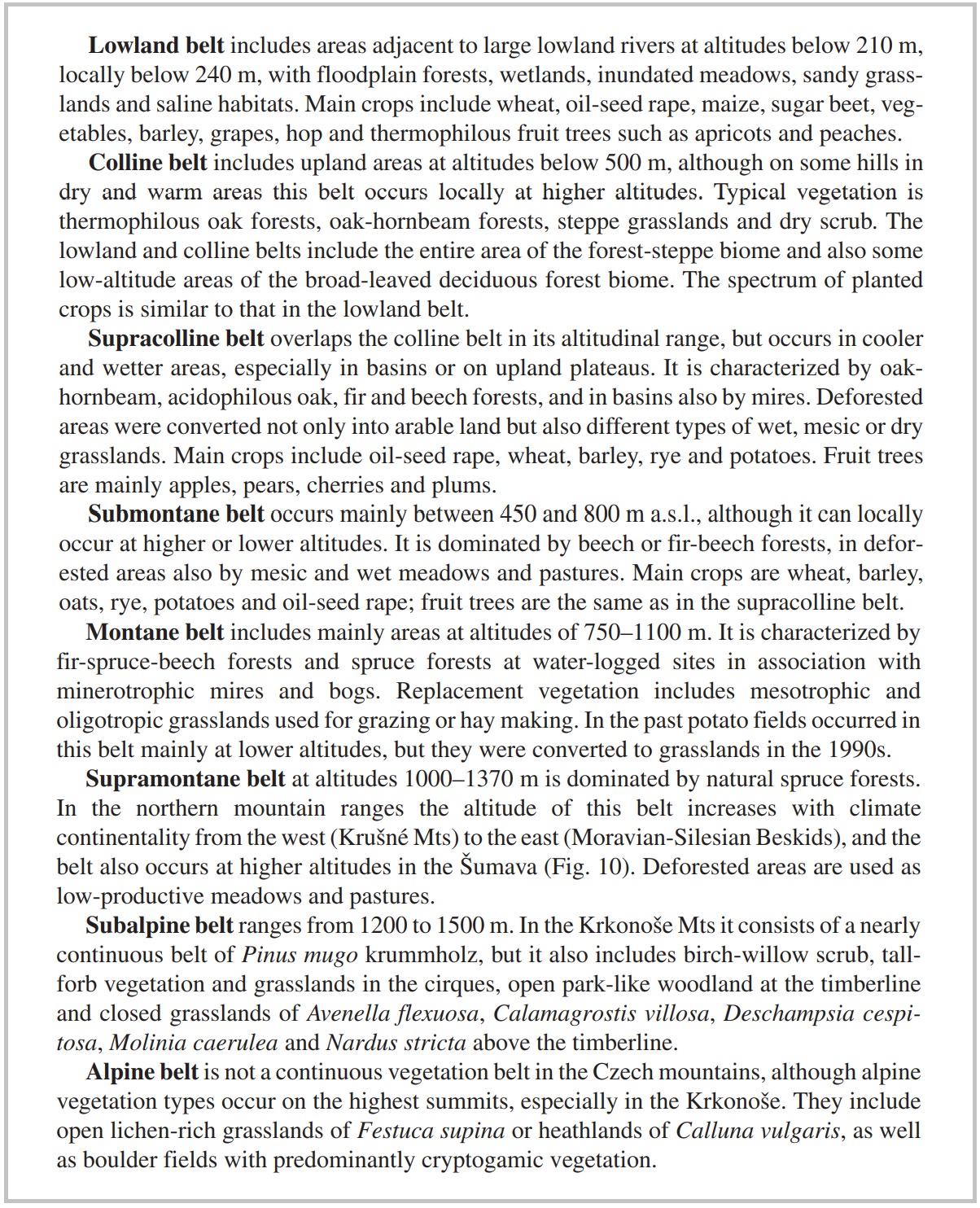
Altitudinal vegetation belts are developed in every area with sufficient elevation differences. Both precipitation and temperature are changing with increasing elevation (see Topic "Climate and weather") and influence the vegetation. Maximum eight belts could be distinguished in the territory of the Czech Republic: lowland, colline, supracolline, submontane, montane, supramontane, subalpine and alpine belt (Fig. 1). The extension of individual vegetation belts can vary among regions.

Fig. 1. Altitudinal belts and timberline in the summit areas of the highest Czech mountain ranges. Altitudes of the highest peak of each range are given. The scheme represents entire mountain ranges including the parts ouside the borders of the Czech Republic (Source: Holý, 2012).
There is a brief description of individual altitudinal vegetation belts (from Holý, 2012):
There are different
classifications of vegetation belts in the literature. One of the most common one use the forest vegetation belts (Fig. 2). Do not forget that the Czech landscape is transformed by the anthropogenic activities and the tree composition of below mentioned belts and spatial distribution of forest does not correspond to the real situation (compare to the Fig. 2 in the previous Chapter 1.1).


Fig. 2. Forest altitudinal vegetation zones.