Bohemian Karst
1. Evolution of Bohemian Karst
The Bohemian Karst lies predominantly on the limestones of the Paleozoic Prague basin. Sedimentation of the sea bed continued here from the Ordovician to the Mid-Devonian. The Ordovician sediment layers consist of alternating coarser and finer layers which reflect the alternating periods of shallow and deep sea. At the beginning of the Silurian period , black shales were deposited here (as everywhere outside the tropics). Underground volcanism began to affect the Prague basin from the Mid-Ordovician period - the sea became much shallower and many benthic organisms such as bivalves, cephalopods, gastropods, brachiopods and corals lived here - and this resulted in the limestone sedimentation (limestone is a carbonate sedimentary rock that is often composed of the skeletal fragments of marine organisms). During the Devonian, this basin was moved into the equatorial zone and another rich development of marine organisms in the tropical sea occurred.
At the end of the Mid-Devonian period, the sea retreated and the sedimentary infill of the whole basin was folded, and the geological structure was also broken by the N-S faults.
The Bohemian Karst was on dry land for about 270 million years after this development and the uplifted Variscan mountain range was gradually leveled off. During the Tertiary period, the karst caves began to develop during this period.
During the Quaternary period, the relief and undeground features developed into the shapes we can see today. The extensive denudation plateau at elevations of around 400 m, with rounded peaks and short ridges was divided by the deeply-carved canyon-like valley of the Berounka river. The short tributary streams with low flow levels and valleys with irregular gradients were also formed (e.g. Bubovický Stream valley). On the floors of these valleys, below the karst springs, tuffa mounds and cascades were formed, and in some cases they are still developing. (Edited and shortened from: https://ceskykras.ochranaprirody.cz/en/landscape-attribute/geology/)
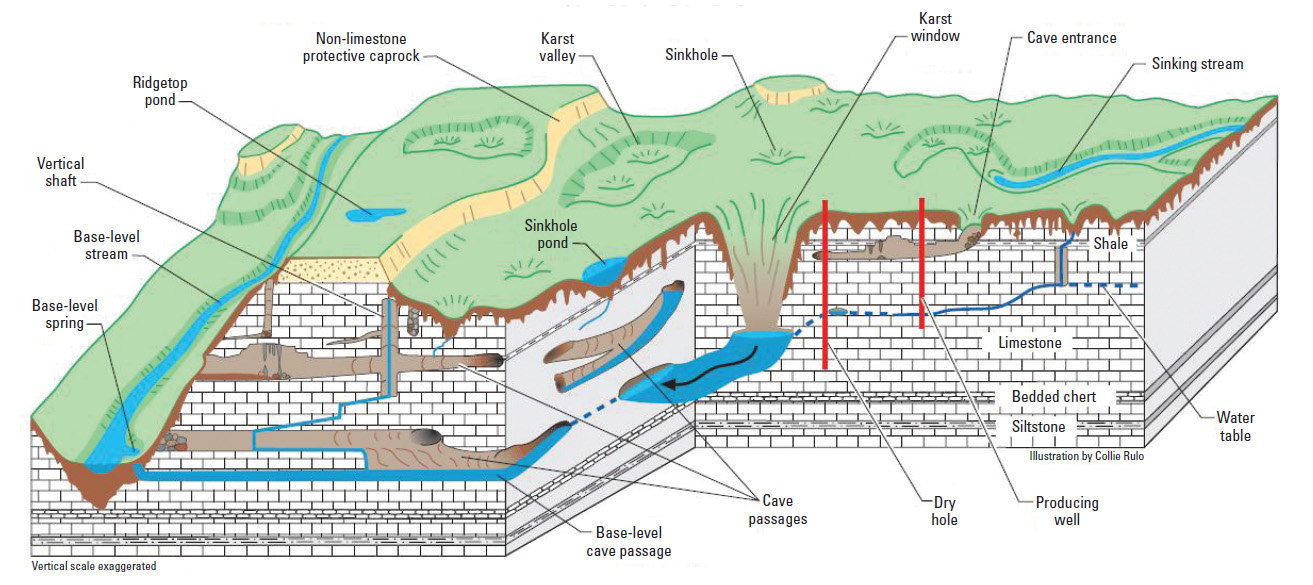
On this figure you can see almost all Karst features (both surficial and undeground) that can be seen in the Bohemian Karst. The development of karst features occurs whenever water starts to dissolve limestone bedrock near its cracks, or bedding planes. As time goes on, fractures are getting wider, and eventually a drainage system of some sort is formed underneath. Calcium carbonate dissolved in the water may precipitate out where the water discharges some of its dissolved carbon dioxide. Rivers emerging from springs may produce tufa terraces (e.g. Bubovický waterfall), consisting of layers of calcite deposited over extended periods of time. In caves, a variety of features collectively called speleothems are formed by deposition of calcium carbonate and other dissolved minerals.