
Learning unit: What Is Mediation?
Communication is often understood as the ability to speak, write, listen, or read. However, in today's multilingual and multicultural world, effective communication requires much more. People frequently need to explain ideas, clarify misunderstandings, adapt information for different audiences, or help others reach a shared understanding. These processes are collectively referred to as mediation.
The Common European Framework of Reference for Languages: Companion Volume (CEFR, 2020) recognises mediation as one of the four modes of communication, alongside reception, production, and interaction. Rather than focusing only on language proficiency, mediation emphasises the ability to facilitate understanding and collaboration between individuals with different linguistic, cultural, or professional backgrounds.
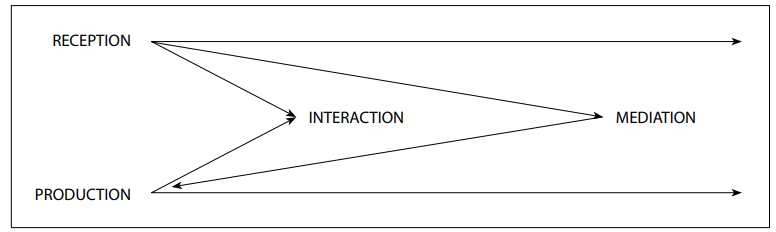
The relationship between reception, production, interaction and mediation (CEFR, 2020, p.34)
According to the CEFR Companion Volume, mediation occurs when an individual acts as a social agent who creates bridges between people, texts, concepts, or cultures in order to facilitate communication and build shared understanding.
Unlike translation or interpretation, mediation is not simply about transferring words from one language to another. It involves selecting, adapting, simplifying, explaining, reformulating, and negotiating meaning according to the needs of a particular audience.
Examples
|
A lecturer explains a complex scientific theory using everyday language. |
The lecturer is mediating concepts.
|
|
An Erasmus student explains university regulations to another international student. |
The student is mediating a text.
|
|
Two colleagues disagree during a meeting. A third colleague helps them reach a common understanding. |
The colleague is mediating communication.
|
The Four Modes of Communication
|
Mode |
What it involves |
Example |
|
Reception |
Understanding spoken or written texts |
Reading an article |
|
Production |
Creating spoken or written texts |
Giving a presentation |
|
Interaction |
Exchanging information with others |
Participating in a discussion |
|
Mediation |
Helping others understand or communicate |
Explaining, summarising, facilitating dialogue |