
Topic 1. Community engagement and diversity
Section outline
-
Section Outline
Estimated study time: 30 minutes
In this section, participants are introduced to community engagement as a context in which problem-solving, collaboration, and transferable employability skills are applied in practice.
Community engagement often involves people and organisations with different perspectives, priorities, expectations, and available resources. These differences can create challenges, but they can also support more inclusive and creative solutions when they are approached constructively.
By the end of this section, participants will be able to:
-
explain the meaning and relevance of community engagement;
-
identify common challenges in community engagement contexts;
-
recognise how diverse interests, limited resources, and uncertainty can influence collaborative work;
-
explain why problem-solving skills are important for effective and inclusive community engagement.
This section includes a short introductory input, learning materials, a community-based example, and a short knowledge check.
Learning Materials
Understanding Community Engagement and Common Challenges
Community engagement refers to collaborative processes in which individuals, groups, institutions, and community stakeholders work together to address shared needs, challenges, or goals.
Effective community engagement requires more than good intentions. Participants may have different priorities, expectations, experiences, levels of influence, and access to resources. These differences can make collaboration more complex and require careful communication, problem analysis, and decision-making.
Common challenges in community engagement include:
-
competing interests among stakeholders,
-
limited time, funding, or other resources,
-
uncertainty about roles and responsibilities,
-
different expectations about outcomes,
-
communication difficulties,
-
disagreement about priorities or methods,
-
changing community needs and circumstances.
Transferable employability skills are highly relevant in these situations. Skills such as communication, teamwork, adaptability, critical thinking, initiative, and problem solving help participants understand different perspectives, identify realistic options, and work toward feasible solutions.
A structured problem-solving approach can help participants move from disagreement or uncertainty toward constructive action. This involves clearly defining the problem, gathering relevant information, recognising different stakeholder perspectives, identifying available resources, considering possible options, and selecting an appropriate response.
Community engagement is therefore both a social and a professional learning context. It provides opportunities to apply and further develop competences that are relevant across academic, civic, and professional settings.
-
Community Engagement and Common Challenges
Hello and welcome to Module 1.
In this short video, we will introduce the idea of community engagement and look at some of the common challenges that can arise when different people and organisations work together.
Community engagement refers to collaborative processes in which individuals, groups, institutions, and community stakeholders work together to address shared needs, challenges, or goals.
These stakeholders may include students, universities, local organisations, public institutions, professionals, volunteers, and members of the wider community.
Although they may share a general goal, stakeholders do not always have the same priorities, expectations, or resources. This is why community engagement often requires careful communication and problem solving.
Some common challenges include limited time or funding, unclear roles and responsibilities, different expectations, competing priorities, communication difficulties, and changing community needs.
For example, imagine that a university and a local youth organisation want to organise a joint workshop. The university would like to focus on employability skills, while the local organisation believes that social inclusion should be the main priority. At the same time, both organisations have limited funding and only a few volunteers available.
The challenge is therefore not simply to decide which idea is better. The first step is to understand the different perspectives, identify the available resources and limitations, and look for a realistic solution that addresses the needs of the stakeholders involved.
This is where problem-solving skills become especially important.
A structured approach can help us define the problem, understand different perspectives, identify available resources, generate possible options, and choose a constructive next step.
Throughout this course, you will practise these skills in different community engagement situations.
As you continue to the learning materials, think about this question:
What kinds of challenges might arise when people or organisations with different priorities try to work toward a shared goal?
-
Section Outline
Estimated study time: 30 minutes
This section focuses on self-awareness as a foundation for effective participation in community-based and collaborative work. Participants are encouraged to reflect on their strengths, values, personal qualities, transferable competences, and the roles they may take when working with others.
The aim is to help participants understand how self-perception can influence communication, motivation, collaboration, and the way they contribute to community initiatives.
By the end of this section, participants will be able to:
-
identify their personal strengths and transferable competences;
-
reflect on their self-perception and preferred roles in collaborative and community-based work;
-
connect academic, personal, professional, and volunteering experiences with competences relevant for community engagement;
-
describe how their competences can contribute to a shared community goal or initiative.
This section includes a short learning input, an applied competence-mapping task, a model example, and a self-evaluation activity
-
-
Apply the concepts from Module 1 to a short community engagement scenario and evaluate your response using a model example and self-assessment checklist.
-
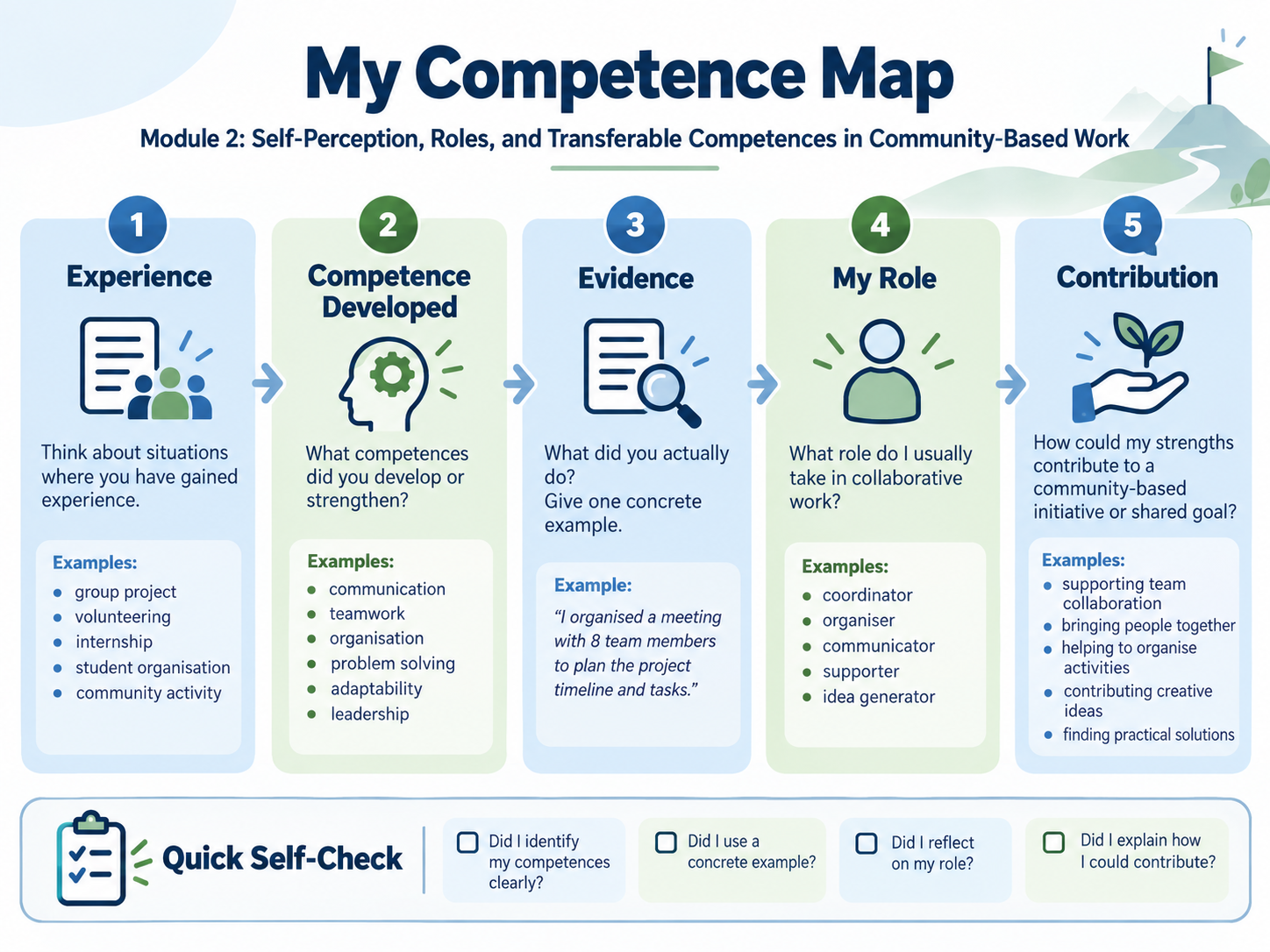
Use this infographic to identify your experiences, transferable competences, preferred role in collaborative work, and potential contribution to a community-based initiative.
-
Students mustViewMake entries: 1
Estimated time: 15 minutes
Complete the following exercise.
Create a short table with three columns:
-
Experience
Example: group project, internship, volunteering, part-time job, student organisation, community activity. -
Competence developed
Example: communication, organisation, problem solving, teamwork, adaptability, leadership. -
Evidence/example
Describe one concrete situation in which you demonstrated this competence.
After completing the table, write a short reflection of 50–100 words answering:
-
Which three competences are currently your strongest?
-
Which role do you usually take in collaborative or group situations?
-
Which one or two competences would you like to develop further?
-
How could your strengths contribute to a community-based initiative or shared goal?
Model example
Experience: Volunteering at a student event
Competence developed: Organisation and teamwork
Evidence/example: I coordinated the registration desk, communicated with other volunteers, and helped adjust the schedule when one activity was delayed.Short reflection:
My strongest competences are organisation, communication, and teamwork. In group situations, I often take a coordinating role because I like to organise tasks and keep track of deadlines. I would like to develop my confidence in public speaking. In a community initiative, I could contribute by helping organise activities, communicating with stakeholders, and supporting collaboration within the team.Self-evaluation
Use the checklist below to review your response:
-
Did I identify competences based on concrete experiences?
-
Did I provide at least one clear example of how I demonstrated a competence?
-
Did I reflect on my preferred role in collaborative work?
-
Did I identify at least one area for further development?
-
Did I explain how my competences could contribute to a community-based initiative?
How did you do?
5 Yes answers:
Excellent. You have clearly linked your experiences, competences, and potential contribution to collaborative community work.3–4 Yes answers:
Good progress. Review the areas you did not include and consider how your competences could be described more clearly or applied in a community context.0–2 Yes answers:
Review the learning material on self-perception, roles, and transferable competences, then try the activity again with a stronger focus on concrete evidence and contribution to collaborative work.Submission format: Online text
-
-
Section Outline
Estimated study time: 40 minutes
This section focuses on communicating competences, motivations, and ideas clearly and effectively in community engagement contexts.
Participants learn how to present their own contribution, explain the value of an initiative, and adapt communication to different stakeholders. Particular attention is given to empathetic, respectful, and welcoming communication, especially in situations where stakeholders may have different needs, expectations, or perspectives.
By the end of this section, participants will be able to:
-
communicate their competences and motivations clearly;
-
present a short and structured community engagement proposal;
-
adapt communication to different stakeholders and contexts;
-
recognise communication that supports empathy, inclusion, and constructive collaboration.
This section includes a short learning input, an infographic, a stakeholder communication activity, and an interactive knowledge check with immediate feedback.
-
-
Students mustViewMake entries: 1
Estimated time: 15–20 minutes
Choose one of the following scenarios:
Scenario A
A student group wants to organise a community event that connects university students with a local organisation working with young people.
Scenario B
You would like to propose a small initiative to improve social inclusion and participation among students and community members.
Scenario C
A local organisation is interested in collaborating with students, but it is not yet clear what each partner could contribute.
Your task
Prepare a short engagement pitch of approximately 100–150 words.
Use the following structure:
-
Who are you?
Briefly describe your role or relevant background. -
What can you contribute?
Identify one or two relevant competences or experiences. -
What is the need or challenge?
Describe the community issue or opportunity. -
What do you propose?
Present one realistic idea or action. -
Why could this be useful?
Explain the potential benefit for the community or stakeholders. -
How would you invite collaboration?
End with a sentence that invites feedback, dialogue, or joint planning.
Model example
I am a psychology student with experience in group projects, volunteering, and organising student activities. I could contribute communication, planning, and teamwork skills.
I would like to propose a small workshop series that brings university students and local young people together to discuss employability, well-being, and community participation. The initiative could create opportunities for mutual learning and help participants build useful skills and connections.
I would suggest starting with one pilot workshop and then collecting feedback from participants and partner organisations.
I would be interested to hear your priorities and ideas so that we could adapt the initiative together.
Self-evaluation
Use the checklist below to review your pitch:
-
Did I clearly explain who I am and what I can contribute?
-
Did I identify a realistic community need or challenge?
-
Did I propose a concrete and feasible action?
-
Did I explain why the proposal could be useful?
-
Did I use clear, respectful, and collaborative language?
-
Did I invite stakeholder input rather than presenting the idea as a fixed solution?
How did you do?
5–6 Yes answers:
Excellent. Your pitch is clear, relevant, and collaborative, and it communicates both your contribution and the value of the initiative.3–4 Yes answers:
Good progress. Review the points you did not include and consider how your proposal could become more specific or more responsive to stakeholder perspectives.0–2 Yes answers:
Review the learning material on structured self-presentation and stakeholder communication, then revise your pitch with a stronger focus on clarity, feasibility, and collaboration.Submission format: Online text
-
-
Students mustViewMake attempts: 1Receive a grade
This short activity helps you recognise communication strategies that support empathy, inclusion, and constructive stakeholder dialogue. Choose the response that best supports collaborative community engagement.
-
Section Outline
Estimated study time: 30 minutes
This section focuses on the role of social resources, networks, and support systems in effective community engagement.
Participants will explore how different people, organisations, institutions, and informal networks can provide information, expertise, practical support, feedback, access to opportunities, and emotional encouragement. Particular attention is given to recognising which resources are already available and which connections may need to be developed further.
By the end of this section, participants will be able to:
-
explain the importance of social resources and networks in community engagement;
-
identify relevant people, organisations, and support systems connected to a community initiative;
-
distinguish between different types of support and resources;
-
map available resources and recognise gaps;
-
identify one realistic action for strengthening a support network or partnership.
This section includes a short learning input, a resource-mapping activity, and a self-reflection exercise with model guidance
-
-
Students mustViewMake entries: 1
Estimated time: 15 minutes
Think of a community initiative, university project, volunteering activity, or social issue that you would like to support.
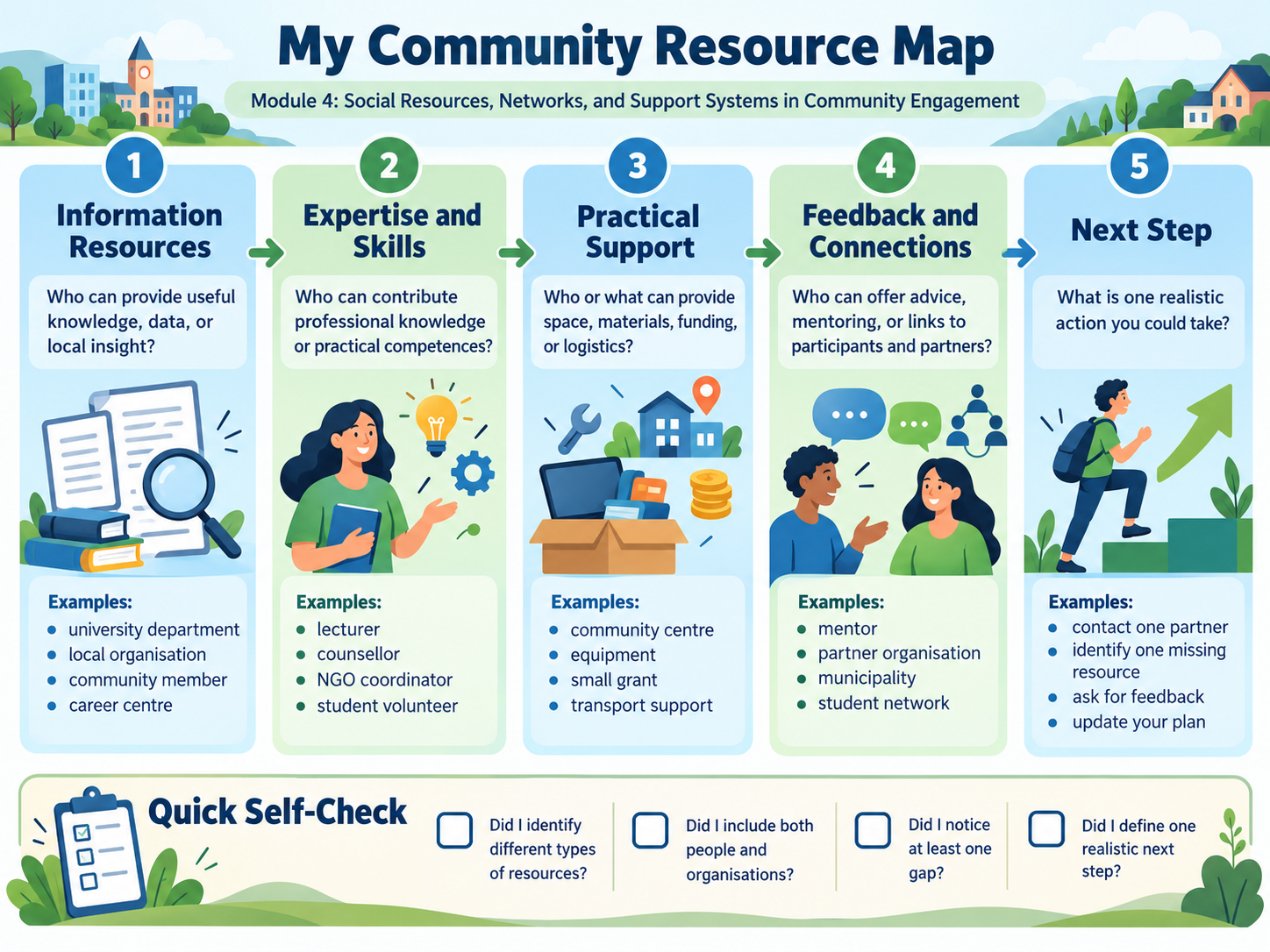
Create a simple resource map by identifying at least one example in each category:
-
Information resources
Who could provide useful knowledge, data, or local insight? -
Expertise and skills
Who could contribute relevant professional knowledge or practical competences? -
Practical support
Who or what could provide space, equipment, materials, funding, or logistical support? -
Feedback and guidance
Who could provide advice, mentoring, or constructive feedback? -
Access and connections
Who could connect the initiative with relevant participants, organisations, or decision-makers?
After completing your map, write a short reflection of 50–100 words:
-
Which resources are already available to you?
-
Where do you notice the biggest gap?
-
Which person or organisation could you approach to strengthen the initiative?
-
What is one realistic next step you could take?
Model example
Community initiative: A workshop for young people on employability and well-being.
-
Information resources: University career centre and local youth organisation
-
Expertise and skills: Psychology lecturer and career counsellor
-
Practical support: Community centre providing a room
-
Feedback and guidance: NGO project coordinator
-
Access and connections: Local youth organisation connecting the project with participants
Short reflection:
The strongest resources are professional expertise and access to participants. The main gap is practical funding for materials. A realistic next step would be to contact a local organisation or university unit that could provide small-scale financial or logistical support.Self-evaluation
Use the checklist below to review your resource map:
-
Did I identify resources from more than one category?
-
Did I include both formal and informal sources of support?
-
Did I identify at least one gap or missing resource?
-
Did I consider who could help strengthen the initiative?
-
Did I define one realistic next step?
How did you do?
5 Yes answers:
Excellent. You have created a balanced resource map and identified a realistic way to strengthen your community initiative.3–4 Yes answers:
Good progress. Review the categories you did not include and consider whether additional people, organisations, or support systems could strengthen your plan.0–2 Yes answers:
Review the learning material on social resources, networks, and support systems, then revise your map with a stronger focus on available resources, gaps, and possible partnerships.Submission format: Online text
-
-
Use this infographic to identify the different types of social resources, support systems, and connections that may strengthen a community initiative. Consider which resources are already available, where important gaps exist, and what realistic next step you could take.
-
Section Outline
Estimated study time: 50 minutes
This section focuses on the psychological resources that support effective participation in collaborative and community-based work.
Community engagement often involves uncertainty, changing circumstances, disagreement, limited resources, and occasional setbacks. Participants therefore need not only practical problem-solving skills, but also resilience, adaptability, emotional regulation, and constructive coping strategies.
By the end of this section, participants will be able to:
-
explain the role of resilience and adaptability in community engagement;
-
recognise common psychological reactions to uncertainty, disagreement, and setbacks;
-
distinguish between more and less adaptive coping strategies;
-
identify personal and social resources that support constructive coping;
-
develop a realistic response plan for challenging collaborative situations.
This section includes a short structured learning input, a scenario-based reflection, and a checklist-based self-assessment.
-
-
Students mustViewMake entries: 1
Estimated time: 15–20 minutes
Read the following scenario:
Your team is organising a community initiative together with a local partner. One week before the planned activity, the partner informs you that they can no longer provide the venue and several volunteers are also unavailable. Some team members become frustrated and start blaming each other.
Your task
Write a short response of 100–150 words addressing the following questions:
-
What are the main challenges in this situation?
-
Which aspects are within your control?
-
What might need to be adapted or changed?
-
Which personal or social resources could help the team?
-
What would be one constructive next step?
Model example
The main challenges are the loss of the venue, fewer available volunteers, and growing tension within the team. The original plan may no longer be realistic, but the team can still control how it responds.
A constructive approach would be to clarify the most urgent needs, identify alternative venues, and adjust the scale of the activity if necessary. The team could also contact other organisations or university units for practical support.
It would be important to reduce blame and refocus the discussion on possible solutions. A realistic next step would be to organise a short team meeting, divide responsibilities, and agree on one revised plan that can be implemented with the available resources.
Self-assessment checklist
Use the checklist below to review your response:
-
Did I identify the main challenge clearly?
-
Did I distinguish between what can and cannot be controlled?
-
Did I suggest at least one realistic adaptation?
-
Did I identify personal or social resources that could help?
-
Did I propose a constructive next step?
-
Did I avoid blame and focus on solutions?
How did you do?
5–6 Yes answers:
Excellent. You are applying resilience, adaptability, and constructive coping strategies effectively.3–4 Yes answers:
Good progress. Review the elements you did not include and consider how your response could become more flexible, realistic, and solution-focused.0–2 Yes answers:
Review the learning material on resilience, adaptability, and coping, then revise your response with greater attention to controllable factors, available resources, and practical next steps.Submission format: Online text
-
-
Students mustReceive a gradeReceive a passing grade
This final quiz checks your understanding of the key concepts covered across all five modules of the course.
The questions focus on:
-
community engagement and diversity,
-
self-perception and transferable competences,
-
communication with stakeholders,
-
social resources and support systems,
-
resilience, adaptability, and coping.
Read each statement carefully and decide whether it is True or False.
You will receive feedback after completing the quiz.
Estimated time: 8–10 minutes
Passing grade: 80% -
-
Congratulations! You have completed the course.
Throughout this course, you explored how problem-solving competences can support effective and inclusive community engagement.
You reflected on your own strengths, roles, and transferable competences; practised communicating ideas and contributions clearly; identified social resources, networks, and support systems; and considered how resilience, adaptability, and constructive coping can help when uncertainty, disagreement, or setbacks occur.
You also applied these competences to realistic community-based scenarios and reflected on how your own knowledge, skills, and resources can contribute to collaborative initiatives.
The key message of this course is that effective problem solving is not only about finding a solution. It also involves understanding different perspectives, recognising available resources, adapting when circumstances change, and working constructively with others.
We encourage you to continue applying these competences in your academic, professional, civic, and community contexts.
-
Students mustViewMake entries: 1
Imagine It Is 2035
You are looking back on your academic, professional, and community engagement experiences.
Complete the following sentences:
I am proud because…
I have learned to work with others by…
The biggest challenge I overcame was…
The competence that helped me the most was…
One way I contributed to a community or shared goal was…
When circumstances changed, I adapted by…
-