
AEL5 Unit 5b Book
4. Specialist Reading and Cause-Effect Phrases
As you probably know, there are various sources of energy. One of them is solar radiation. To convert solar radiation into electricity, photovoltaic (PV) panels are used. However, for the system to work, several PV panels are needed. On the one hand, PV panels consist of smaller units, but on the other hand, they make up much bigger units, as you can see in the following diagram. In this task, there is a description of the individual parts of the diagram. Look at the picture carefully and complete the table with the names of the individual parts of the diagram.
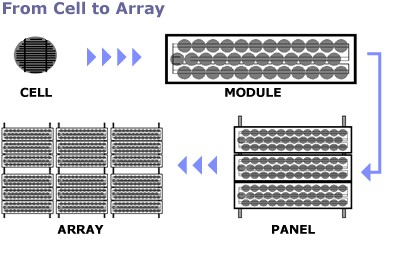
Diagram from: https://www.solardirect.com/archives/pv/pvlist/pvlist.htm
As you can see above, the fundamental part of a PV panel is a PV cell. Now, let´s find out about the principle of the cell. Scan the explanation in this reading comprehension task and answer the accompanying questions as quickly as possible.
Now that you understand the fundamental principle behind PV panels, you can look at the text from the grammatical point of view. Read the text again and focus on the cause-effect relationships. In this task, you can see the same information as in the text, but in the form of phrases. Mark each of them as a cause (C) or an effect (E) or an effect and a cause (E / C). Be careful: three of the phrases function as both a cause and effect, which is known as a causal chain. If you have problems distinguishing between causes and effects, look back at the original sentences in the text.
As you can see, the cause is not always the first in a sentence. In other words, causes and effects can be swapped if some appropriate connectives are used. However, the cause-effect relationship can be expressed not only by using a connective, but also using a relative clause, a present participle or a mere verb. In this task, you can see the same sentences as in the text in previous exercise, but rephrased a little bit. Use the new connectives to fill in all the gaps. While filling in the gaps, pay special attention to punctuation in the sentences. Also, notice that even though the connectives have been changed, it is still clear what is a cause and what is an effect.
The basic expressions introduced so far are not the only ones used to express cause-effect relationships. For example, you can also use prepositional verbs, i.e. verbs followed by a preposition. In this grammar overview, you can find a list of cause-effect expressions. The list is rather long, but you will have a chance to practise these expressions not only in this unit by doing tasks A, B and C, but also later in Unit 11a in the AEL6N course. After finishing Task C, leave it open and listen to the related recording here to check your answers.