
Geology of the Czech Republic
2. The Bohemian Massif
The Bohemian Massif is a fragment of the vast Variscan orogen which was formed during the Palaeozoic. It is composed of four separate regional domains which are covered by younger Mesozoic sediments in the Central part and predominantly Cenozoic (Paleogene and Neogene) rocks in the east.
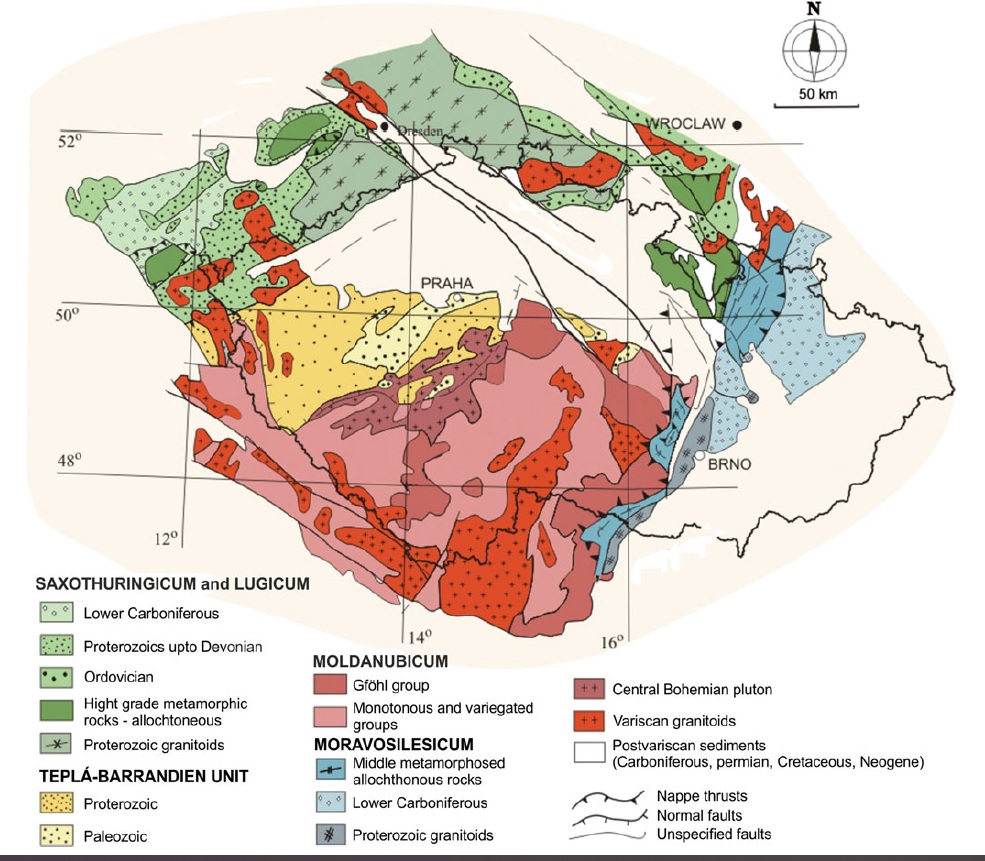
Fig. 1. Four main Variscan regional units of the Bohemian Massif. Cretaceous postvariscan sediments cover the majority of the central Bohemia, Neogene sediments cover the eastern part of the Czech territory (source: Pánek et Hradecký Eds., 2016).
During the oldest geological times (Proterozoic) the Bohemian Massif was situated in the area of low southern latitudes on the northern edge of Gondwana (one of the so called supercontinents). The marine environment was present. The Variscan orogeny join the four mentioned units and the Bohemian Massif was gradually transformed into a platform unit. During the Carboniferous, it became dry land. In the most of the area, with the exception of intramontane depressions, deep erosion of the Variscan basement took place. Erosion and continental sedimentation were interrupted only for a short time by a marine transgression over part of the area in the Jurassic, Cretaceous and Neogene Periods. In the Late Cretaceous, a part of the Bohemian Massif subsided along the faults of the Elbe Fault Zone and became a site of at first continental and later marine sedimentation in the Bohemian Cretaceous Basin.
A significant milestone in geological development of Bohemian Massif occured during the Mesozoic and the Tertiary when faults and tectonic zones, created by the Variscan orogeny, were reactivated, which reacted to changes in the stress regime in the lithosphere in the course of so-called Saxonian tectonics due to deformations in the foreland of the Alpine orogen.
The present-day volcanic relief is a relic of volcanic activity occuring from Cretaceous to Quaternary during the above mentioned Saxonian tectonics. Main neovolcanic areas are in the western and northwestern Bohemia (Doupovské hory/Doupov Mts., České středohoří/Central Bohemian Uplands) and in north Moravia (Nízký Jeseník).
In the Quaternary the Bohemian Massif was a dry land and, after the regression of the sea from the Carpathian Foredeep in the Tertiary, both units - the Bohemian Massif and the Western Carpathians develop under the same conditions.
Further reading:
Grygar, R. Geology and Tectonic Development of the Czech Republic. In
Pánek, T. a Hradecký, J. (Eds.) Landscapes and Landforms of the Czech
Republic. Cham: Springer International Publishing, 2016, p. 7-18.